


WASHINGTON: Iran remained a top state sponsor of terrorism around the world in 2018, the State Department said in its annual terrorism report on Friday.
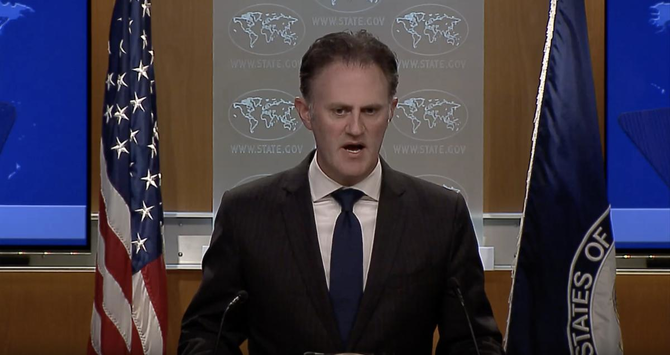
A briefing by the department’s counter-terrorism spokesman Nathan Sales showed the regime funnels nearly a billion dollars a year to support its proxies in the region despite Washington having significantly ramped up its sanctions against Tehran.
The report also showed global presence of Daesh continued to advance in 2018 through networks and affiliates, even though the Trump administration declared it defeated the jihadi group in Syria and killed its leader last month in a US raid.
Terrorism tactics and the use of technologies have also evolved in 2018, while war-hardened fighters from groups such as Daesh returning to their home countries began raising fresh threats, the report said.
Today, @StateDeptCT Ambassador Nathan Sales briefed the media on the release of the Country Reports on Terrorism 2018. Watch his full remarks. https://t.co/re88smFd4I #CRT2018 pic.twitter.com/2jNTN1epTF
— Department of State (@StateDept) November 1, 2019
“Even as Daesh lost almost all its physical territory, the group proved its ability to adapt, especially through its efforts to inspire or direct followers online,” said Sales using an acronym for Daesh, the US counter-terrorism coordinator, whose office produced the congressionally mandated report.
“Additionally, battle-hardened terrorists headed home from the war zone in Syria and Iraq or traveled to third countries, posing new dangers,” he said.
Daesh declared its so-called “caliphate” in 2014 after seizing large swathes of Syria and Iraq. The hard-line group established its de facto capital in the Syrian city of Raqqa, using it as a base to plot attacks in Europe.
In 2017, Daesh lost control of Mosul in Iraq and Raqqa in Syria, and quickly thereafter almost all of its territory as a result of operations by US-backed forces. Its leader, Abu Bakr Al-Baghdadi, was killed last month in Syria in a raid by US Special forces.
World leaders welcomed his death, but they and security experts warned that the group, which carried out atrocities against religious minorities and horrified most Muslims, remained a security threat in Syria and beyond.
The group on Thursday confirmed his death in an audio tape posted online and said a successor, identified as Abu Ibrahim Al-Hashemi Al-Quraishi, had been appointed. It vowed revenge against the US.


