

Bahrain’s Maki: Innovative Japanese cuisine with a personal touch

Maki at Bahrain’s World Trade Center offers Japanese food with a distinct twist. (Supplied)
Updated 01 November 2019
Follow

Bahrain’s Maki: Innovative Japanese cuisine with a personal touch

MANAMA: The first thing we noticed on walking into Maki was the décor. It’s cool without being intimidating —brushed concrete floors and metal accessories. The second was that there was an impressive number of full tables for a Wednesday night — always a good sign.

We were led to a window table and, as if by magic, our server produced mini towelettes — the pre-compressed kind onto which she poured a little water and we watched them expand. Not rocket science, but an amusing touch to set the tone.

I thought it a little odd when she carefully unwrapped our chopsticks but her actions were soon explained when she returned moments later with the wrappers folded into origami shapes to form chopstick rests. I’m a sucker for personal touches and this small offering put a smile on my face.
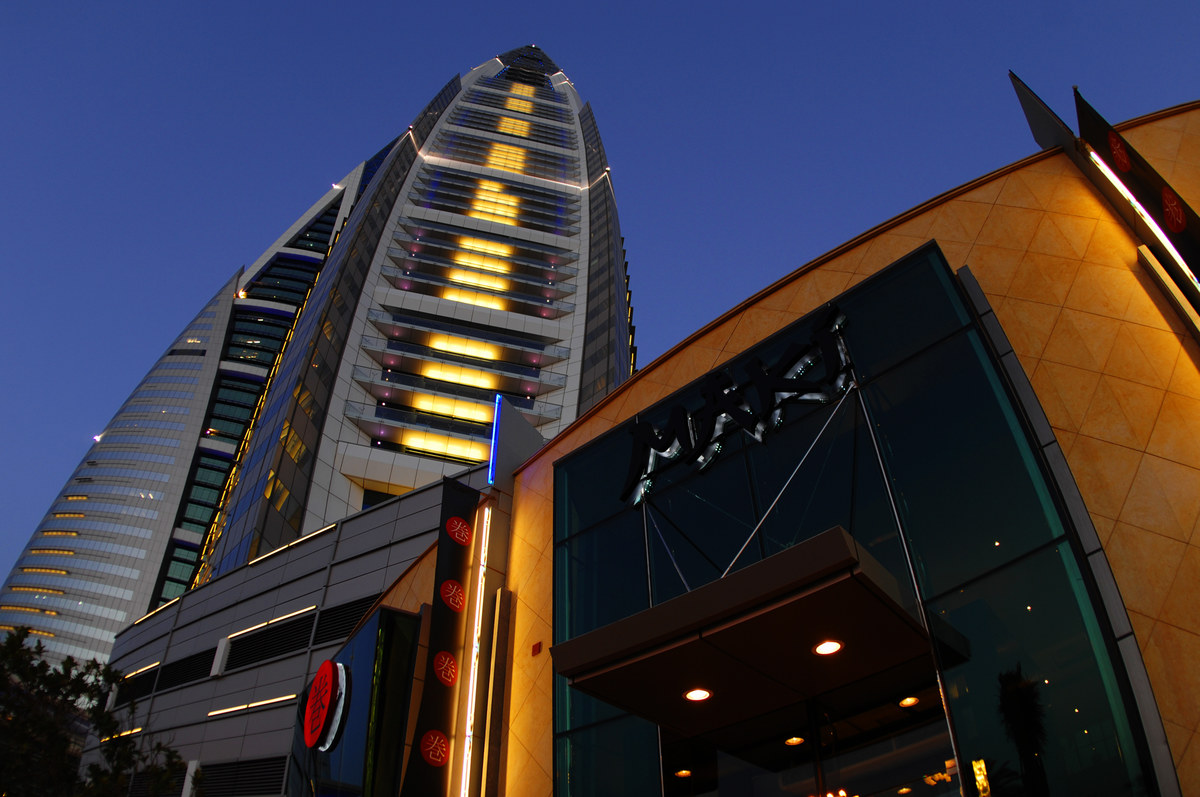


Maki is located at Bahrain’s World Trade Center. (Supplied)

She was also extremely knowledgeable about the menu, no small task since the brothers who own the restaurant are constantly coming up with new items in a Japanese-fusion style.

Our first dish was the Chef Chopped Salad — tuna, salmon, avocado, iceberg lettuce, tobiko and crispy tempura with rocket, peanut wasabi and the Maki special salad dressing. Definitely big enough for two, this not only looked great but also presented a surprising flavor combination.

The crunchy texture of the tempura coupled with the unmistakable taste of the fish roe gave a distinctly Japanese feel, with the peanut wasabi providing sufficient kick to counteract any over-fishiness (if such a thing exists). Plenty of rocket and a slathering of the tangy, piquant house dressing satisfied a craving for greens.
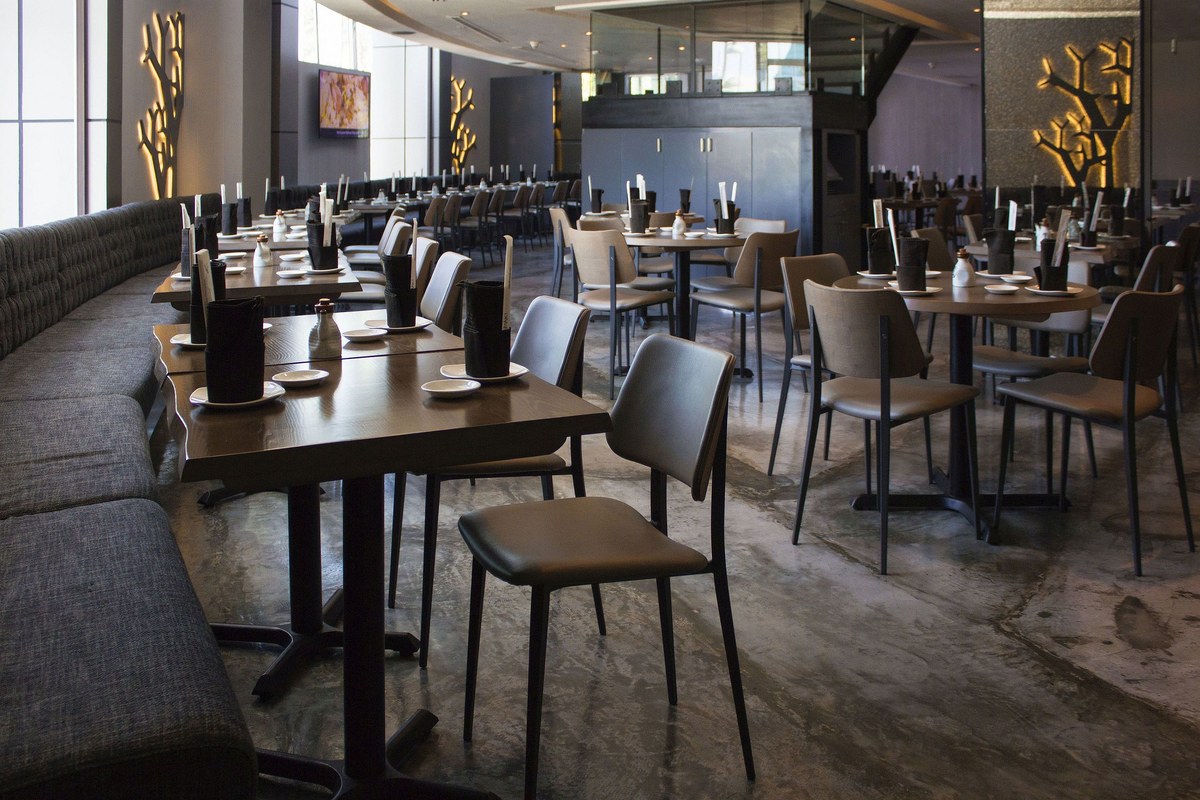


The restaurant is not intimidating —brushed concrete floors and metal accessories. (Supplied)

Next up was one of the evening’s standout dishes, Tempura Prawn Tacos. Yep, there’s that fusion thing going on. Along with the prawns and tempura, the star of the dish was Japanese guacamole — it’s like regular guac, but with the addition of shiso leaf, ginger and wasabi paste. When tucked into a crisp, warm taco shell and topped with Maki’s signature sauce, it makes for a dish that’s really hard to beat. I certainly wouldn’t think of Japanese cuisine as comfort food, but this comes close to qualifying.

The Spicy Real Crab Sushi that followed was the second standout. Mixed with carrot, cucumber, spring onion and crispy tempura, the crab was deliciously fresh, sweet and melt-on-the-tongue tender, perfectly complemented by the sweet-and-spicy sauce and the rich tang of the nori. To be honest, I could quite happily have stopped at this point a very happy women.

However, in the interests of research, we had also ordered the Shakira Sashimi — slices of raw tuna served in a special citrus sauce topped with sesame and spring onion. My guest found the sauce a little overpowering and salty, but I was delighted to find such obviously fresh tuna with not even a tinge of fishy smell and a perfect mouth-pleasing texture.
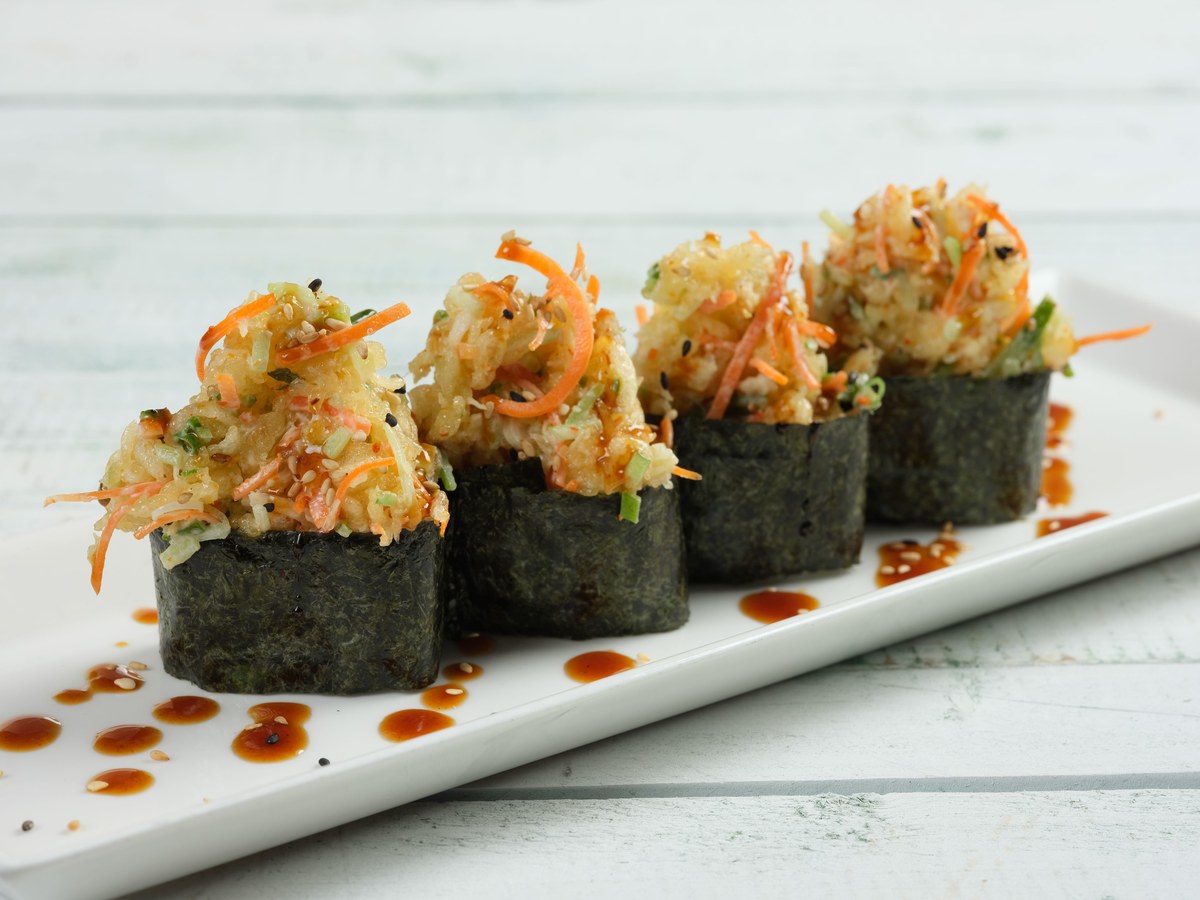


Spicy Real Crab Sushi was mixed with carrot, cucumber, spring onion and crispy tempura. (Supplied)

Our last savory dish was the Athari Maki, which is perhaps best described as Mediterranean. The restaurant owners are Lebanese and one of them is crazy for the high-quality olives and olive oil produced on the family farm. This Maki is testament to that, with a specially created olive wrap replacing the usual nori. It’s super thin, emphatic in flavor and the perfect accompaniment to the other ingredients, which include salmon, filo prawn tempura and black truffle pearls. Together they present a flavor combination you won’t find anywhere else with the pearls bursting on your tongue in a wake-up call to the taste buds before the rest of the sensations hit.

We finished with an extremely photogenic dessert, the Kone-Afa Vanilla Ice Cream – another of Maki’s exclusive creations. I adore sweet vermicelli, from which the cone is made, so this was another standout for me, made even better by the addition of yuzu blossom syrup that gave the ice-cream filling a hint of the tropics and sat perfectly with the fresh raspberry sauce and pistachio-flake topping.


Sheikha Al-Mayassa talks cultural patronage at Art Basel Qatar Conversations panel

Updated 04 February 2026
Follow

Sheikha Al-Mayassa talks cultural patronage at Art Basel Qatar Conversations panel

DOHA: Cultural leaders at the inaugural edition of Art Basel Qatar in Doha have discussed how patronage is reshaping art ecosystems, with Qatar’s own long-term cultural vision at the center.

The opening panel, “Leaders of Change: How is patronage shaping new art ecosystems?” brought together Sheikha Al-Mayassa bint Hamad bin Khalifa Al-Thani, chair of Qatar Museums, and Maja Hoffmann, founder and president of the Luma Foundation, in a discussion moderated by Hans Ulrich Obrist, artistic director of the Serpentine Galleries in London. The talk formed part of the Art Basel Conversations x Qatar Creates Talks program, coinciding with the debut of Art Basel Qatar which runs in Doha until Feb. 8.

Sheikha Al-Thani framed Qatar’s cultural project as a strategic, long-term endeavor anchored in national development. “Qatar has a national vision called 2030 where culture was one of the main pillars for socioeconomic development and human development,” she said. “We have always invested in culture as a means of human development.”

That vision, she explained, underpins the decision to welcome a major international fair like Art Basel to Doha after turning away many previous proposals.

“For the longest time, I can’t tell you how many art fairs came to us wanting to be here, and we never felt it was the right time,” she said. “However, this is an important year for us and we felt, with the surplus of talent and the growing gallery scene we had here, that it was time to bring industry to talent, because that’s how we will spur the economic diversification from hydrocarbon to a knowledge-based society.”

She was also keen to stress that Art Basel Qatar was not conceived as a conventional marketplace.

 “This is not your typical art fair … It’s a humane art fair where engagement is more important than transaction, discourse more important than division, and curiosity more important than conviction,” she added.

That ethos extends to the fair’s artistic leadership. Al-Thani described how the decision to have an artist — Wael Shawky — serve as artistic director emerged collaboratively with Art Basel’s team.

“He’s a global artist who’s now become a very local artist, very invested in our local art scene. And really, I think that’s the beauty of partnerships … There is a safe space for us to critique each other, support each other, and really brainstorm all the possibilities … and then come to a consensus of what would make sense for us,” she said.

Collecting art, she added, has long been embedded in Qatari society: “My grandmother is almost 100 years old. She was collecting in the 60s when Qatar was a very poor country. It’s in our DNA … always with this notion of investing in knowledge and human development.”

Today, that impulse translates into comprehensive, multi-disciplinary collections: “We are both collecting historical objects, contemporary objects, modern objects, architecture, archival material, anything that we feel is relevant to us and the evolution of this nation towards a knowledge-based economy.”

Looking ahead, Al-Thani outlined a new cultural triangle in Doha — the National Museum of Qatar, the Museum of Islamic Art and the forthcoming Art Mill Museum — as engines for both economic diversification and intellectual life.

 “That ecosystem will enhance the economic growth and diversification, but also the knowledge that’s available, because the diversity in the collections between these three institutions will no doubt inspire young people, amateurs, entrepreneurs to think outside the box and inform their next business,” she said.

The panel closed with a focus on the future of large-scale exhibitions with Rubaiya, Qatar’s new quadrennial, timed to coincide with the anniversary of the 2022 World Cup.

“Every four years in memory of the opening of the World Cup, we will open the quadrennial. This year, the theme is ‘Unruly Waters.’ At the center of the theme is Qatar’s trading route to the Silk Road,” explained Al-Thani.

“It’s important for us to trace our past and claim it and share it to the rest of the world, but also show the connectivity that Qatar had historically and the important role it has been playing in diplomacy.”