

Pakistani director hopeful film on child marriage will shine bright

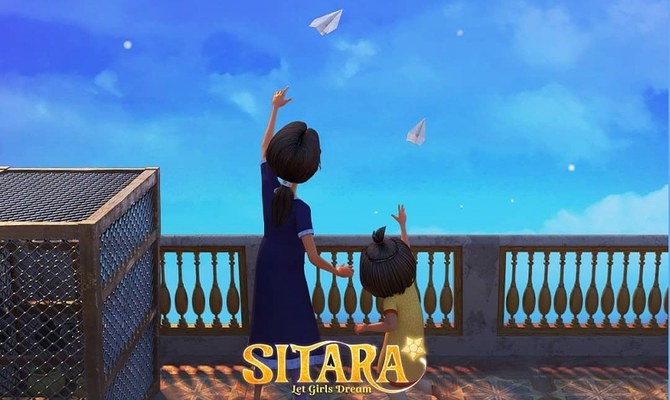
Sitara tells the story of a 14-year-old girl, Pari, and her sister Meher and the impact that child marriage has on them. (Photo taken from Instagram)
Updated 29 October 2019
Follow

Pakistani director hopeful film on child marriage will shine bright

  • Sharmeen Obaid Chinoy says the first Pakistani animated “Sitara” will release on Netflix USA and global
  • She hoped it would encourage people to support their daughters in realizing their dreams.

ISLAMABAD: Sharmeen Obaid Chinoy announced on October 28, 2019, that “Sitara” will release on Netflix USA and global, the first Pakistani animated film to get a global release on the streaming platform in early 2020.

Chinoy says she wants “Sitara” to strike a chord with young girls and their parents inspired by real-life stories, the animated film focuses on the impact of social evil.

When Sharmeen Obaid Chinoy released her latest animated film in New York this month, she hoped it would encourage people to support their daughters in realizing their dreams.

Sitara (star in Urdu) is the award-winning Pakistani director’s latest offering and is focused on the social evil of child marriage in South Asian countries, including Pakistan.

“I always wanted to start a global conversation about why we are not investing in the dreams of our daughters?,” Chinoy told Arab News in an email interview on the inspiration behind the film.

The feature revolves around the story of a 14-year-old girl named “Pari” who wants to become a pilot but sees her dream “ruefully snatched” away from her after she is forced into an arranged marriage.
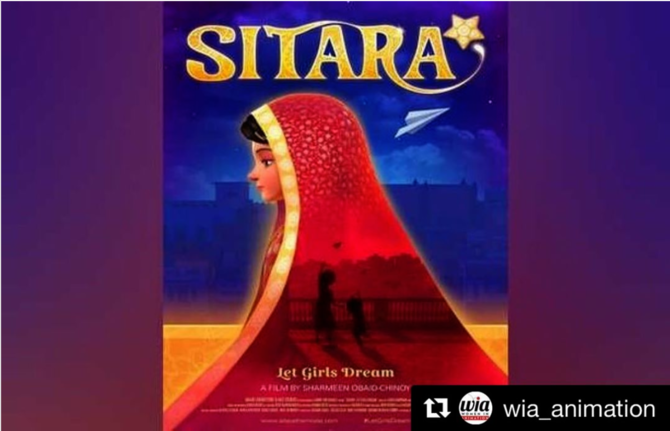


Child marriage is often a focal storyline in animated films from Sharmeen Obaid Chinoy's production company SOC Films. Chinoy believes the medium transcends age groups and can be watched by everyone, children and adults alike. (Photo taken from Instagram)

An expert on the topic after having made several films on child marriage – a centuries-old issue which continues to plague several South Asian countries – Chinoy is hoping her latest venture reaches girls of all ages and their parents, too.

A study conducted by UNICEF in 2017 estimated that 21 percent of Pakistani girls are married before their 18th birthday.

When asked if any particular story had struck a chord with her, she said that the film is “woven from the testimonies of many young girls.”

“[It’s about] their broken promises and what it means to them when they feel powerless and are unable to do anything to change their circumstances,” she added.

Animation, a medium which Chinoy often employs in her initiatives, continues to be her go-to choice in this film, too.

“I want children to see a reflection of themselves on the big screen; to see their clothes; to see their streets; to see their world come alive,” she said before highlighting some of the major obstacles faced by young girls today.

“Girls around the world are told from a young age what they can and cannot achieve when they grow older they are told that “this is not something girls do,” she said, denouncing the “artificial limitations on young girls today.”

“In boardrooms, in parliament and in positions of leadership, girls and women are routinely excluded and kept out. In 2019, that is unacceptable and the ownership lies on us, the women, to fight back to have a greater say so that we can make decisions for other girls,” she said.

She says that one needs to focus on the tinier details before looking at the larger picture to understand the depth of the problem.

“When a table is laid out [a girl child] is the last to be given food, when the clothes are made she is the last to get them. To go to school, she is the last one to get books,” Chinoy said, adding that this is particularly the case in South Asian countries.

“In other societies, girls might get an education but when it comes to jobs and promotions they are held back... Depending on the society and community, there is still discrimination, there is still misogyny, there is still exclusion,” she said.

When asked about what steps can be taken to counter the issue of child marriage, Chinoy stressed that the change needs to start at home.

“One of the factors that play heavily into girls leaving school and being forced into marriage is trust and responsibility. Parents feel that when a girl reaches a certain age...they would rather get the girl married off. There is this sense of burden and responsibility that forces girls into this life of early marriage,” she said, adding that the onus lies on us “to change the mindset of parents.”


Pakistan puts border districts on high alert amid Iran protests — official

Updated 10 min 22 sec ago
Follow

Pakistan puts border districts on high alert amid Iran protests — official

  • The development comes as Iranian authorities try to suppress protests over faltering economy, with over 2,600 killed
  • Militancy in Balochistan has declined following the return of nearly 1 million Afghans, the additional chief secretary says

QUETTA: Pakistan has heightened security along districts bordering Iran as violent protests continue to engulf several Iranian cities, a top official in Pakistan’s southwestern Balochistan province said on Thursday, with authorities stepping up vigilance to guard against potential spillover.

The development comes as Iranian authorities try to suppress protests, which began late last month over the country’s faltering economy and the collapse of its currency, with more than 2,600 killed in weeks of violence in the Islamic republic.

The clampdown on demonstrations, the worst since the country’s 1979 Islamic revolution, has drawn threats from the United States (US) of a military intervention on behalf of the protesters, raising fears of further tensions in an already volatile region.

Pakistan, which shares a 909-kilometer-long border with Iran in its southwest, has said that it is closely monitoring the situation in the neighboring country and advised its citizens to keep essential travel documents with them amid the unrest.

“The federal government is monitoring the situation regarding what is happening in Iran and the provincial government is in touch with the federal government,” Hamza Shafqaat, an additional chief secretary at the Balochistan Home Department, told Arab News in an exclusive interview on Thursday.

“As far as the law and order is concerned in all bordering districts with Iran, we are on high alert and as of now, the situation is very normal and peaceful at the border.”

Asked whether Islamabad had suspended cross-border movement and trade with Iran, Shafqaat said trade was ongoing, but movement of tourists and pilgrims had been stopped.

“There were few students stuck in Iran, they were evacuated, and they reached Gwadar,” he said. “Around 200 students are being shifted to their home districts.”

SITUATION ON PAKISTAN-AFGHANISTAN BORDER

Pakistan’s Balochistan province has long been the site of an insurgency by ethnic Baloch separatists and religiously motivated groups like the Tehreek e Taliban Pakistan (TTP). Besides Iran, the province shares more around 1,000-kilometer porous border with Afghanistan.

Islamabad has frequently accused Afghanistan of allowing its soil for attacks against Pakistan, an allegation denied by Kabul. In Oct., Pakistan and Afghanistan engaged in worst border clashes in decades over a surge in militancy in Pakistan. While the neighbors agreed to a ceasefire in Doha that month, relations between them remain tensed.

Asked about the government’s measures to secure the border with Afghanistan, Shafqaat said militancy in the region had declined following the return of nearly 1 million Afghan nationals as part of a repatriation drive Islamabad announced in late 2023.

“There is news that some of them keep on coming back from one border post or some other areas because we share a porous border and it is very difficult to man every inch of this border,” he said.

“On any intervention from the Afghanistan side, our security agencies which are deputed at the border are taking daily actions.”

LAW AND ORDER CHALLENGE

Balochistan witnessed 167 bomb blasts among over 900 militant attacks in 2025, which killed more than 400 people, according to the provincial government’s annual law and order report. But officials say the law-and-order situation had improved as compared to the previous year.

“More than 720 terrorists were killed in 2025 which is a higher number of operations against terrorists in many decades, while over a hundred terrorists were detained by law enforcement agencies in 90,000-plus security operations in Balochistan,” Shafqaat said.

The provincial government often suspended mobile Internet service in the southwestern province on various occasions last year, aimed at ensuring security in Balochistan.

“With that step, I am sure we were able to secure hundreds of lives,” Shafqaat said, adding it was only suspended in certain areas for less than 25 days last year.

“The Internet service through wireless routers remained open for the people in the entire year, we closed mobile Internet only for people on the roads because the government understands the difficulties of students and business community hence we are trying to reduce the closure of mobile Internet.”