

Superstorm Kyarr causes flooding, panic in Pakistan’s coastal villages

1 / 3
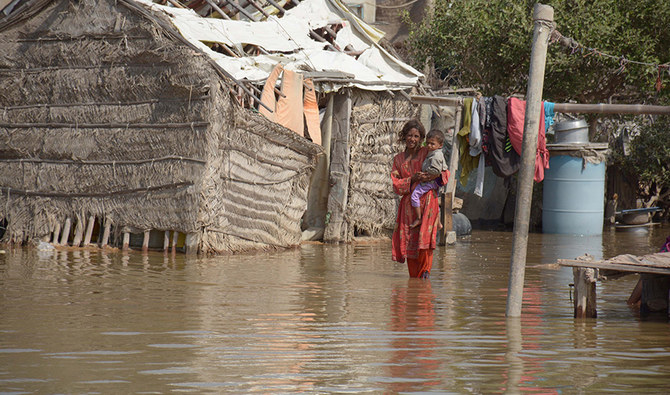
Seawater flooded people’s homes in Chashma and Rehri Goth, two fishing villages on Karachi’s coast, due to high tides caused by Cyclone Kyarr in the Arabian Sea on Sunday night. Photograph taken on Oct 28, 2019 (AN Photo)
2 / 3
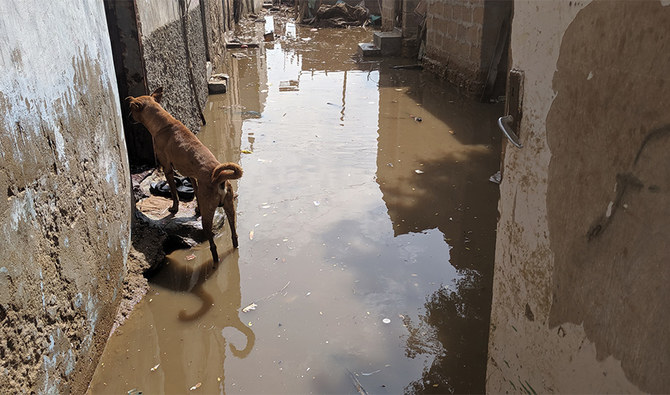
Seawater flooded people’s homes in Chashma and Rehri Goth, two fishing villages on Karachi’s coast, due to high tides caused by Cyclone Kyarr in the Arabian Sea on Sunday night. Photograph taken on Oct 28, 2019 (AN Photo)
3 / 3
Seawater flooded people’s homes in Chashma and Rehri Goth, two fishing villages on Karachi’s coast, due to high tides caused by Cyclone Kyarr in the Arabian Sea on Sunday night. Photograph taken on Oct 28, 2019 (AN Photo)
Updated 29 October 2019
Follow

Superstorm Kyarr causes flooding, panic in Pakistan’s coastal villages

  • Over a hundred villages in Karachi’s coastal areas are threatened by sea erosion
  • Meteorologists say the country is not under ‘direct threat’ by Cyclone Kyarr

KARACHI: Sughra Haroon, who lives in a small hamlet near the Arabian Sea, woke up in the middle of the night, Sunday, and found that her family was surrounded by ascending water. She got hold of her children and spent the rest of the night under the sky at a distant location from her cottage near the seashore.
Haroon’s home in Rehri is among hundreds of villages where water entered people’s homes on Sunday night, after cyclonic superstorm Kyarr affected Karachi’s coastal belt in southern Pakistan, forcing inhabitants, predominantly fisherfolk, to stay awake and alert through the night.
“I was born in this house, and I became a grandmother while living under this roof,” Haroon told Arab News. “It’s not that I haven’t seen tidal waves from the shore, but the water never sneaked up on me before. It was frightening.”
“The water may have receded,” she said on Monday afternoon while pointing to the grimy floor of her hut in Rehri. “But they say its level will be much higher tonight.”
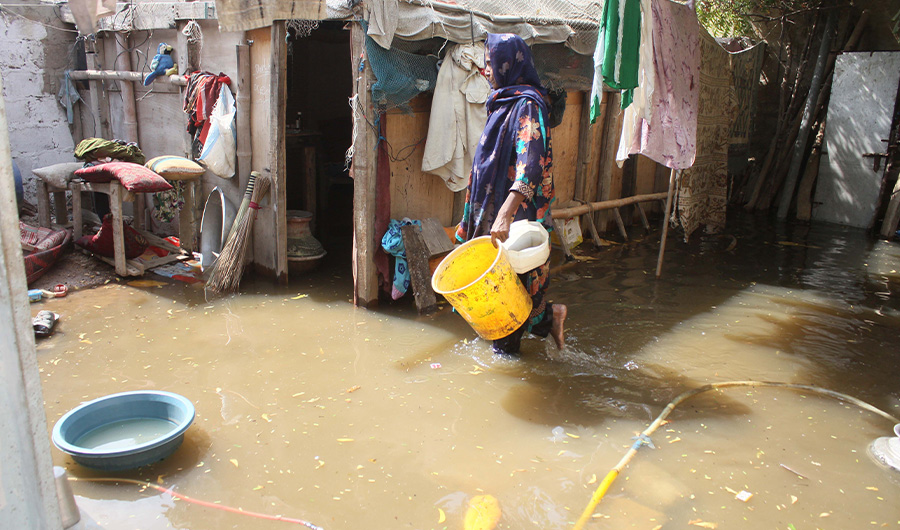


Seawater flooded a home in Chashma Goth, Karachi, due to Cyclone Kyarr in the Arabian Sea on Sunday night. Photograph taken on Oct 28, 2019 (AN Photo)

The Pakistan Meteorological Department said in a statement on Monday: “The Super Storm Kyarr is likely to move further northwest toward Oman coast during the next few days. Currently, none of the Pakistan coastal area is under direct threat from this system. However, under its influence scattered DS/TS-rain is expected in lower Sindh and along Makran Coast during Wednesday-Friday. Fishermen are advised not to venture in deep sea from today.”
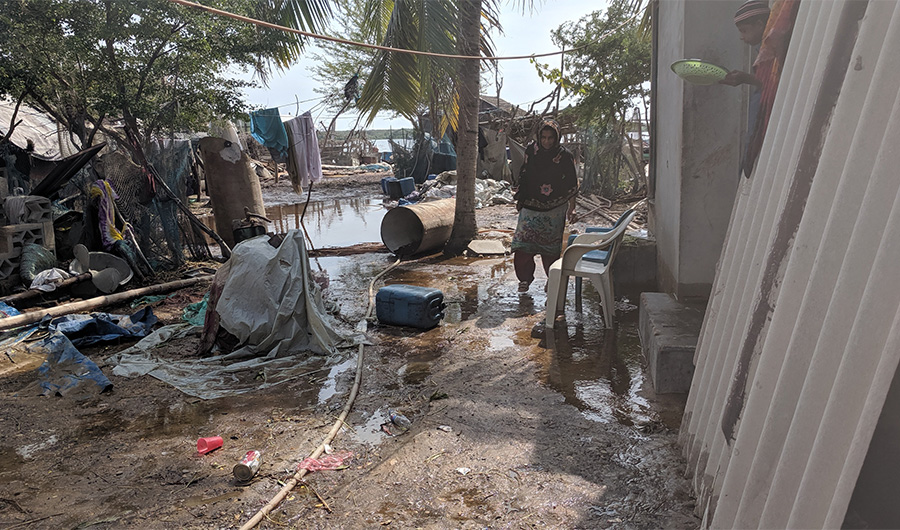


Sughra Haroon checks her belongings after the seawater receded Monday afternoon in Rehri Goth, Karachi. Photograph taken on Oct 28, 2019 (AN Photo)

Some fishermen said that though the sea had always fed their families, it was becoming more dangerous every year for their settlements due to the effects of sea erosion and climate change.
“I was born in this village,” said Shafi Muhammad, 55, a fisherman at Chashma Goth. “When there were high tides, the water soaked us up in this neighborhood, but it never rolled into our houses like this before.”
“With each passing year,” he added, “the sea level is gradually rising.”
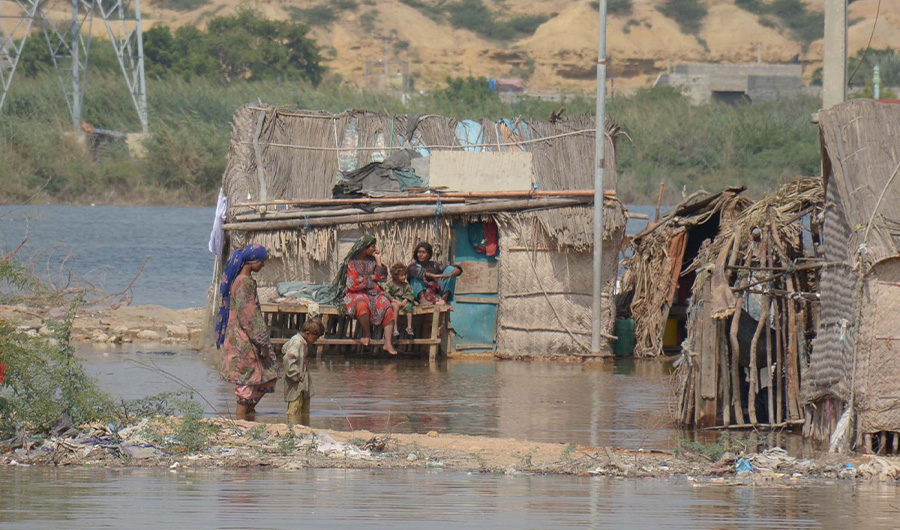


Women sit at a bench as water engulfed their house in Chashma Goth, Karachi, due to a cyclone in the Arabian Sea on Sunday night. Photograph taken on Oct 28, 2019 (AN Photo)

As seawater breached the coastline across the southern edge of the country, many activists, who have been concerned about sea erosion, said the government was not doing enough to prevent these settlements from vanishing underwater.
“Even a slight effect of a storm can submerge these communities,” said Zuhaib Ahmed Pirzada, who was part of the Restore Water Movement, a rally that was taken out in July this year to release enough river water into the sea.
“Despite the fact that the sea intrusion has engulfed 2.5 million acres of land in Thatta, Badin and Sujawal districts, the authorities are paying no heed,” he said.
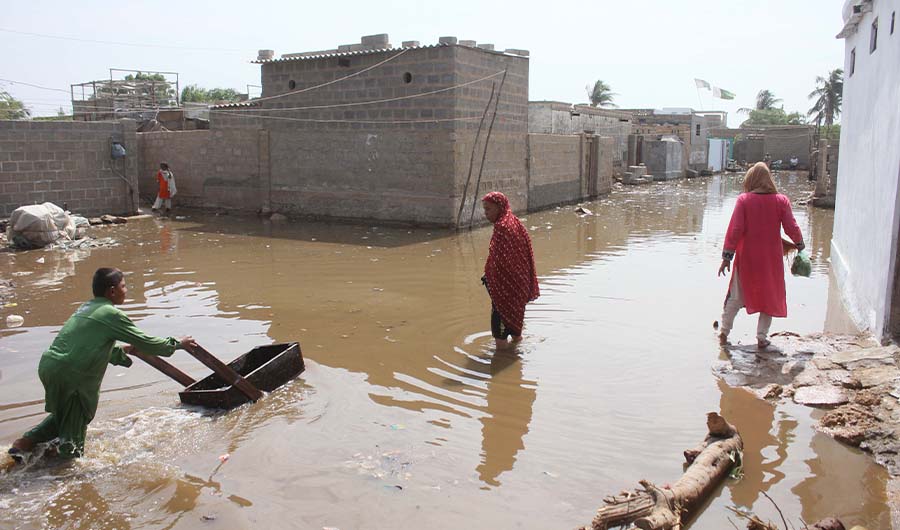


Seawater flooded people’s homes in Chashma and Rehri Goth, two fishing villages on Karachi’s coast, due to high tides caused by Cyclone Kyarr in the Arabian Sea on Sunday night. Photograph taken on Oct 28, 2019 (AN Photo)

Since the authorities did not release adequate fresh water downstream from Kotri Barrage, Pirzada added, not enough silt was going into the Indus River Delta which, consequently, was putting coastal settlements at risk of being overrun by seawater.
Sea erosion had already drowned 28 out of 42 such parishes in Kharo Chan Taulka, he noted. “The situation has also been aggravated by climate crisis,” Pirzada said.
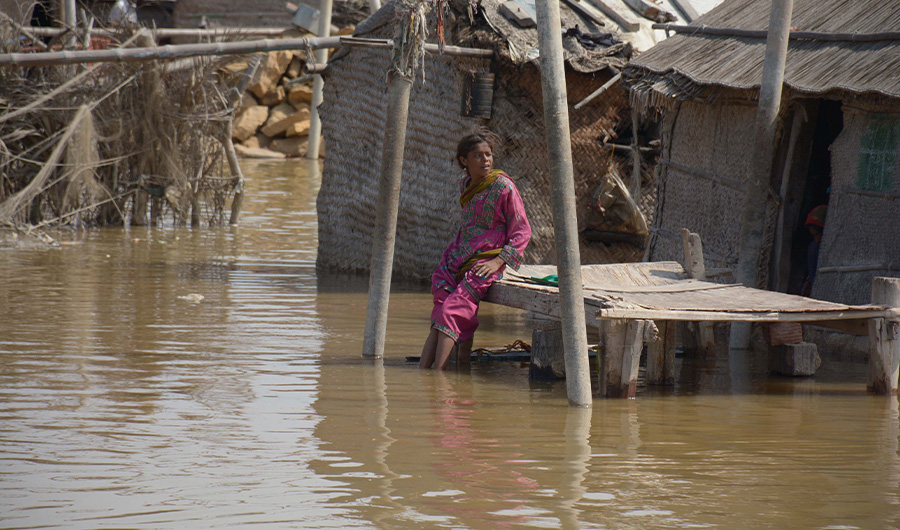


Seawater flooded people’s homes in Chashma and Rehri Goth, two fishing villages on Karachi’s coast, due to high tides caused by Cyclone Kyarr in the Arabian Sea on Sunday night. Photograph taken on Oct 28, 2019 (AN Photo)

The Indus River Delta has 17 creeks which enter into the Arabian Sea with 15 of them in Thatta, Sujawal and Badin. Before Pakistan came into being, Pirzada noted, 90 million acre-feet (MAF) of water was released from Kotri Barrage to the delta. In 2018, this figure decreased to 1.7 MAF.
“Releasing water is the domain of the federal government. All we can do is rehabilite and provide relief to the people. It’s true that these villages will vanish due to climate change. If sea erosion cannot be stopped, the fishermen will have to leave, but they say they cannot do that since they are living here for centuries,” Pakistan People’s Party lawmaker, Agha Rafi Ullah, told Arab News.
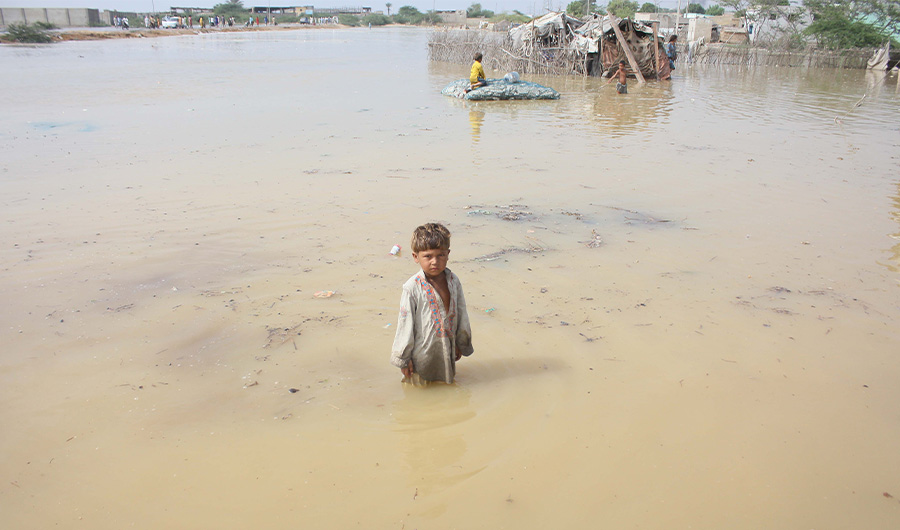


Seawater flooded people’s homes in Chashma and Rehri Goth, two fishing villages on Karachi’s coast, due to high tides caused by Cyclone Kyarr in the Arabian Sea on Sunday night. Photograph taken on Oct 28, 2019 (AN Photo)

Meanwhile, fisherman Shafi Muhammad said he had spotted a place atop a nearby mound as a safe place for his children.
“Let’s see how things unfold,” he said. “We have no hopes from the authorities.”


Sindh government announces compensation as 15 killed, 65 missing after Karachi mall blaze

Updated 9 sec ago
Follow

Sindh government announces compensation as 15 killed, 65 missing after Karachi mall blaze

  • 15 confirmed dead include firefighter, $36,000 per victim pledged as search continues
  • Traders seek urgent rehabilitation after 1,200 shops destroyed in Saddar building inferno

ISLAMABAD: The Sindh provincial government on Monday announced compensation for victims of a deadly fire at a major shopping plaza in Karachi, saying 15 people were confirmed dead while 65 were reported missing as recovery operations continued at the site.

The blaze broke out late Saturday at Gul Plaza in Karachi’s Saddar business district and spread rapidly through multiple floors, trapping shoppers and workers inside the densely packed building. 15 deaths have been confirmed so far, including a firefighter, while debris removal and search operations remain underway, Sindh Chief Minister Murad Ali Shah told reporters on Monday afternoon. 

Deadly fires in commercial buildings are a recurring problem in Karachi, a city of more than 20 million people, where overcrowding, outdated infrastructure and weak enforcement of fire safety regulations have repeatedly resulted in mass casualties and heavy economic losses.

Announcing relief measures, Shah said the provincial government would provide Rs10 million ($36,000) in compensation to the family of each person killed in the fire, which destroyed over 1,200 shops in the plaza. 

“On behalf of the government of Sindh, we will give one crore rupees to every person who has lost his life,” Shah said at a press conference, adding that payments would begin once documentation was completed.

Shah said one of the15 victims was a firefighter he identified by his first name, Furqan, who died while battling the blaze, noting that Furqan’s father had also been killed in the line of duty years earlier. Shah said the Karachi mayor had been directed to ensure care for the firefighter’s family.

The chief minister also announced the formation of a joint committee involving provincial officials and the Karachi Chamber of Commerce and Industry (KCCI) to assess losses and oversee rehabilitation of affected traders. He said temporary arrangements were being explored to relocate 1,000 to 1,200 shops so businesses could resume operations as quickly as possible.

Citing past precedents such as the Bolton Market arson and Cooperative Market fire, Shah said similar compensation and recovery mechanisms had helped traders rebuild their livelihoods and would guide the current response.

Karachi has previously suffered devastating commercial fires that prompted large-scale compensation and rehabilitation efforts. 

In 2009, a massive arson attack at Bolton Market, one of the city’s oldest wholesale hubs, destroyed hundreds of shops and disrupted supply chains across the city. The federal and Sindh governments later approved special relief packages that funded compensation, reconstruction and the rebuilding of fire-hit markets. More recently, fires at the Cooperative Market and Victoria Building areas again wiped out clusters of small traders, leading authorities to reuse leftover funds from earlier relief schemes to compensate affected businesses. Officials say these precedents have shaped the province’s current approach to combining government support with trader-led assessments to restore livelihoods after major disasters.

KCCI said on Sunday preliminary assessments showed more than 1,000 small and medium-sized businesses were completely destroyed in the latest fire, leaving thousands of families without incomes. Traders have urged both provincial and federal authorities to announce a comprehensive rehabilitation package.

Authorities have ordered a formal inquiry into the incident, with Shah stressing that the investigation would focus on identifying systemic failures rather than assigning blame.

He said a fire safety audit covering 145 buildings, conducted in 2024, would now be enforced immediately, alongside mandatory installation of fire alarms in commercial markets across the city.

Prime Minister Shehbaz Sharif has also offered full federal support, calling for a “coordinated and effective system” to control fires quickly in densely populated urban areas and prevent similar tragedies in the future.

Battling large fires in Karachi’s congested commercial districts remains notoriously difficult. Many markets and plazas are built with narrow access points, encroachments and illegal extensions that block fire tenders, while buildings often lack functioning fire exits, alarms or sprinkler systems. 

Although safety regulations exist, inspections are sporadic and penalties rarely enforced, allowing hazardous wiring and flammable materials to go unchecked — conditions that enable fires to spread rapidly and magnify human and economic losses.