

Wrong about Japan: Arab News-YouGov survey reveals Arab misconceptions

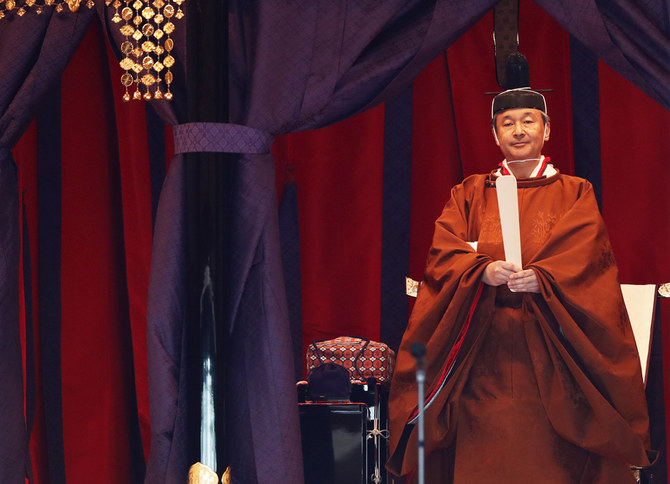
Japan's Emperor Naruhito attends a ceremony proclaiming his enthronement at the Imperial Palace in Tokyo on Oct. 22, 2019. In an Arab News-YouGov poll, 7 out of every 10 Arabs surveyed thought the Japanese emperor has the power to sign laws. (Issei Kato/Pool Photo via AP, File)
Updated 28 October 2019
Follow

Wrong about Japan: Arab News-YouGov survey reveals Arab misconceptions

  • A total of 3,033 Arabic speakers from 18 countries were interviewed in the survey
  • Many believe the Japanese invented mobile phones and created the personal computer

DUBAI: Nearly half the people in the Arab world believe the Japanese invented the mobile phone and more than a third think they also created personal computers, a new survey suggests.

The Arab News-YouGov poll, which highlights Arabs’ positive perceptions of Japan, has also revealed a number of misconceptions.

Arabs are misinformed about Japan’s executive authority, with 30 percent thinking the emperor has the power to sign laws. An even bigger number — 45 percent — believe Japan has a nuclear bomb.

Based on online interviews with 3,033 Arabic speakers from 18 countries, the poll was commissioned by Arab News as part of the recent launch of its Japan online edition.

Such misconceptions among Arabs were attributed by experts to several factors, including how history is taught, knowledge gaps across generations and the use of technology.

Politics

Ignorance of Japanese politics was also common among the respondents, almost half of whom said Japan was a member of the UN Security Council. Nine percent thought Japan’s military was aligned with North Korea.

Japan’s history of earthquakes and natural disasters, including the 2012 Fukushima nuclear plant disaster, appears to have influenced Arab perceptions. Close to half of the respondents associated Japan with earthquakes, despite its advanced infrastructure for managing natural disasters.

Dr. Theodore Karasik, senior adviser at Gulf State Analytics in Washington, DC, said mobile phones were a useful tool to eliminate misconceptions. “The way Japanese society uses mobile phones provides an interesting cross-cultural reference point regarding use of public space and being better informed,” he said.

And who invented them? That was Marty Cooper, a US engineer, in 1973.


Syria Kurds chief says ‘all efforts’ being made to salvage deal with Damascus

Updated 25 December 2025
Follow

Syria Kurds chief says ‘all efforts’ being made to salvage deal with Damascus

  • Abdi said the Syrian Democratic Forces (SDF), the Kurds’ de facto army, remained committed to the deal
  • The two sides were working toward “mutual understanding” on military integration and counter-terrorism

DAMASCUS: Syrian Kurdish leader Mazloum Abdi said Thursday that “all efforts” were being made to prevent the collapse of talks on an agreement with Damascus to integrate his forces into the central government.
The remarks came days after Aleppo saw deadly clashes between the two sides before their respective leaders ordered a ceasefire.
In March, Abdi signed a deal with Syrian President Ahmed Al-Sharaa to merge the Kurds’ semi-autonomous administration into the government by year’s end, but differences have held up its implementation.
Abdi said the Syrian Democratic Forces (SDF), the Kurds’ de facto army, remained committed to the deal, adding in a statement that the two sides were working toward “mutual understanding” on military integration and counter-terrorism, and pledging further meetings with Damascus.
Downplaying the year-end deadline, he said the deal “did not specify a time limit for its ending or for the return to military solutions.”
He added that “all efforts are being made to prevent the collapse of this process” and that he considered failure unlikely.
Abdi also repeated the SDF’s demand for decentralization, which has been rejected by Syria’s Islamist authorities, who took power after ousting longtime ruler Bashar Assad last year.
Turkiye, an important ally of Syria’s new leaders, sees the presence of Kurdish forces on its border as a security threat.
In Damascus this week, Turkish Foreign Minister Hakan Fidan stressed the importance of the Kurds’ integration, having warned the week before that patience with the SDF “is running out.”
The SDF control large swathes of the country’s oil-rich north and northeast, and with the support of a US-led international coalition, were integral to the territorial defeat of the Daesh group in Syria in 2019.
Syria last month joined the anti-IS coalition and has announced operations against the jihadist group in recent days.