Iraqis gather for more protests after death toll reaches 63

1 / 4
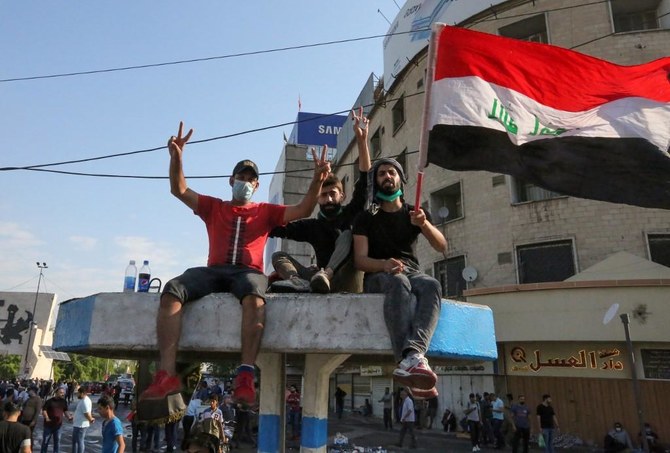
Iraqis gathered in Tahrir Square in Baghdad for another day of demonstrations. (AFP)
2 / 4
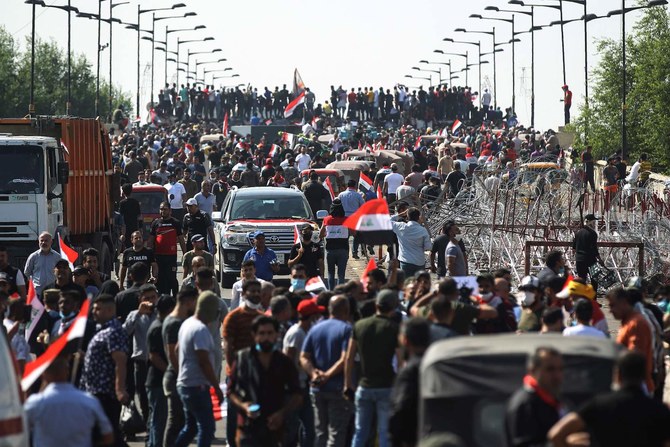
Iraqi protesters gather on the capital Baghdad's Al-Jumhuriyah Bridge on October 26, 2019, during an anti-government protest. (AFP)
3 / 4
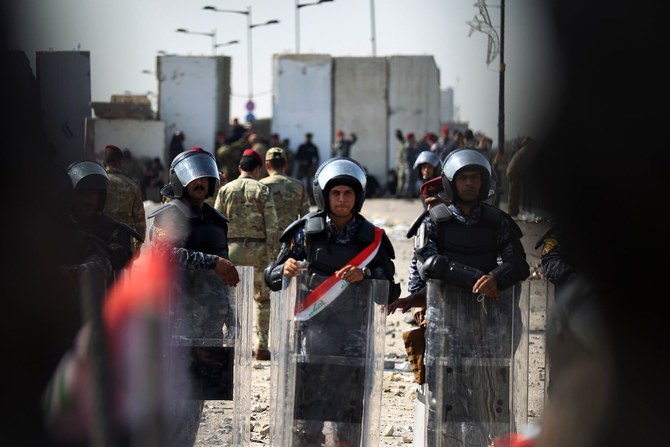
Iraqi security forces stand guard during an anti-government protest near the capital Baghdad's Al-Jumhuriyah Bridge on October 26, 2019. (AFP)
4 / 4
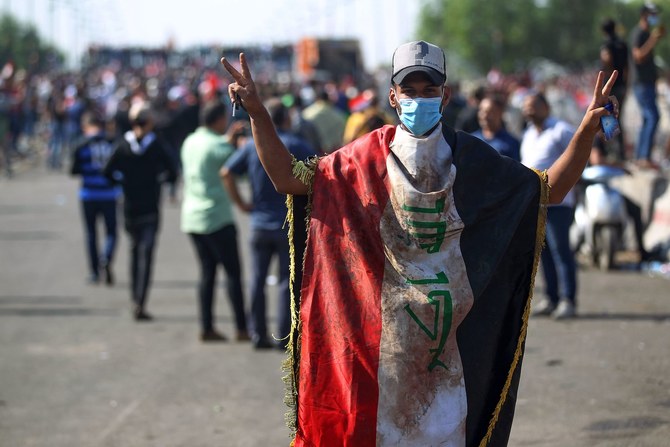
An Iraqi protester, draped in a national flag, flashes the victory sign near the capital Baghdad's Al-Jumhuriyah Bridge on October 26, 2019, during an anti-government rally. (AFP)
Updated 26 October 2019
Follow

Iraqis gather for more protests after death toll reaches 63

  • Some 200 of the protesters had camped out overnight in the capital's central Tahrir Square, and were cleaning up the area
  • Parliament was set to meet on Saturday in an emergency session to discuss protesters' demands

BAGHDAD: At least 63 people have died in two days of anti-government protests in Iraq's capital and across its south, a national rights watchdog said Saturday.

The Iraqi Human Rights Commission said the highest tolls from clashes since Friday were in the southern provinces of Dhi Qar and Missan.

Protests in the south have taken a new turn, with demonstrators torching government and paramilitary offices.

Some 200 of the protesters had camped out overnight in the capital's central Tahrir Square, and were cleaning up the area. Others read verses from the Qur'an to mourn those killed.

Eight protesters were killed in Baghdad on Friday, most of them after being struck by tear gas canisters launched by security forces trying to control the crowds.


Across the country, at least 40 protesters died, as demonstrators vented their frustration at political elites who they say have failed to improve their lives after years of conflict and economic hardship.
Parliament was set to meet on Saturday in an emergency session to discuss protesters' demands.
"The government has been stealing from us for 15 years. Saddam went and 1,000 Saddams have been hiding in the Green Zone," a young protester, who declined to be named, said on Friday, referring to the former Iraqi dictator.
The Green Zone is the central government zone of Baghdad that was closed to the Iraqi public for many years.

The Interior Ministry praised what it called the restraint shown by security forces on Friday.
"The security forces secured the protection of demonstrations and protesters responsibly and with high restraint, by refraining from using firearms or excessive force against demonstrators," the ministry said in a statement on Saturday.
In Iraq's mainly Shiite southern provinces, which saw violence overnight as protesters clashed with Iranian-backed Shiite militias, the situation was calmer on Saturday, with a curfew still in place across most urban areas.

However, the heads of powerful Iraqi paramilitary factions threatened they would take "revenge" on Saturday after their offices in the south of the country were torched during deadly protests.
Demonstrators set fire to dozens of government buildings and offices belonging to the influential Hashed Al-Shaabi paramilitary force across southern cities late Friday.
In Missan province, the headquarters of the Asaib Ahl Al-Haq, one of the Hashed factions, was torched and a leading commander of the group reportedly killed.
Wissam Al-Alyawi was later pronounced dead by the group, after footage circulated online showing him writhing in an ambulance as a crowd of men tried to break into it.
Asaib chief Qais Al-Khazaali was in Baghdad on Saturday for the funeral procession of Alyawi and his brother Issam, apparently killed in the same incident.
"His blood is on America and Israel's hands, but I will take revenge - many times over," Khazaali told mourners, holding back tears as he stood next to their wailing mother.
"This blood is proof to all our people of the size of the conspiracy that is targeting us," he said.
Dozens of Hashed fighters were gathered in military fatigues for the procession in central Baghdad, just a few districts south of where protests were taking place in Tahrir (Liberation) Square.


The latest bloodshed was the second major bout of violence this month. A series of clashes two weeks ago between protesters and security forces left 157 people dead and over 6,000 wounded.
More than 2,000 people were injured nationwide in those protests, according to medical sources and the Iraqi High Commission on Human Rights (IHCHR).


The UN says Al-Hol camp population has dropped sharply as Syria moves to relocate remaining families

Updated 15 February 2026
Follow

The UN says Al-Hol camp population has dropped sharply as Syria moves to relocate remaining families

  • Forces of Syria’s central government captured the Al-Hol camp on Jan. 21 during a weekslong offensive against the SDF, which had been running the camp near the border with Iraq for a decade

DAMASCUS: The UN refugee agency said Sunday that a large number of residents of a camp housing family members of suspected Daesh group militants have left and the Syrian government plans to relocate those who remain.
Gonzalo Vargas Llosa, UNHCR’s representative in Syria, said in a statement that the agency “has observed a significant decrease in the number of residents in Al-Hol camp in recent weeks.”
“Syrian authorities have informed UNHCR of their plan to relocate the remaining families to Akhtarin camp in Aleppo Governorate (province) and have requested UNHCR’s support to assist the population in the new camp, which we stand ready to provide,” he said.
He added that UNHCR “will continue to support the return and reintegration of Syrians who have departed Al-Hol, as well as those who remain.”
The statement did not say how residents had left the camp or how many remain. Many families are believed to have escaped either during the chaos when government forces captured the camp from the Kurdish-led Syrian Democratic Forces last month or afterward.
There was no immediate statement from the Syrian government and a government spokesperson did not respond to a request for comment.
At its peak after the defeat of IS in Syria in 2019, around 73,000 people were living at Al-Hol. Since then, the number has declined with some countries repatriating their citizens. The camp’s residents are mostly children and women, including many wives or widows of IS members.
The camp’s residents are not technically prisoners and most have not been accused of crimes, but they have been held in de facto detention at the heavily guarded facility.
Forces of Syria’s central government captured the Al-Hol camp on Jan. 21 during a weekslong offensive against the SDF, which had been running the camp near the border with Iraq for a decade. A ceasefire deal has since ended the fighting.
Separately, thousands of accused IS militants who were held in detention centers in northeastern Syria have been transferred to Iraq to stand trial under an agreement with the US
The US military said Friday that it had completed the transfer of more than 5,700 adult male IS suspects from detention facilities in Syria to Iraqi custody.
Iraq’s National Center for International Judicial Cooperation said a total of 5,704 suspects from 61 countries who were affiliated with IS — most of them Syrian and Iraqi — were transferred from prisons in Syria. They are now being interrogated in Iraq.