

Oil, gas giants spend €250 million on EU lobbying: Green groups

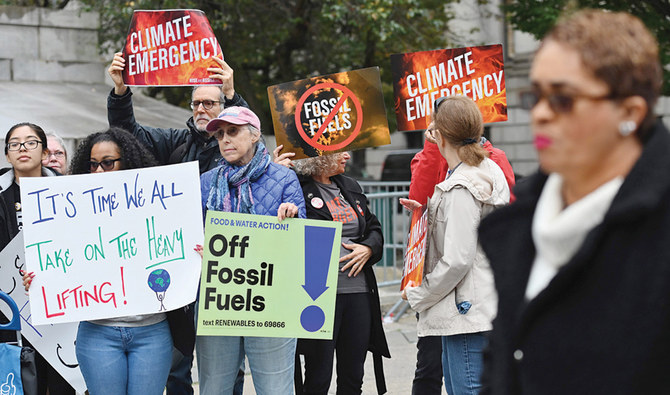
Climate activists stage a demonstration in New York City, US. (File/AFP)
Updated 24 October 2019
Follow

Oil, gas giants spend €250 million on EU lobbying: Green groups

  • The EU is seen as one of the global leaders when it comes to climate action.

PARIS: The five biggest publicly listed oil and gas companies and trade groups representing them spent more than €250 million ($278 million) lobbying the EU to influence climate action since 2010, environmental groups said on Thursday.

Research showed that BP, Chevron, ExxonMobil, Shell and Total, as well as trade groups acting on their behalf, have held at least 327 high-level meetings with European Commission officials since Commission President Jean-Claude Juncker took office in 2014 — an average of more than one a week.

The findings came from publicly listed documents, and companies who responded to requests for comments said there was no conflict of interest in their executives meeting high-level EU policymakers.

But green groups said the money spent on access to officials showed to what extent oil and gas firms were seeking to influence decisions in Brussels.

“This is part of a long trail of the fossil fuel industry delaying, weakening and torpedoing much-needed climate action,” said Pascoe Sabido, a researcher and campaigner with Corporate Europe Observatory.

The EU is seen as one of the global leaders when it comes to climate action.

But there are fears its member states are not phasing out fossil fuels quickly enough to comply with the 2015 Paris climate accord, which commits nations to limit warming to “well below” 2 degrees Celsius (3.6 Fahrenheit).

A Commission spokeswoman said it was “good practice that politicians and officials meet with external actors.”

She added that “some meetings” with oil and gas representatives focused on “renewables and the ways to decarbonize our economy.”

Last year the International Panel on Climate Change (IPCC) called for a radical drawdown in fossil fuel use to hit the safer 1.5C cap laid out in the Paris deal.

Yet global emissions are rising year on year, and environmental groups fear major EU gas infrastructure projects in the pipeline could lock the continent into fossil fuels well beyond the IPCC’s deadlines.

The investigation by Corporate Europe Observatory, Food & Water Europe, Friends of the Earth Europe, and Greenpeace EU looked at companies’ own declarations and the EU’s lobby transparency register and published meetings.

It found that the five firms declared spending of €123.3 million ($137 million) on EU lobbying between 2010-2018. Trade associations representing them spent an additional €128 million in that period.

In April, the watchdog Global Witness calculated that oil and gas majors were planning to spend $5 trillion (€4.5 trillion) on new exploration by 2030, a figure it said was “poles apart” from the Paris goals.

A spokeswomen from Total said the figures contained in Thursday’s report “in no way reflect” what the group spends on lobbying.

“Total is convinced that a collective approach is necessary to respond to the magnitude of the climate issue,” she said.

An ExxonMobil spokesman said the giant “complies fully with the requirements of the EU Transparency Register.”

“ExxonMobil believes that climate change risks warrant action and it’s going to take all of us — business, governments and consumers — to make meaningful progress,” he said.

A spokeswoman for Shell said it “firmly rejected” the report’s premise.

“We are crystal clear about our support for the Paris agreement ... everything we do is to advocate for good policy outcomes to that end.”

BP and Chevron did not respond to requests for comment.

The green groups called for a “firewall” to protect EU officials from fossil fuel representatives to avoid conflicts of interest.

“Tackling the climate emergency means leaving the vast majority of known fossil fuel reserves under ground and that is incompatible with the future projections of these firms who are going to massively increase their production over the next 10-20 years,” Sabido said.

Myriam Douo, from Friends of the Earth Europe, said citizens could no long afford the “delay tactics” of fossil fuel producers.

“We must listen to the millions of young climate protesters on our streets and cut fossil fuels out of our politics now.”


Apparel Group expands Saudi presence with 25 new brands 

Updated 7 sec ago
Follow

Apparel Group expands Saudi presence with 25 new brands 

RIYADH: Apparel Group is seeking to strengthen its presence in the Saudi market through digital commerce expansion, adding 25 new brands to its portfolio, and plans to grow its store network by 200 outlets this year to reach a total of 1,000, CEO Neeraj Teckchandani told Al-Eqtisadiah.

He noted that Saudi Arabia has been one of the group’s key markets since entering in 2007, currently operating more than 800 stores across the Kingdom. He added that the group’s current expansion plans include opening over 200 new stores this year, following 150 openings last year, with expectations that Saudi Arabia will become the group’s largest market in terms of footprint and revenue share in the coming period. 

Teckchandani added that the group continues to invest in e-commerce through its digital platform, SixFeet, launched in 2016, which contributed 10 percent of total group sales, noting that plans are underway to gradually increase this share in 2026 through technology investments and enhanced digital shopping experiences. 

The group is also preparing to launch a unified SuperApp this year, integrating its loyalty program, the SixFeet platform, and all digital assets into a single application to accelerate e-commerce growth, improve customer experience, and increase operational efficiency. 

New fashion and restaurant brands 

The CEO said the new brands added to the group’s portfolio cover fashion, footwear, restaurants, and entertainment, including Footasylum, FitFlop, and Clarins, as well as Bobbi Brown, Wagamama, Ivy Asia, and Punjab Grill. 

He noted that some brands have already opened in Saudi Arabia, with further expansion planned this year and next. 

85 brands under the group 

Apparel Group manages 85 global brands and over 2,500 stores across Saudi Arabia, the UAE, Bahrain, Qatar, and Oman. 

The company has also expanded strategically into India, South Africa, Singapore, and Indonesia, as well as Thailand, Malaysia, and Egypt. 

Its portfolio includes internationally renowned fashion, footwear, and lifestyle brands such as Tommy Hilfiger, Charles & Keith, Skechers, Aldo, Crocs, Calvin Klein and Aéropostale. The group also operates food and lifestyle brands including Tim Hortons, Jamie’s Italian, and Cold Stone Creamery, alongside beauty labels such as Inglot and Rituals. R&B, its in-house label, is currently the fastest-growing brand in the region. 

Securing locations in new centers 

Teckchandani pointed out that the Saudi market is witnessing rapid expansion in the shopping mall sector, with 30 new centers expected to open by 2030, affirming that the group has secured strategic locations in several of these projects and aims to expand its store network in parallel with real estate growth in the retail sector. 

He added that the group has also invested in operational infrastructure within Saudi Arabia, establishing a main distribution center in Riyadh to support supply chains, relocating to its new regional headquarters in Majdoul Tower, and expanding its logistics arm, “Connect Logistics,” as well as “Shopfit Interior,” a company specializing in store fit-outs. 

He added that the parent company is prioritizing investment in advanced technology and AI, along with launching the unified SuperApp in the second quarter of 2026, and has appointed a group-level chief digital officer to support this phase, with results expected in the short to medium term. 

Saudi expansion drives growth 

Teckchandani emphasized that Saudi Arabia represents the group’s main growth engine in the coming years, supported by strong consumer demand, rapid development of shopping centers, and increasing contribution from digital commerce. 

Apparel Group’s expansion comes amid a broader retail sector boom in Saudi Arabia, driven by rising consumer spending and accelerated development of malls under Vision 2030. 

The retail sector is one of the largest non-oil contributors to GDP, with increasing growth in digital sales channels as companies integrate e-commerce with traditional stores to enhance operational efficiency and expand market share. 

Major retailers are seeking to capitalize on population growth and rising purchasing power, alongside the expansion of hospitality and entertainment projects, boosting demand for global brands. Investments in logistics infrastructure and digital transformation have also become critical competitive factors, especially as e-commerce accounts for a growing share of total retail sales.