

Russia, China making efforts to revive Afghan peace talks — Taliban spokesman

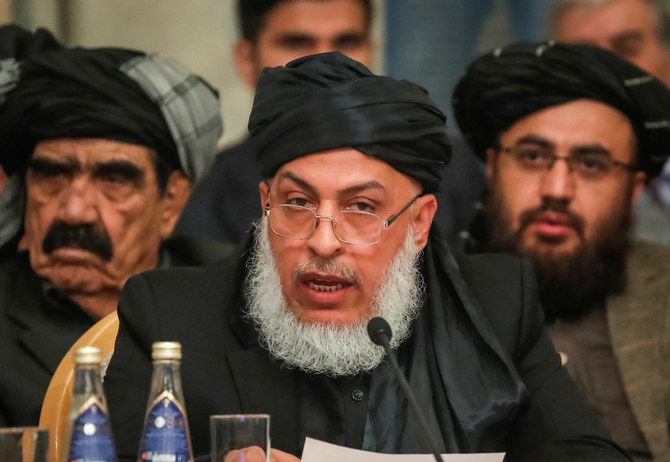
Head of Political Office of the Taliban Sher Mohammad Abbas Stanakzai speaks at a conference arranged by the Afghan diaspora, in Moscow, Russia Feb. 5, 2019. (REUTERS/ File)
Updated 23 October 2019
Follow

Russia, China making efforts to revive Afghan peace talks — Taliban spokesman

  • China is organizing talks among Afghan rival factions next week as part of efforts to end years of war
  • Members of the Pakistani delegation will interact with representatives of China, Russia and the US in Moscow on Thursday

ISLAMABAD: Afghan Taliban spokesman Suhail Shaheen said on Wednesday that Russia and China were making efforts to revive peace talks aimed at striking a deal for the United States and other foreign troops to withdraw from Afghanistan in exchange for Taliban security guarantees.

Last month, US President Donald Trump halted the talks with the Taliban after the militants carried out a bomb attack in Kabul that killed 12 people, including an American soldier.

Shaheen said there was no decision yet to restart the talks but “there are some contacts by the Americans, .. efforts by Russia, China, and other countries are underway to revive the peace process.” he added.

Late on Tuesday, Shaheen tweeted that a Chinese delegation led by Chinese special envoy for Afghanistan, Deng Xijun, met the head of the Taliban political office, Mullah Abdul Ghani Baradar, in Qatar on Tuesday and invited him to participate in intra-Afghan talks. He said Baradar accepted the invitation and a large delegation of the political office would travel to Beijing for talks scheduled to be held on October 28-29.

The intra-Afghan dialogue, rounds of which have also been held in Moscow and Doha this year, is aimed at reconciliation between Afghanistan’s warring parties and has been running parallel to the talks between the insurgents and the United States.

China, which shares a short border with Afghanistan, has been trying to encourage peace efforts and last month a Taliban delegation visited Beijing for talks with government officials.

Shaheen said on their part the Taliban were ready for talks with the US to restart.

“The way is open if the Americans plan to return to the peace agreement. If they continue the war, we are also ready for that. Now it is up to them,” Shaheen said. “We will not beg to anyone. They have violated commitment, not us.”

“If they cannot agree to a cease-fire during these very important peace talks, and would even kill 12 innocent people, then they probably don’t have the power to negotiate a meaningful agreement anyway,” Trump had said on Twitter last month when he called off talks.

The surprise announcement left in doubt the future of the draft accord worked out by Zalmay Khalilzad, the special US envoy for peace in Afghanistan, for a drawdown of thousands of US troops over the coming months.

Representatives of China, Russia, the United States, and Pakistan will also hold a consultation on the Afghan peace process in Moscow on Thursday to discuss steps to bring the peace process on track, officials at the Pakistani foreign office said, declining to be named.

Additional secretary at the Foreign Office Muhammed Aejaz is expected to represent Pakistan at the meeting. 

Afghan commentator Zakir Jalaly said the US had previously not shown interest in Russia’s “Moscow Format” process started in 2016 since the Americans would refuse to take part in meetings in Russia.

“The US has now realized that it cannot make any progress without Russia, China, and Pakistan and that is why it is now involved in regular consultations with key players,” Jalaly told Arab News from Kabul on Wednesday.

He said after the Taliban visited Russia, Iran, China, and Pakistan and took advantage of the regional consensus on a political solution to the Afghan conflict, “the US has been compelled not to ignore major players in the peace process.”


Pakistan vows to play active role against climate change on International Day of Clean Energy 

Updated 4 sec ago
Follow

Pakistan vows to play active role against climate change on International Day of Clean Energy 

  • Governments, civil societies every year mark Jan. 26 as International Day of Clean Energy, calling for inclusive transition to clean power
  • Pakistan ranks among nations most vulnerable to climate change, suffering from erratic weather patterns such as floods, heatwaves, storms

ISLAMABAD: Pakistan will play an active role in global efforts against climate change, President Asif Ali Zardari vowed on Monday as the world marks International Day of Clean Energy today. 

The International Day of Clean Energy is marked every year on Jan. 26 during which governments and civil societies around the world call for awareness on climate change impacts and demand action for a just and inclusive transition to clean energy for the benefit of the people.

Burdened by an energy crisis that has resulted in costly fuel imports over the past couple of years, Pakistan has sought to shift to clean energy to place less burden on its fragile economy. The South Asian country has emerged as one of the world’s fastest growing solar markets, with 12 gigawatts (GWs) of off-grid and over 6GWs of net-metered solar capacity by the end of 2025. In the last fiscal year, renewables accounted for a historic 53 percent of total electricity generation, according to the prime minister’s coordinator on climate change, Romina Khurshid Alam. 

“Pakistan will play an active role in global efforts against climate change,” Zardari was quoted in a statement released by his office. “Investment in safe technologies is essential for the protection of the planet.”
Zardari stressed that clean energy is essential for inclusive development, noting that Pakistan has made the transition toward it a “national priority.”

He said clean energy occupies a central place in the government’s policy framework, adding that Pakistan has set a target of electric vehicles comprising 30 percent of all passenger vehicles and heavy-duty truck sales by 2030. 

The Pakistani president cited air pollution as a major challenge to public health in the country, noting its social and economic costs for the government and the people. 

“Pakistan is committed to building a reliable and sustainable energy system,” he said. 

Pakistan ranks among nations most vulnerable to climate change and has seen erratic changes in its weather patterns that have led to frequent heatwaves, untimely rains, storms, cyclones, floods and droughts in recent years. 

In 2022, monsoon floods killed over 1,700 people, displaced another 33 million and caused over $30 billion losses. Over 1,000 people were killed in floods last year as well due to torrential monsoon rains and floods triggered by climate change impacts and excess water released by Indian dams.