

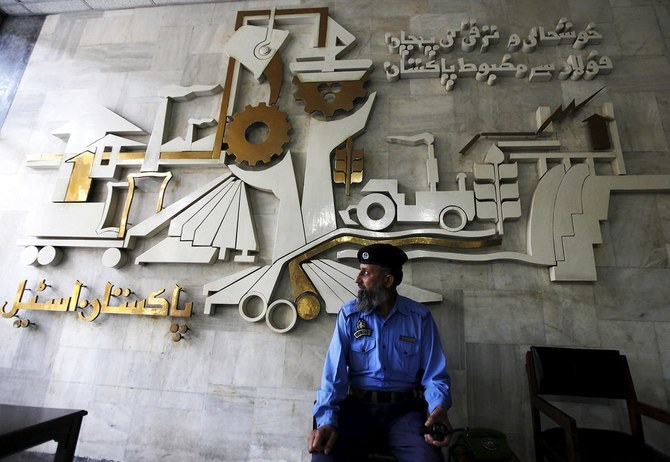

KARACHI: Pakistan’s legislators and stakeholders on Monday decided to revive the country’s largest lossmaking public sector megacorporation, the Pakistan Steel Mills, and clear about Rs15 billion belonging to its workers, a senator and stakeholders confirmed to Arab News on Monday.
A meeting of Senate’s Standing Committee on Industries and Production was held to review the revival plan of the Pakistan Steel Mills which has remained non-functional since June 2015 after witnessing a decline in its production since 2008.
“The steel mill will be revived and for that, we have scheduled an advisory meeting in the next 15 days that will determine our future course of action. Today’s meeting was attended by professionals and they have informed us that the mill is 100 percent in working condition. They also maintained that some vested interest groups do not want to run the steel mills,” said Senator Aurangzeb Khan, member of the standing committee.
“When and how to restart the steel mills will be decided in the next meeting,” he assured.
The Pakistan Steel Mills was constructed in 1973 under an agreement signed between the country’s administration and the erstwhile Union of Soviet Socialist Republic (USSR) in 1971. The Soviets also agreed to provide technical and financial assistance for the construction work.
The senator said that the accumulated dues of workers and stakeholders had increased to around Rs15 billion since the closure of the mill.
“The steel mill is closed and the workers’ dues have accumulated to Rs14-15 billion. Today we have decided that the dues will be paid in 18-month installments of Rs5 billion which will be released in six months each,” Khan said.
Pakistan is also seeking Chinese and Russian help to revive the steel mills, though the stakeholders informed the senate body they could revive it on their own with local expertise.
“We don’t need any Chinese or Russian experts; we can run the mill with local expertise. Machinery and specialists, if needed, will be allowed to hire,” Mumrez Khan, the convener of the PSM Stakeholders’ Group, comprising employees, pensioners, suppliers, dealers, and contractors, told Arab News.
The incumbent government of Prime Minister Imran Khan is looking at various options to revive the steel mills that include induction of professional management, but no final decision has so far been made in this connection.
“The daily losses are estimated to be around Rs120 million due to the closure of plants,” Mumrez Khan claimed, adding that during the last 14 months of the current administration the closure of the mill has cost the country Rs50 billion.
The stakeholders made the revival of the mill contingent on the reconstitution of the board of directors by inducting relevant experts and professional management.
They also insisted on initiating the accountability process against people responsible for its closure, asking the government to refer their cases to the National Accountability Bureau (NAB) and instruct the Federal Investigation Agency (FIA) to recover the mill’s dues.
“The steel import tariff must be rationalized to provide level playing field to all the competitors in the country,” Khan added, claiming that “the revival of the steel mills will add Rs100 billion revenue.”
“I have informed the legislators that the accumulated losses of the steel mills have jumped to about $11 billion due to the closure of plants and imports of steel products,” he said.
Pakistan is also mulling to privatize this lossmaking public entity but no decision has so far been taken. However, it was decided that the defunct entity would be revived before taking any final decision regarding its privatization.
Spread over an area of 18,600 acres with 10,390 acres for the main plant, the Pakistan Steel Mills is located 40 kilometers from Karachi in the Port Qasim vicinity. The PSM had a production capacity of 1.1 million tons of steel which was expandable to 3 million tons per annum. The main PSM products included coke, pig iron, billets, cold-rolled sheets, hot-rolled sheets, and galvanized sheets.


