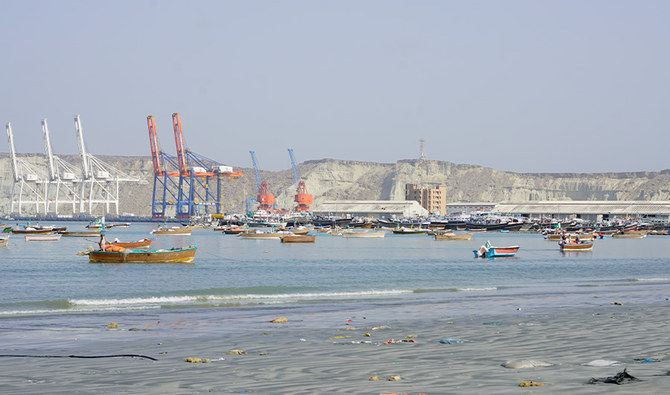
KARACHI: The first scheduled ship carrying a shipment of Afghan Transit Trade (ATT) cargo was unable to dock at the deepwater port of Gwadar on Sunday in Pakistan’s southwestern Balochistan province, due to customs’ issues and the lack of trucking facilities on hand for bulky cargo transportation, port officials said.
Last week, Pakistan had announced its newly developed Gwadar port was open for business, and authorities declared the port’s trade related infrastructure was ready to handle bulk cargos to and from Afghanistan.
In 2010, Pakistan and Afghanistan revised a bilateral trade agreement that called for greater facilitation and cooperation in the movements of goods between the two countries. But the very first transit cargo ship bound for Gwadar, carrying 15,000 tons of chemical fertilizer to be trucked onwards to Afghanistan, never docked at the new port.
“The ship is delayed due to some issues related to customs,” Jiand Baloch, a spokesperson for the Gwadar Port Authority (GPA) told Arab News on Sunday.
Another senior Gwadar official said the ship’s arrival could also have been delayed due to the lack of required trucking facilities at Gwadar to handle ATT goods.
“The trucks for transportation... are not enough to handle such a huge volume of goods from Gwadar,” the official, who declined to be named, told Arab News.
Port officials said customs authorities wanted to ensure the clearance of ATT goods from Gwadar was in line with Pakistan’s strict Ministry of Commerce and Textile instructions.
“Bulk cargoes imported at Gwadar port for onward transit to Afghanistan will be transported in containers after stuffing/loading the same into containers of international specifications,” a letter from the commerce ministry to the Federal Board of Revenue (FBR) stated on Tuesday.
Representatives of the transporters’ association said they were reluctant to move their set-up to Gwadar for the provision of cross boarder transportation, when they were already fully functional in the southern port city of Karachi.
“We have moved in Karachi and have set up our business facilities here,” Israr Ahmed Shinwari, a spokesman for the All Pakistan Oil Tankers Association told Arab News.
“The second reason is security, because our drivers have been martyred in Balochistan,” he said, referring to the security situation in the restive province which borders Afghanistan.
Meanwhile, officials of the Pakistan Afghanistan Joint Chamber of Commerce & Industry (PAJCCI) termed Pakistan’s decision to handle ATT from Gwadar a “positive but premature” step.
“We are also promoting the transportation of ATT from Gwadar, but it is a premature announcement because of (current) transportation and customs clearance (facilities),” Zubair Motiwala, Chairman of PAJCCI told Arab News.
However, Motiwala said he believes these are “teething problems” that will be sorted once the port starts receiving bulk cargo.
Stakeholders also pointed to insufficient supporting infrastructure in need of an upgrade before Gwadar could be fully relied on for the transportation of goods bound for Afghanistan.
“The eastern bypass is yet to be constructed while the western road is not capable of handling such heavy traffic, which may cause problems for the local population,” Shaukat AK Populzai, President of the Balochistan Economic Forum, told Arab News.
In July, Pakistan and Afghanistan resumed talks to iron out their differences in the way of the transit treaty after a three-year hiatus. The turnaround came after Afghan President Ashraf Ghani met with Prime Minister Imran Khan in Islamabad on June 27 where both sides agreed to deepen trade relations.
Pakistani traders have long called for a stop to the misuse of the ATT facility, and say goods are often smuggled back into Pakistan, or never reach Afghanistan in the first place. However, they expect the handling of ATT goods at Gwadar will reduce the smuggling.
“The ATT handling at Gwadar will reduce the chances of goods coming back to Karachi because it would increase the distance,” Motiwala said adding “ATT handling at Gwadar Port would reduce the distance from and to Afghanistan via Chaman border crossing that is beneficial for both Pakistan and Afghanistan.”
In order to make ATT more attractive from Gwadar, Pakistan has offered a 90 day free period for the standing of cargo, well above the 15 days being offered in Karachi.
To facilitate trade with Afghanistan last month, Pakistan opened the Torkham border round-the-clock, which has increased trade between the two countries. According to Pakistan’s ministry of commerce, the flow of cargoes under the Afghan Transit Trade increased 44 percent during the last fiscal year.


![]()
![]()

Gwadar port’s first scheduled Afghan Transit Trade ship fails to dock

Gwadar port’s first scheduled Afghan Transit Trade ship fails to dock
- Customs, transportation problems held the cargo ship back on Sunday
- ATT from Gwadar a ‘positive but premature’ announcement, says chairman of Pak-Afghan commerce body
Latest updates


Recommended


© 2026 SAUDI RESEARCH & PUBLISHING COMPANY, All Rights Reserved And subject to Terms of Use Agreement.