

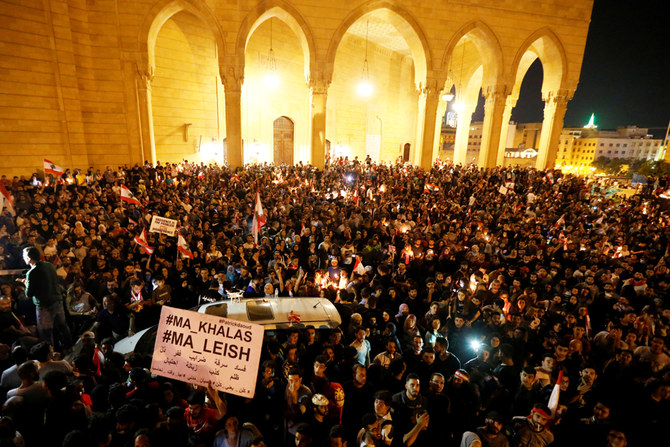
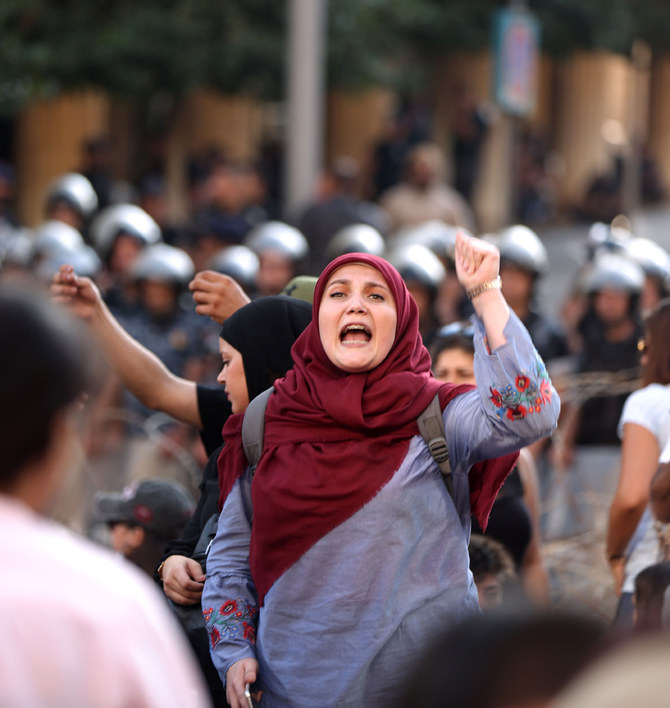
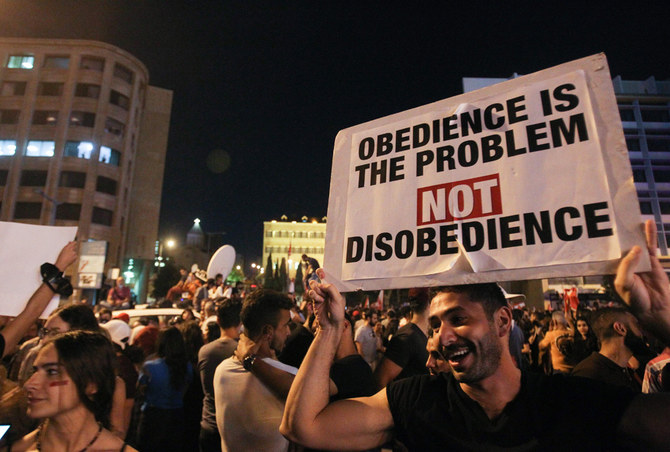

BEIRUT: Lebanon’s “strong republic” bloc quit the coalition government on Saturday as tens of thousands of people took to the streets for a third day of protests against tax increases and alleged official corruption.
Samir Geagea, head of the Lebanese forces party, said his group was resigning from the government ahead of the 72-hour deadline that Prime Minister Saad Hariri gave to partners in power to help make his reform programs work.
Lebanon’s banks will remain closed on Monday due to nationwide protests, the Association of Banks in Lebanon announced on Sunday, according to the country's state news agency.
Geagea’s Christian party has four ministers in the coalition government, namely: Ghassan Hasbani, Kamil Abu Suleiman, Richard Qayomjian and May Chidiac.
“Since people have lost confidence in the political class, and since the people in the street represent all segments of society and because all components of the government does not want serious and actual reform, we were the first party to act with transparency and when discussing the 2020 budget, we demanded a basket of immediate reforms, but we did not feel the seriousness required,” Geagea told a late night press conference that extended into the early hours of Sunday.
“We are now convinced that the government is unable to take the necessary steps to save the situation,” said Geagea. “Therefore, the bloc decided to ask its ministers to resign from the government.”
He denied “any talk of an agreement with Prime Minister Hariri regarding the resignation of ministers.”
Geagea’s announcement was welcomed by the protesters, who are still sit in yards in Beirut, Jounieh, Tripoli and Tyre. They demanded the resignation of the remaining in power.
‘Sweeping overhaul needed’
The protesters took to the streets despite calls for calm from politicians and dozens of arrests on Friday. Many waved billowing Lebanese flags and insisted the protests should remain peaceful and non-sectarian.
The demonstrators are demanding a sweeping overhaul of Lebanon’s political system, citing grievances ranging from austerity measures to poor infrastructure.
They have blocked main roads and threatened to topple the country’s fragile coalition government.
Most Lebanese politicians have uncharacteristically admitted the demonstrations are spontaneous, rather than blaming outside influences.
Demonstrators in Beirut celebrated the news of the coalition party’s resignation, calling on other blocs to leave the government. In Tripoli, they let off fireworks.
“I am thinking maybe it’s better all the government resign,” said one protester, 24-year-old Ali. “I am thinking maybe it’s better to go to another election as people already woke up.”
The army on Saturday called on protesters to “express themselves peacefully without harming public and private property.”
Saturday evening, thousands were packed for a third straight night into the Riyadh Al-Solh Square in central Beirut, despite security forces having used tear gas and water cannons to disperse similar crowds a day before.
AI slams ‘use of excessive force’
Amnesty International said the security forces’ reaction was excessive, pointing out that the vast majority of protesters were peaceful.
“The intention was clearly to prevent protesters gathering — in a clear violation of the right to peaceful assembly,” it said.
Small groups of protesters have also damaged shop fronts and blocked roads by burning tires and other obstacles.
The Internal Security Forces said 70 arrests were made Friday on accusations of theft and arson.
But all of those held at the main police barracks were released Saturday, the National News Agency (NNA) said.
The demonstrations first erupted on Thursday, sparked by a proposed 20 US-cent tax on calls via messaging apps such as WhatsApp.
Such calls are the main method of communication for many Lebanese and, despite the government’s swift abandonment of the tax, the demonstrations quickly swelled into the largest in years.
Prime Minister Hariri has given his deeply divided coalition until Monday evening to give back a reform package aimed at shoring up the government’s finances and securing desperately needed economic assistance from donors.
He held a series of meetings Saturday regarding the situation, NNA said.
Hariri’s political rival, Hezbollah leader Hassan Nasrallah, told protesters Saturday their “message was heard loudly.”
But he warned against demanding the resignation of the government — saying it could take a long time to form a new one and solve the crisis.
The current unity government has the backing of most Lebanese political parties, including Hezbollah.
Protesters attacked in Tyre
In the southern port city of Tyre, supporters of Shia politician and speaker of parliament Nabih Berri attacked protesters Saturday, a witness said, a day after demonstrators had accused him of corruption.
His Amal political party condemned the attack and called for an investigation.
More than a quarter of the Lebanese population lives below the poverty line, according to the World Bank.
Many of the country’s senior politicians came to prominence during the country’s 15-year civil war, which ended in 1990.
The promised austerity moves are essential if Lebanon is to unlock $11 billion in economic assistance pledged by international donors last year.
Growth has plummeted in recent years, with political deadlock compounded by the impact of eight years of war in neighboring Syria.
Lebanon’s public debt stands at around $86 billion — more than 150 percent of gross domestic product — according to the finance ministry.
(With AFP and Reuters)


