

Turkey accused of using illegal phosphorus munitions in Syria

1 / 2
A young Kurdish man is treated at an emergency clinic for burns suffered from a suspected phosphorus bomb dropped by Turkish jets in northern Syria. (Photo credit: The Times of London)
2 / 2
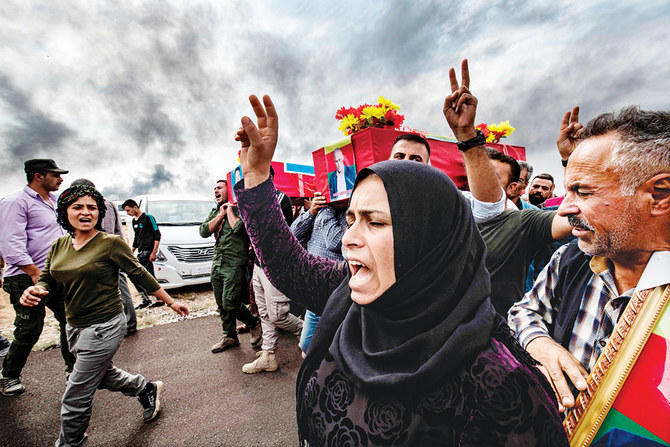
Mourners near the Syrian Kurdish border town of Ras Al-Ain attend the funeral of civilians and fighters, who died in attacks by Turkish-led forces. (AFP)
Updated 20 October 2019
Follow

Turkey accused of using illegal phosphorus munitions in Syria

  • Reports are credible, expert tells Arab News
  • Hospitals report spike in burns victims

ANKARA: Accusations that Turkey has used banned incendiary weapons against civilians in its invasion of northern Syria are credible, a leading security analyst told Arab News on Saturday.

Kurdish leaders said Turkish President Recep Tayyip Erdogan’s fighter jets had dropped munitions containing napalm and white phosphorus on civilian targets in the border town of Ras Al-Ain, a key objective for Turkish troops.

“The Turkish aggression is using all available weapons against Ras Al-Ain,” the Kurdish administration said. “Faced with the obvious failure of his plan, Erdogan is resorting to weapons that are globally banned, such as phosphorus and napalm.”

Nicholas Heras, an analyst at the Center for New American Security, told Arab News: “There are now multiple credible reports that Turkey has used white phosphorus munitions in its campaign in northeast Syria, and especially against the stubborn defenders of the city of Ras Al-Ain.”

The attacks on Ras Al-Ain are being investigated by UN chemical weapons inspectors, the Organization for the Prohibition of Chemical Weapons (OPCW), and Human Rights Watch. 

OPCW said it had “not yet determined the credibility of these allegations,” and its inspectors were monitoring the situation.

If the use of banned incendiary weapons were proved, it would be a grave violation of Turkey’s pledge to wage war with concern for civilian lives, Heras said.

HIGHLIGHTS

  • Erdogan’s jets ‘dropped munitions containing napalm and white phosphorus in Ras Al-Ain.’
  • The attacks are being probed by UN chemical weapons inspectors and Human Rights Watch.
  • A video posted on social media shows children with burns that a doctor says were consistent with the use of banned weapons.


Rami Abdel Rahman, head of UK-based monitoring group the Syrian Observatory for Human Rights, said there had been a spike in burn wounds treated at the Syrian-Kurdish hospital at Tal Tamir, mostly casualties brought in from the Ras Al-Ain area. 

The Kurdish Red Crescent said at least six people were being treated in hospital for burns. 

Kurdish officials posted a video on social media showing children with burns that one doctor in Hasakeh province said were consistent with the use of banned weapons.

Hamish de Bretton-Gordon, a British chemical weapons expert, told the UK newspaper The Times that the burns appeared to have been caused by white phosphorus.
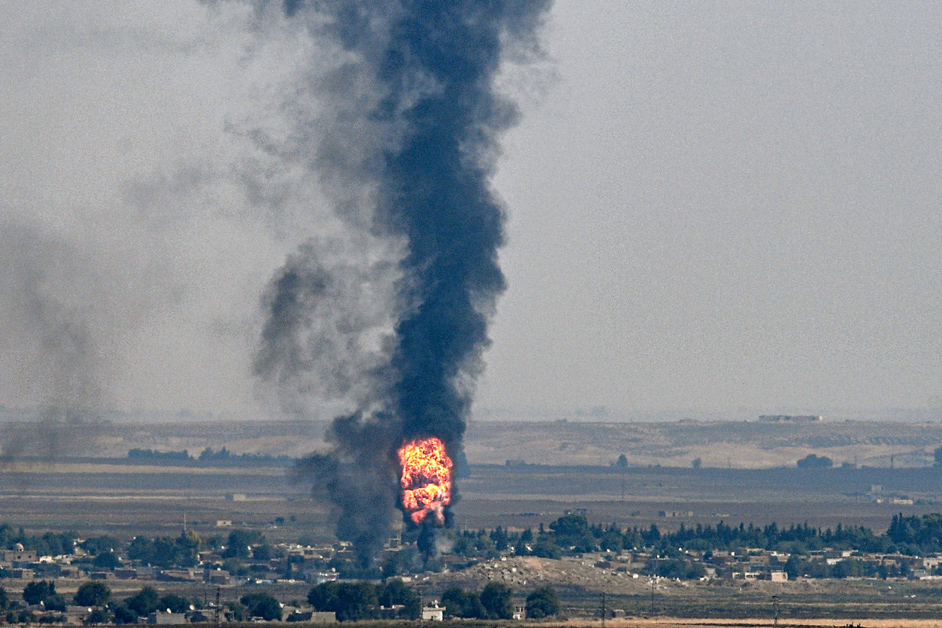


This picture taken on October 17, 2019 shows smoke and fire rising from the Syrian town of Ras al-Ain during the Turkish offensive against Kurdish groups in northeastern Syria. Kurdish authorities in northeastern Syria accused Turkey of resorting to banned weapons such as napalm and white phosphorus munitions. (AFP / Ozan Kose)

The substance may be used to create a smoke screen, or as a battlefield marker, especially at night, but its use as an incendiary weapon is prohibited under international law.

Since 1997, Turkey has been a signatory to the Convention on the Prohibition of the Development, Production, Stockpiling and Use of Chemical Weapons and on their Destruction.

Dr. Willem Theo Oosterveld, a senior fellow at the Hague Centre for Strategic Studies, said the deployment of white phosphorus was not explicitly prohibited by the Geneva Conventions. 

However, he said, under humanitarian law “the use of means and methods of warfare which are of a nature to cause superfluous injury or unnecessary suffering is prohibited.”


Iran protest instigators will receive no leniency, judicial chief says

Updated 6 sec ago
Follow

Iran protest instigators will receive no leniency, judicial chief says

TEHRAN: The head of Iran’s judiciary warned that those behind a recent wave of anti-government protests could expect punishment “without the slightest leniency.”
What began earlier this month as demonstrations against the high cost of living boiled over into a broader protest movement that represented the gravest challenge to the leadership in years.
The protests have abated under an internet blackout that left the country largely cut off from the outside world.
“The people rightly demand that the accused and the main instigators of the riots and the acts of terrorism and violence be tried as quickly as possible and punished if found guilty,” judicial chief Gholamhossein Mohseni Ejei was quoted as saying by the official Mizan online news portal.
He went on to say “the greatest rigor must be applied in the investigations,” but insisted that “justice entails judging and punishing without the slightest leniency the criminals who took up arms and killed people, or committed arson, destruction, and massacres.”
The Iranian government has put the death toll from the protests at 3,117, including 2,427 people it has labeled “martyrs” — a term used to distinguish members of the security forces and innocent bystanders from those described by authorities as “rioters” incited by the US and Israel.
Rights groups have accused authorities of repeatedly using live ammunition on protesters, but Col. Mehdi Sharif Kazemi, commander of Iran’s special police, maintained authorities had used only non-lethal measures such as water cannon to quell the unrest.
“The use of weapons (by the police) during this operation has sparked some criticism, but in fact, the police did not resort to using any firearms,” he was quoted as saying by the Mehr news agency.
“We used non-lethal means in order to guarantee the safety of the population and avoid any killings.”
Italian Foreign Minister Antonio Tajani urged the EU to list Iran’s Revolutionary Guards Corps as a “terrorist organization” following the crackdown on protests.
Tajani said he would propose the idea “in coordination with other partners” at a meeting of EU foreign ministers in Brussels on Thursday.
“The losses suffered by the civilian population during the protests demand a clear response,” he wrote on X.
He also called for the EU to levy individual sanctions against those responsible.

The EU has already sanctioned several hundred Iranian officials over crackdowns on previous protest movements and over Tehran’s support for Russia’s war on Ukraine.

The bloc has also banned the export to Iran of a raft of components that could be used in the country’s drone and missile manufacturing.
Last week, EU chief Ursula von der Leyen announced plans to ban additional exports of critical drone and missile technologies.
An EU official on Friday confirmed that the proposal to designate the IRGC as a terrorist organization was on the table for this week’s meeting, but said it requires unanimity for approval and that “we are not yet there.”