

Is the conditional cease-fire in northern Syria too good to be true?

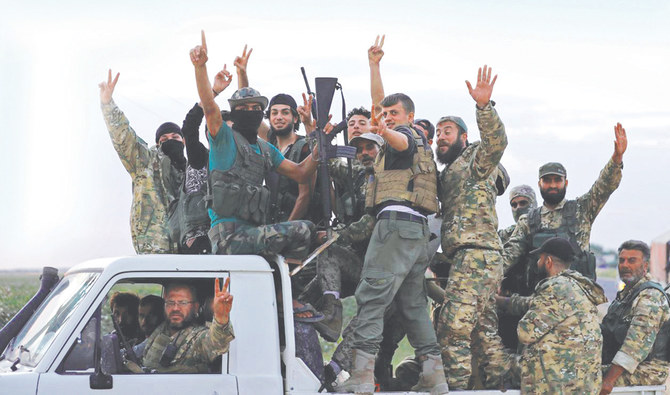
Turkey-backed Syrian rebels drive on top of a truck to cross into Syria, near the border town of Akcakale in Sanliurfa province, Turkey, on Thursday. (Reuters)
Updated 19 October 2019
Follow

Is the conditional cease-fire in northern Syria too good to be true?

  • If truce conditions are not met, Turkey will relaunch Syria operation ‘in a more decisive manner’

ANKARA: The surprise cease-fire deal between US Vice President Mike Pence and Turkish President Recep Tayyip Erdogan in Ankara has brought a new dimension to the dynamics in northern Syria. Turkey launched the cross-border offensive last week after US President Donald Trump announced he was pulling US forces out of the Syria-Turkey border region.
Ankara’s goal is to push back a Kurdish militia group — the People’s Protection Units (YPG) — that it sees as a terrorist organization. The Syrian Democratic Forces (SDF) — a group dominated by the YPG — fought with the US against Daesh in Syria.
On Thursday evening Turkey agreed to a 120-hour pause in military operations against the YPG militia for the next five days to give Kurdish troops time to withdraw from a proposed “safe zone” along its border.
Ankara has agreed to a permanent cease-fire once the withdrawal is complete, Pence told reporters in Ankara after his meeting with Turkish officials.
In return, the US will not impose further sanctions on Turkey and remove the ones imposed last week, although there is still a risk that a bipartisan group of US senators will press ahead with new sanctions.
Erdogan is due to meet President Vladimir Putin in Russia on Tuesday, where further talks are expected about Turkey’s safe zone plans.
“I consider my meeting with President Putin as another element of this (safe zone) process,” Erdogan said Friday. “Turkey wouldn’t be bothered by Assad regime control in towns like Manbij, Kobani and Qamishli if the YPG is completely cleared out.” The question remains whether the cease-fire will hold.
In comments to local television on Thursday night, the SDF’s Gen. Mazloum Kobani said the deal only applied to the area between the towns of Tal Abyad and Ras Al-Ain.
Erdogan announced on Friday that if the conditions in the agreement were not met during the 120 hour-pause, Turkey would relaunch Operation Peace Spring “in a more decisive manner.”
Selim Sazak, a doctoral researcher at Brown University and the research director of Ankara-based consulting firm TUM Strategy, believed the agreement would be implemented and the YPG would withdraw.

FASTFACT

Erdogan is due to meet President Vladimir Putin in Russia on Tuesday, where further talks are expected about Turkey’s safe zone plans.

“The agency of the YPG is fairly limited. If the deal collapses because of the YPG, it’s actually all the better for Ankara,” he told Arab News.
“What Ankara originally wanted was to take all of the belt into its control and eliminate as many of the YPG forces as possible. Instead, the YPG is withdrawing with a portion of its forces and its territory intact. Had the deal collapsed because of the YPG, Ankara would have reason to push forward, this time with much more legitimacy.”

Opinion

This section contains relevant reference points, placed in (Opinion field)

Tal Abyad and Ras Al-Ain were the easiest link in the second phase of Turkey’s Syrian operation and with the same tactic, he added.
“On the west of the Euphrates, Ankara began by drawing a wedge in the YPG-controlled territory via the Arab-dominant Jarablus and Al-Bab and then opened the wedge toward Afrin on the east and Manbij on the west. The same is happening here. Drive a wedge through Ras Al-Ain and Tal Abyad, open it up toward Kobani on the west and Qamishli on the east.”

Ultimate goal
Sazak said he believed that Ankara was sincere about not having territorial ambitions.
“Its ultimate goal is for the YPG to be pushed away from the border. If that’s the case, it doesn’t matter who controls Kobani or Manbij so long as it’s not the YPG. In the short run, it gives Ankara more time, but in the long run it is probably not an ideal position.”
Dareen Khalifa, a senior Syria analyst at the International Crisis Group, said the cease-fire had unclear goals.
There was no mention of the scope of the area that would be under Turkish control and, despite Pence referring to a 32-km zone in his speech, the length of the zone remains ambiguous, she said.
“It’s unclear if the US only agreed to what (the US special representative on Syria) James Jeffrey and Mazloum described — the 110-km area currently under Turkish control — or to YPG withdrawal from the entire zone, which is over 400 km along the Turkish border,” she told Arab News.
“If it is the former and the YPG is expected only to leave the area where Turkey is already at, then the agreement might stall over divergent interpretations from both sides. I don’t expect Turkey to settle for less when they could push for more.”
Khalifa said if it was the latter and the US agreed to a full YPG withdrawal from a 30-km area along the entire 400-km border strip then the US, in search for a face-saving deal, has decided to capitulate to Turkish demands and claim it is a deal reached through negotiations.


US military launches strikes in Syria against Daesh fighters after American deaths

Updated 20 December 2025
Follow

US military launches strikes in Syria against Daesh fighters after American deaths

  • “This is not the beginning of a war — it is a declaration of vengeance,” Defense Secretary Pete Hegseth says
  • President Trump earlier pledged “very serious retaliation” but stressed that Syria was fighting alongside US troops

WASHINGTON: The Trump administration launched military strikes Friday in Syria to “eliminate” Daesh group fighters and weapons sites in retaliation for an ambush attack that killed two US troops and an American interpreter almost a week ago.
A US official described it as “a large-scale” strike that hit 70 targets in areas across central Syria that had Daesh (also known as Islamic State or IS) infrastructure and weapons. Another US official, who also spoke on condition of anonymity to discuss sensitive operations, said more strikes should be expected.
The attack was conducted using F-15 Eagle jets, A-10 Thunderbolt ground attack aircraft and AH-64 Apache helicopters, the officials said. F-16 fighter jets from Jordan and HIMARS rocket artillery also were used, one official said.
“This is not the beginning of a war — it is a declaration of vengeance. The United States of America, under President Trump’s leadership, will never hesitate and never relent to defend our people,” Defense Secretary Pete Hegseth said on social media.


President Donald Trump had pledged “very serious retaliation” after the shooting in the Syrian desert, for which he blamed Daesh. The troops were among hundreds of US troops deployed in eastern Syria as part of a coalition fighting the terrorist group.
Trump in a social media post said the strikes were targeting Daesh “strongholds.” He reiterated his support for Syrian President Ahmad Al-Sharaa, who he said was “fully in support” of the US effort to target the militant group.
Trump also offered an all-caps threat, warning the group against attacking US personnel again.
“All terrorists who are evil enough to attack Americans are hereby warned — YOU WILL BE HIT HARDER THAN YOU HAVE EVER BEEN HIT BEFORE IF YOU, IN ANY WAY, ATTACK OR THREATEN THE USA.,” the president added.
The attack was a major test for the warming ties between the United States and Syria since the ouster of autocratic leader Bashar Assad a year ago. Trump has stressed that Syria was fighting alongside US troops and said Al-Sharaa was “extremely angry and disturbed by this attack,” which came as the US military is expanding its cooperation with Syrian security forces.
Syria’s foreign ministry in a statement on X following the launch of US strikes said that last week’s attack “underscores the urgent necessity of strengthening international cooperation to combat terrorism in all its forms” and that Syria is committed “to fighting Daesh and ensuring that it has no safe havens on Syrian territory and will continue to intensify military operations against it wherever it poses a threat.”


Daesh has not claimed responsibility for the attack on the US service members, but the group has claimed responsibility for two attacks on Syrian security forces since, one of which killed four Syrian soldiers in Idlib province. The group in its statements described Al-Sharaa’s government and army as “apostates.” While Al-Sharaa once led a group affiliated with Al-Qaeda, he has had a long-running enmity with Daesh.
Syrian state television reported that the US strikes hit targets in rural areas of Deir ez-Zor and Raqqa provinces and in the Jabal Al-Amour area near Palmyra. It said they targeted “weapons storage sites and headquarters used by Daesh as launching points for its operations in the region.”

Trump this week met privately with the families of the slain Americans at Dover Air Force Base in Delaware before he joined top military officials and other dignitaries on the tarmac for the dignified transfer, a solemn and largely silent ritual honoring US service members killed in action.

President Donald Trump, from left, Defense Secretary Pete Hegseth and Chairman of the Joint Chiefs Air Force Gen. Dan Caine attend a casualty return ceremony at Dover Air Force Base, Delaware, on Dec. 17, 2025,of soldiers who were killed in an attack in Syria last week. (AP)

The guardsmen killed in Syria last Saturday were Sgt. Edgar Brian Torres-Tovar, 25, of Des Moines, and Sgt. William Nathaniel Howard, 29, of Marshalltown, according to the US Army. Ayad Mansoor Sakat, of Macomb, Michigan, a US civilian working as an interpreter, was also killed.
The shooting nearly a week ago near the historic city of Palmyra also wounded three other US troops as well as members of Syria’s security forces, and the gunman was killed. The assailant had joined Syria’s internal security forces as a base security guard two months ago and recently was reassigned because of suspicions that he might be affiliated with Daesh, Interior Ministry spokesperson Nour Al-Din Al-Baba has said.
The man stormed a meeting between US and Syrian security officials who were having lunch together and opened fire after clashing with Syrian guards.
When asked for further information, the Pentagon referred AP to Hegseth’s social media post.