LONDON: Delivery delays to Boeing’s 777X jetliner are holding back Emirates’ growth and could partially affect the Gulf carrier’s broader fleet requirements, airline President Tim Clark said on Thursday.
Dubai-based Emirates has 150 of the 350-400-seat model on order, of which eight were originally slated for delivery next year, and has yet to firm up orders for 40 of Boeing’s mid-size 787 jets.
The world’s largest operator of long-haul aircraft is also in talks to complete an order for 70 Airbus jets, with both sets of negotiations in focus ahead of the Dubai Airshow in November.
Boeing suspended load testing on its new 777X in September, when media reports said a cargo door failed a ground test. There have also been issues with its General Electric GE9X engine, the largest ever produced for an airliner.
The plane was originally due to enter service with Emirates in June 2020. In an interview, Clark said Emirates no longer expects to receive the first 777X before “April or the second quarter” of 2021.
“That has conditioned everything else,” he told Reuters on the sidelines of the Airlines 2050 conference in London.
“First of all, I want to know when the thing’s going to come,” he said. “Our fleet plans are very much driven by when these aircraft are going to be delivered to us.”
The airline’s capacity growth is being held back by the delivery delays and will resume only “when I get some visibility on all this,” Clark said.
A Boeing spokesman said the US manufacturer was working through its “disciplined development process” to prepare the 777-9 for its first flight and delivery to launch customers.
In September, Boeing Chief Executive Dennis Muilenburg said it was “working toward entry into service (of the 777X) by the end of 2020,” subject to the availability of engines.
There has been speculation that Emirates could defer or reduce 777X orders, or else downgrade some to the smaller 787.
Clark told the Seattle Times in June that Emirates was discussing a combination of 777Xs and 787s that may preserve overall numbers but substitute some jets and defer others.
Planemakers already face pressure over late deliveries of smaller aircraft, with Boeing’s 737 MAX grounded following two accidents and Airbus’s A320neo hit by industrial delays. But the November air show is expected to test airlines’ leverage in negotiations for some of the industry’s biggest jets.
While Boeing tries to finalize its 787 deal, Airbus will be hoping to complete an order for 40 similar-sized A330neo and 30 A350 jets which Emirates tentatively ordered in February when Airbus decided to halt production of its flagship A380.
Asked about the status of new Airbus orders, Clark stressed the importance of keeping costly assets working reliably.
“You’ve probably heard me say in the industry, I want aircraft that will give me 99.9 percent dispatch reliability from day one. Until they can contract for that, we’re not going to take them.”
An Airbus spokeswoman said the A330 family has a dispatch reliability — or the proportion of departures without technical problems — of 99.4 percent, with the A350 already at 99.9 percent.
Clark said the aerospace industry had “over-promised” in recent years, placing jets in the market before they had the technical maturity to deal reliably with hot Gulf conditions.
“The engines in particular have got to be able to do that, and I’m not quite sure they are there yet.”
He also said Emirates would begin flying to Mexico City as planned on Dec. 9, despite a successful challenge by Delta Air Lines’ partner Aeromexico against a bilateral government pact underpinning the new route.
“This is Aeromexico and Delta making life difficult for us,” Clark said. “There will be a legal wrangling going on, but as far as I’m concerned, we’re going to fly.”
Delta referred queries to Aeromexico which had no immediate comment.


Boeing 777X delays may affect Dubai-based Emirates’ fleet plans: president
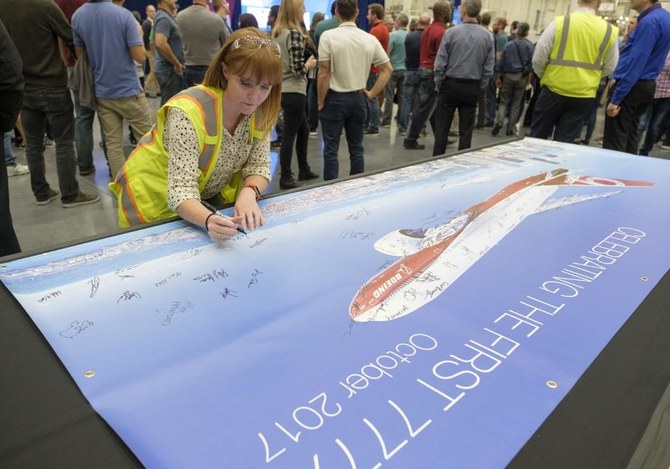
Boeing 777X delays may affect Dubai-based Emirates’ fleet plans: president

- Emirates has 150 of the 350-400-seat model on order, of which eight were originally slated for delivery next year
- Boeing suspended load testing on its new 777X in September, when media reports said a cargo door failed a ground test


Stc partners with Qiddiya as Six Flags official connectivity provider
RIYADH: Saudi stc Group has announced its partnership with Qiddiya as the official connectivity partner for the Six Flags theme park, providing telecom services, smart city solutions, and an integrated digital infrastructure in line with global standards, coinciding with the park’s official opening.
Under the partnership, stc will deliver an advanced digital ecosystem to enhance visitors’ experiences at Qiddiya, offering high-performance connectivity and smart technologies to facilitate entry and manage visitor flow within the park, ensuring a seamless and safe experience.
The collaboration reflects stc’s commitment to providing advanced digital infrastructure that supports Qiddiya’s ambitions and elevates the visitor experience.
By leveraging smart connectivity, smart city technologies, and innovative payment solutions, stc aims to deliver an integrated and streamlined experience across the destination.
The initiative also highlights stc’s role in supporting the tourism and entertainment sectors with world-class digital infrastructure that aligns with Saudi Arabia’s vision and future goals.