

Afghan polls: US diplomat stresses need for transparency

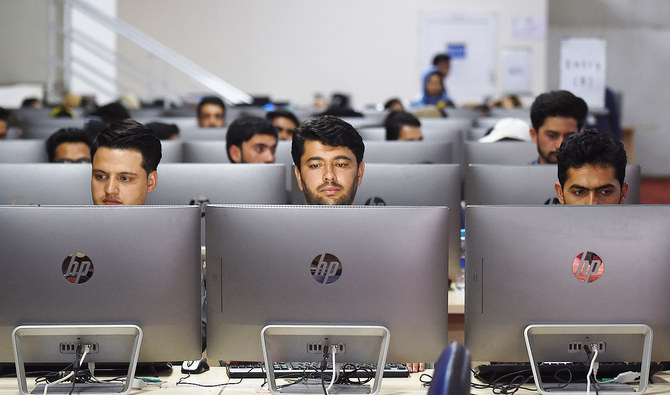
Independent Election Commission (IEC) workers sit at a computer terminal while election information from all over the country is gathered at the Data Centre in Kabul on October 2, 2019. (AFP)
Updated 17 October 2019
Follow

Afghan polls: US diplomat stresses need for transparency

  • Wells visit follows accusations of electoral fraud by leading candidates

KABUL: US Assistant Secretary of State Alice Wells, during talks with Afghan President Ashraf Ghani and Chief Executive Dr. Abdullah Abdullah, stressed the need for a transparent vote amid accusations by nominees that the two incumbent leaders were involved in presidential election fraud.

The vote saw the lowest turnout in any ballot since the ousting of the Taliban whose threats — apart from fatigue among voters, mismanagement, irregularities and violations — deprived hundreds of thousands of people from taking part in the polls on Sept. 28.

The IEC said that it will not be able to release the initial results on Oct. 19 because it had faced technical shortcomings, even as a number of presidential nominees said on Tuesday that Ghani and Abdullah were involved in fraud, adding that they aimed to put pressure on the IEC to announce the results in their favor.

The IEC, the Electoral Complaints Commission (ECC) and officials close to Ghani and Abdullah have denied the charges.

Wells, the US assistant secretary of state for South and Central Asia, arrived in Afghanistan on Monday and has since held separate meetings with Ghani and Abdullah who have shared power since the 2014 election that was marred with fraud. It followed a run-off where they agreed to share power under a US-brokered deal.

“I emphasized to Pre@Ashraf Ghani and CE Abdullah … that Afghan government institutions, leaders and elections must be transparent and accountable to the Afghan people …” she tweeted on Tuesday night.

“The IEC & ECC have a challenging task to review votes & process complaints, concerns, & allegations of fraud from across the country. We will support their decision on timing of release of preliminary results. Better for IEC/ECC to deliver an accurate result than a rushed one …”

The vote had been delayed twice due to division within government leaders and mismanagement as well as the progress made in peace talks between US diplomats and the Taliban.

Officials from Ghani’s administration said that the president had won a second term in office, while Abdullah declared himself as winner, causing uncertainty about the vote and doubt about the future of the country, which has been locked in war after more than four decades of foreign intervention.

The Council of Presidential Candidates (CPC) on Tuesday said that each of these two candidates declared themselves a winner of the election while the nation was still awaiting the election commission’s verdict to announce the results.

The CPC members also said that any attempt to put pressure on the election results — before the invalidation of fake votes — could push the country into a crisis.

“The ruling team is trying to refer the issue of the non-biometric votes to the Supreme Court, and this will be a great act of oppression. This will reduce any trust that the Afghan people have in the legal and judicial institutions,” Rahmatullah Nabil, a presidential candidate, said.

“These candidates (Ghani and Abdullah) messed up with three elections, so there is no one worse than them,” Enayatullah Hafiz, another presidential nominee, said.

“We didn’t get an answer from the international community whenever we consulted them, we asked several times whether you (international community) will guarantee the transparency of the election,” Ahmad Wali Massoud, a presidential election candidate, said.

Council members said that they will also dispatch a letter to the UN Security Council about the fraud by the leaders of the national unity government.

FASTFACTS

• Sept. 28 polls saw the lowest turnout in any ballot since the ousting of the Taliban.

• Of the 9.6 million people who had registered for voting, only 2 million people cast their ballot.

• The election commission says it will not be able to release the initial results on Oct. 19.

“We are completely monitoring the work of the secretariat of the election commission, we will not allow them to commit a violation. Anyone who tries to commit a violation — his place will be in prison,” said Shahab Hakimi, a presidential election candidate.

The council also stated that it was trying to prevent the entry of 1 million fake votes into the election commission’s database.

“Alice Wells visit to Afghanistan conveys two messages: first, election bodies were under immense pressure by parties and she has a clear answer to them,” Wahidullah Ghazikhail, an analyst, told Arab News.

“Second, her remarks are hopeful for Afghans, despite the elections results being postponed. From her talks with the president and CEO, it seems that the election will go to the second round, and the current government will run until spring because of winter. Meanwhile, Taliban-US talks will resume, and sign an agreement afterward. The Taliban will talk with the winner of the election.”


Displaced Sudanese escape RSF siege in southern Kordofan

Fighters of the paramilitary Rapid Support Forces (RSF) drive an armoured vehicle in southern Khartoum, on May 25, 2023. (AFP)
Updated 4 sec ago
Follow

Displaced Sudanese escape RSF siege in southern Kordofan

  • Some women haul water from a single well, pouring it into plastic buckets to cook, wash, and clean with, while others wait in a long line outside a makeshift health clinic, little more than a large canvas tent

GEDAREF, Sudan: When paramilitary Rapid Support Force fighters closed in on the Sudanese border town and oil field of Heglig, paraplegic Dowa Hamed could only cling to her husband’s back as they fled, “like a child,” she said
Now, the 25-year-old mother of five — paralyzed from the waist down — lies shell-shocked on a cot in the Abu Al-Naga displacement camp, a dusty transit center just outside the eastern city of Gedaref, nearly 800 km from home.
But her family’s actual journey was much longer, crossing the South Sudan border twice and passing from one group of fighters to another, as they ran for their lives with their children in tow alongside hundreds of others.
“We fled with nothing,” Hamed said. “Only the clothes on our backs.”
Hamed and her family are among tens of thousands of people recently uprooted by fighting in southern Kordofan — the latest front in the war between Sudan’s army and the Rapid Support Forces that erupted in April 2023.
Since capturing the army’s last stronghold in Darfur in October, the RSF and their allies have pushed deeper into neighboring Kordofan, an oil-rich agricultural region divided into three states: West, North, and South.
In recent weeks, the paramilitary group has consolidated control over West Kordofan, seized Heglig — home to Sudan’s largest oil field — and tightened its siege on Kadugli and Dilling in South Kordofan, where hundreds of thousands now face mass starvation.
On the night of Dec. 7, the inhabitants of Heglig — many of them the families of oil technicians, engineers, and soldiers stationed at the field — got word that an attack would happen at dawn.
“We ran on foot, barefoot, without proper clothes,” said Hiyam Al-Hajj, 29, a mother of 10 who says she had to leave her mother and six siblings behind as she ran around 30 km to the border.
“The RSF chased us to the border. The South Sudan army told them we were in their country and they would not hand us over,” she said.
They were sheltered in South Sudan’s Unity State, but barely fed.
“Those who had money could feed their children,” Al-Hajj said. “Those who did not went hungry.”
They spent nearly four weeks on the move, trekking long distances on foot and spending nights out in the open, sleeping on the bare ground.
“We were hungry,” she said. “But we did not feel the hunger; all we cared about was our safety.”
Eventually, authorities in South Sudan put them in large trucks that carried them back across the border to army-controlled territory, where they could head east, away from the front lines.
Hamed, who was paralyzed during childbirth, said that “during the truck rides, my body ached with every movement.”
But not everyone made it to Gedaref.
Between the canvas tents of the Abu Al-Naga camp, 14-year-old Sarah is struggling to care for her little brother alone.
In South Sudan, their parents had put them on one of the trucks, “then they said the truck was full and promised they would get on the next one.”
But weeks on, the siblings have received no word as to where their mother and father might be.
Inside the tents, children and mothers sleep on the ground, huddled together for warmth, while outside, children dart across the cracked soil, dust clinging to their bare feet.
According to camp director Ali Yehia Ahmed, 240 families, or around 1,200 people, are now taking refuge at Abu Al-Naga.
“The camp’s space is very small,” Ahmed said, adding that food was in increasingly short supply.
Food is distributed from a single point, forcing families to wait for limited rations.
Some women haul water from a single well, pouring it into plastic buckets to cook, wash, and clean with, while others wait in a long line outside a makeshift health clinic, little more than a large canvas tent.
Asia Abdelrahman Hussein, the minister of social welfare and development of Gedaref State, said shelter was one of the most urgent needs, especially during the winter months.
“The shelters are not enough. We need support from other organizations to provide safe housing and adequate shelter,” she said.
In one of the tents, Sawsan Othman Moussa, 27, said how she had been forced to flee three times since fighting broke out in Dilling.
Now, though she might be safe, “every tent is cramped, medicine is scarce, and during cold nights, we suffer.”