

Efforts underway for speedy reopening of Afghan consulate — KP government

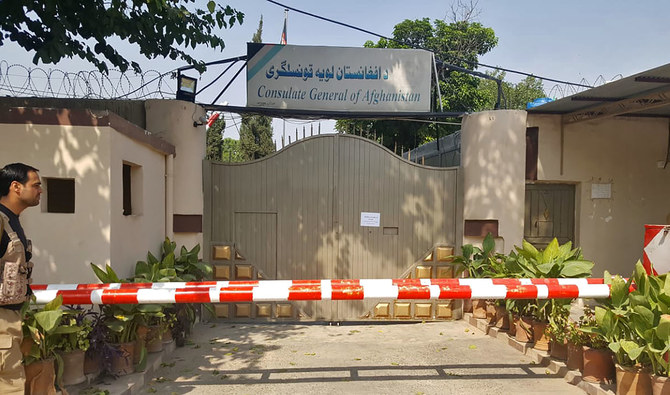
Wide view of the main gate of the Consulate General of Afghanistan in Peshawar, which closed indefinitely to protest the removal of its flag from a disputed property in Peshawar called Afghan Market, Oct 12, 2019. (AN photo)
Updated 12 October 2019
Follow

Efforts underway for speedy reopening of Afghan consulate — KP government

  • Khyber Pakhtunkhwa Information Minister hopeful the issue can be resolved cordially
  • Pakistan’s foreign ministry rejects version of events presented by Afghanistan, hopes decision will be reviewed

PESHAWAR: The provincial government is making efforts to ensure the Afghan consulate in Peshawar is reopened as soon as possible, Khyber Pakhtunkhwa Information Minister Shaukat Yousafzai said on Saturday, a day after Afghanistan closed the facility in the northwestern Pakistani city.
The consulate was closed for an indefinite period on Friday to protest the removal of the Afghan national flag from a disputed property known as Afghan Market that has been in the possession of the Afghan government for several decades.
Yousafzai said the government was making efforts to ensure the speedy reopening of the consulate but did not specify what exact measures were being taken. 
“Evacuating shopkeepers from a disputed property is not that serious in nature ... and will be tackled cordially,” Yousafzai told Arab News, adding that the government was taking steps to ensure the conflict did not escalate. “Small issues should not... give weight to the outburst,” he said.
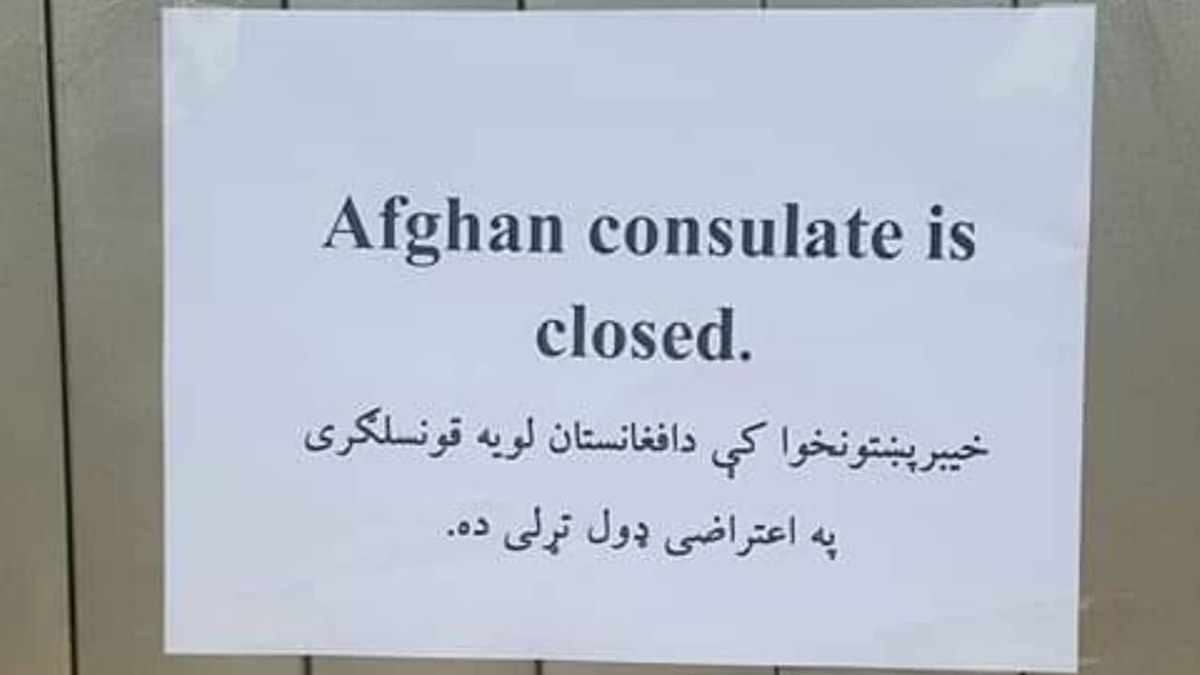


A sign displayed outside the Afghan consulate in Peshawar reads: 'Afghan consulate is closed.' Afghanistan closed its consulate in the northwestern Pakistani city on Friday to protest the removal of its flag from a disputed property called Afghan Market. (AN Photo)

Spread over 2,500 square meters, Afghan Market is situated close to Peshawar’s famous Jinnah Park. It is estimated that Afghanistan’s national bank collects over Rs1 million ($6,380) in rent from shopkeepers working in the market every month.
On October 8, the district administration evicted 180 Afghan shopkeepers from the market and removed the country’s national flag after a contempt of court petition was filed in the Peshawar High Court by Syed Intekhab Haider Abidi, the market’s owner, seeking implementation of a 1998 judgment in his favor. The administration later handed over possession of the shops to Abidi.
In an emergency press conference on Friday, Afghanistan’s Consul General, Muhammad Hashim Niazi, demanded the suspension of the court order and announced that the consulate would be closed in protest indefinitely, adding that the raid was against diplomatic norms.
Meanwhile, a statement from Pakistan’s foreign ministry on Saturday rejected the version of events presented by Afghanistan, and said it was a private legal matter.
“The recent enforcement action by the local administration occurred after legal remedies were exhausted by the Afghan party to this legal dispute. We reject any comments casting aspersions on the judicial process in Pakistan,” the statement said, and added that Pakistan regretted the closure of the consulate.
“We hope that this step would be immediately reviewed and that a private legal case would not be allowed to adversely affect the relations between the two brotherly countries,” it said.
Yousafzai said the provincial government was constitutionally bound to implement the court’s decisions. He said the ruling Pakistan Tehreek-e-Insaf (PTI) had taken steps to strengthen bilateral ties with Afghanistan, and the Afghan government should reciprocate Pakistan’s gestures. 
“We haven’t breached any diplomatic norms as alleged,” Yousafzai said. “Rather, we have implemented the court order evacuating shopkeepers legally.”
“Imran Khan has stepped up diplomacy to mend fraught relations with regional countries including Afghanistan, but we expect Kabul to reciprocate our goodwill gesture,” the information minister added.


Return of millions of Afghans from Pakistan and Iran pushes Afghanistan to the brink, UN warns

Updated 5 sec ago
Follow

Return of millions of Afghans from Pakistan and Iran pushes Afghanistan to the brink, UN warns

  • Afghan authorities provide care packages for those returning that include food aid, cash, a telephone SIM card and transportation
  • But the returns have strained resources in a country struggling with a weak economy, severe drought and two devastating earthquakes

GENEVA: The return of millions of Afghans from neighboring Pakistan and Iran is pushing Afghanistan to the brink, the U.N. refugee agency said on Friday, describing an unprecedented scale of returns.

A total of 5.4 million people have returned to Afghanistan since October 2023, mostly from the two neighboring countries, UNHCR’s Afghanistan representative Arafat Jamal said, speaking to a U.N. briefing in Geneva via video link from Kabul, the Afghan capital.

“This is massive, and the speed and scale of these returns has pushed Afghanistan nearly to the brink,” Jamal said.

Pakistan launched a sweeping crackdown in Oct. 2023 to expel migrants without documents, urging those in the country to leave of their own accord to avoid arrest and forcible deportation and forcibly expelling others. Iran also began a crackdown on migrants at around the same time.

Since then, millions have streamed across the border into Afghanistan, including people who were born in Pakistan decades ago and had built lives and created businesses there.

Last year alone, 2.9 million people returned to Afghanistan, Jamal said, noting it was “the largest number of returns that we have witnessed to any single country.”

Afghanistan’s Taliban rulers have criticized the mass expulsions.

Afghanistan was already struggling with a dire humanitarian situation and a poor human rights record, particularly relating to women and girls, and the massive influx of people amounting to 12% of the population has put the country under severe strain, Jamal said.

Already in just the month and a half since the start of this year, about 150,000 people had returned to Afghanistan, he added.

Afghan authorities provide care packages for those returning that include some food aid, cash, a telephone SIM card and transportation to parts of the country where they might have family. But the returns have strained resources in a country that was already struggling to cope with a weak economy and the effects of a severe drought and two devastating earthquakes.

In November, the U.N. development program said nine out of 10 families in areas of Afghanistan with high rates of return were resorting to what are known as negative coping mechanisms — either skipping meals, falling into debt or selling their belongings to survive.

“We are deeply concerned about the sustainability of these returns,” Jamal said, noting that while 5% of those who return say they will leave Afghanistan again, more than 10% say they know of someone who has already left.

“These decisions, I would underscore, to undertake dangerous journeys, are not driven by a lack of a desire to remain in the country, on the contrary, but the reality that many are unable to rebuild their viable and dignified lives,” he said.
