KARACHI: An accountability court on Friday granted Pakistan’s anti-corruption body a final extension in the remand of former Prime Minister Shahid Khaqan Abbasi, ex-Finance Minister Miftah Ismail and former Pakistan State Oil (PSO) managing director Sheikh Imranul Haq until October 28, local media reported.
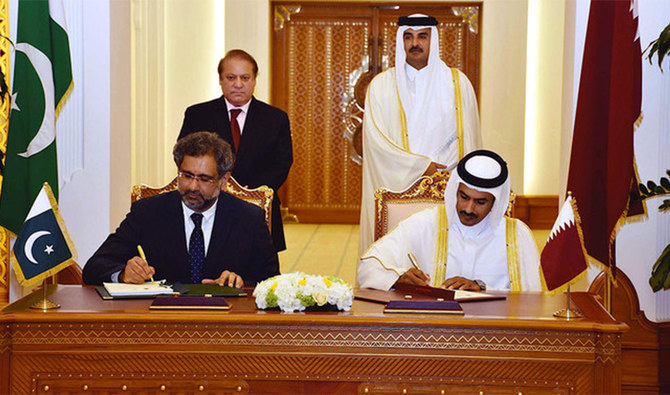
Abbasi was detained in July in a case that was opened last year over a liquefied natural gas (LNG) terminal project signed with Qatar.
The spate of arrests of senior opposition politicians this year have roiled a political scene already thick with accusations of corruption and abuse of office and prompted opposition charges that the government was trying to silence criticism.
Pakistan’s new LNG infrastructure, erected at breakneck speed by the previous administration of Prime Minister Nawaz Sharif, has emerged as a major anti-corruption battlefield.
LNG terminals built in 2016 and 2017 were vital to ending a decade of electricity shortages and turned Pakistan into one the world’s hottest LNG markets, with Qatar and Italy’s Eni signing long-term gas deals worth billions.
But new Prime Minister Imran Khan’s Pakistan Tehreek-i-Insaf (PTI) party has for years alleged corruption. In April, on the instructions of the National Accountability Bureau, the government first barred Abbasi, Ismail, and six bureaucrats involved in the Qatar deal for the first terminal from leaving the country. Abbasi, Ismail and Haq were later arrested in the case. They all deny wrongdoing. No allegations of wrongdoing have been made against the Qatari side.
Political analyst Mazhar Abbas said NAB was legally allowed to remand an accused for 90 days but would now have to produce enough evidence to launch formal charges against Abbasi.
“We cannot discuss the merits and demerits of the case as the case is subjudice but if NAB fails to file a reference, it will prove Abbasi right that this case was part of a victimization drive,” Abbas said.
Nawaz Sharif’s PML-N party was already engaged in a bitter stand-off with Khan’s party, which came to power last year accusing Abbasi and his predecessor, Sharif, of large-scale corruption and mismanagement of the economy.
In 2017 the Supreme Court disqualified Sharif from holding public office over accusations that eventually led to a seven-year jail sentence for receiving undeclared income. Abbasi took over as premier and served for less than a year before losing an election to Khan’s party in 2018.
The PML-N accuses the government of being behind the arrest of Sharif and other opposition leaders. The government has rejected opposition accusations of using the National Accountability Bureau to suppress its critics and opponents.
It says corruption by past governments is the main reason for an economic crisis that has forced Pakistan this year to seek a $6 billion loan package from the International Monetary Fund, its 13th IMF bailout since the 1980s.
Last year, the NAB ordered an inquiry against Abbasi, Sharif and others “for granting a 15-year contract of LNG terminal to a company of their liking in violation of rules and by misuse of their powers, which caused (the) national exchequer a loss of billions of rupees”.


![]()

Anti-graft body gets final remand of ex-PM Abbasi in Qatar LNG case
Anti-graft body gets final remand of ex-PM Abbasi in Qatar LNG case
- Remand of Abbasi, ex-finance minister Ismail and former PSO MD extended until October 28
- Abbasi was detained in July in a case opened last year over an LNG terminal project
Latest updates


Recommended


© 2026 SAUDI RESEARCH & PUBLISHING COMPANY, All Rights Reserved And subject to Terms of Use Agreement.