GM workers struggle with daily expenses as long strike continues

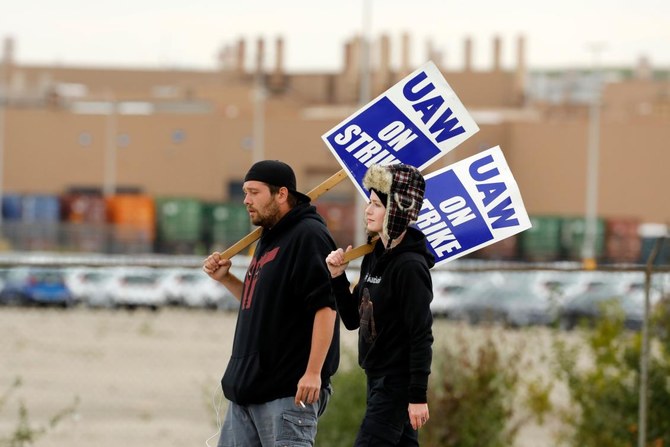
Amy (R) and Matthew Harper (L) walk the picket line outside General Motors (GM) Orion Assembly on October 11, 2019 in Orion Township, Michigan. (File, AFP)
Updated 12 October 2019
Follow

GM workers struggle with daily expenses as long strike continues

  • Nearly 50,000 GM hourly employees have been striking since September 16
  • GM employees who are boycotting receive only $250 a week, a minuscule fraction of their normal salaries

DETROIT, USA: Betty Johnson, who has worked on General Motors assembly lines in Michigan and Tennessee for more than 34 years, said she knew a strike by the United Auto Workers would mean personal sacrifice.

Nearly 50,000 GM hourly employees have been striking since September 16 in a walkout that has halted production at 31 factories and led to thousands of layoffs at auto supply companies.

“It’s not easy,” Johnson said. “I’ve got $45 left from my $250 in strike pay. I’m getting ready to hit up my 401K (retirement account) and borrow from myself,” she said as she picketed outside GM’s Detroit-Hamtramck assembly plant.

GM employees who are boycotting receive only $250 a week, a minuscule fraction of their normal salaries. Johnson has already contacted the United Way, the local community organization that helps families in distress, for assistance in stretching out her utility bills and mortgage payments.

The union has urged members to contact a community information and referral services hotline and passed out cards with the corresponding phone number, Johnson said.

Credit unions supported by organized labor have also stepped forward to help some of the strikers.

“I don’t see how you can feed five children on $250 a week,” said Johnson, noting that many of her coworkers face even greater hardships, especially temporary employees.

The UAW says the typical GM worker at the top of the pay scale makes an average of $65,000 per year and employees with less than eight years seniority make even less.

Meanwhile the seven percent of GM workers classified as temporary employees make $16.50 per hour or about $33,000 per year.

Louis Rocha, president of UAW Local 5960 in a suburb of Detroit, Michigan, who works at an assembly plant where GM builds electric vehicles, said community support has been helpful.

Local 5960 runs a strike kitchen that prepares food around the clock and gives away free meals thanks to donations from local businesses, churches, community groups and ordinary people.

Pizza has been delivered free of charge to the hall every day since the strike began on September 16, he added.

Rocha even recounted the story of a local veterinarian who offered to do surgery on a family’s cat for free so that they didn’t have to euthanize it.
Gerald Lang, Local 5960 vice president, said he doesn’t believe GM ever anticipated the broad community support the UAW has gotten during the walkout.

“There are a lot of workers pinched by corporations. Everyone who packs a lunch box sees it and knows it. They’re expected to do more with less,” said Lang.

Workers have been learning to economize on food, transportation and entertainment. David Michael, a member of Local 5960, said he dropped cable television and switched to processed food.

“I buy gas by the gallon rather than filling it up,” said Michael, who has dipped into savings to cover his bills.
Diana Reed, who has worked for GM for 20 years and is also a member of Local 5960, said she’s begun combing her house for belongings to sell on an online marketplace.

A single mother with five sons, Reed said her three oldest have jobs and are helping with household bills while her youngest two, both at university, took the semester off to save money since she pays their tuition.

“Do I feel bad? Yes. But it’s a concession we had to make,” Reed said. “It’s hard for people to save for something like this,” said Reed, who notes that most workers with children live paycheck to paycheck.

Reed, who has previously made donations to food pantries, now finds the tables turned, accepting donated food. “I had to put down my pride and that was hard. The big thing that made me put that down was thinking about my boys,” she said.


Only 4% women on ballot as Bangladesh prepares for post-Hasina vote

Updated 26 January 2026
Follow

Only 4% women on ballot as Bangladesh prepares for post-Hasina vote

  • Women PMs have ruled Bangladesh for over half of its independent history
  • For 2026 vote, only 20 out of 51 political parties nominated female candidates

DHAKA: As Bangladesh prepares for the first election since the ouster of its long-serving ex-prime minister Sheikh Hasina, only 4 percent of the registered candidates are women, as more than half of the political parties did not field female candidates.

The vote on Feb. 12 will bring in new leadership after an 18-month rule of the caretaker administration that took control following the student-led uprising that ended 15 years in power of Hasina’s Awami League party.

Nearly 128 million Bangladeshis will head to the polls, but while more than 62 million of them are women, the percentage of female candidates in the race is incomparably lower, despite last year’s consensus reached by political parties to have at least 5 percent women on their lists.

According to the Election Commission, among 1,981 candidates only 81 are women, in a country that in its 54 years of independence had for 32 years been led by women prime ministers — Hasina and her late rival Khaleda Zia.

According to Dr. Rasheda Rawnak Khan from the Department of Anthropology at Dhaka University, women’s political participation was neither reflected by the rule of Hasina nor Zia.

“Bangladesh has had women rulers, not women’s rule,” Khan told Arab News. “The structure of party politics in Bangladesh is deeply patriarchal.”

Only 20 out of 51 political parties nominated female candidates for the 2026 vote. Percentage-wise, the Bangladesh Socialist Party was leading with nine women, or 34 percent of its candidates.

The election’s main contender, the Bangladesh Nationalist Party, whose former leader Zia in 1991 became the second woman prime minister of a predominantly Muslim nation — after Pakistan’s Benazir Bhutto — was the party that last year put forward the 5 percent quota for women.

For the upcoming vote, however, it ended up nominating only 10 women, or 3.5 percent of its 288 candidates.

The second-largest party, Jamaat-e-Islami, has not nominated a single woman.

The 4 percent participation is lower than in the previous election in 2024, when it was slightly above 5 percent, but there was no decreasing trend. In 2019, the rate was 5.9 percent, and 4 percent in 2014.

“We have not seen any independent women’s political movement or institutional activities earlier, from where women could now participate in the election independently,” Khan said.

“Real political participation is different and difficult as well in this patriarchal society, where we need to establish internal party democracy, protection from political violence, ensure direct election, and cultural shifts around female leadership.”

While the 2024 student-led uprising featured a prominent presence of women activists, Election Commission data shows that this has not translated into their political participation, with very few women contesting the upcoming polls.

“In the student movement, women were recruited because they were useful, presentable for rallies and protests both on campus and in the field of political legitimacy. Women were kept at the forefront for exhibiting some sort of ‘inclusive’ images to the media and the people,” Khan said.

“To become a candidate in the general election, one needs to have a powerful mentor, money, muscle power, control over party people, activists, and locals. Within the male-dominated networks, it’s very difficult for women to get all these things.”