CAIRO: Egypt, Cyprus, and Greece on Tuesday condemned an “unlawful and unacceptable” bid by Turkey to drill inside waters where Cyprus has exclusive economic rights.
President Abdel-Fattah El-Sisi hosted a meeting Tuesday with Cypriot President Nicos Anastasiades and Greek Prime Minister Kyriakos Mitsotakis in Cairo.
It’s the most recent summit between the three countries’ leaders aimed at forging an energy-based alliance in the east Mediterranean.
“Turkey’s unacceptable practices and drilling ... are a blatant assault on the rights of the Cypriot Republic and the international law,” Anastasiades told a joint news conference.
He said that Cyprus would resort to “all available diplomatic means to halt Turkey’s aggression.”
El-Sisi said unilateral practices by Turkey risk destabilizing the whole eastern Mediterranean and “damage the interests” of its countries.
Turkey dispatched vessels to drill for hydrocarbons inside Cyprus’ exclusive economic zone, claiming it is protecting its own interests and those of Turkish Cypriots.
It is also at odds with Egypt over boundaries in the east Mediterranean.
Cyprus was divided in 1974 when Turkey invaded after a coup by supporters of union with Greece. Only Turkey recognizes a Turkish Cypriot declaration of independence in the island’s northern third.
The Greek Cypriot-led government has said its offshore drilling operations are an exercise of a sovereign right and that any future gas proceeds would be shared equitably if a deal to reunify the island is reached with the breakaway Turkish Cypriots.
The three leaders also condemned Turkey’s planned military offensive into northeastern Syria, after President Donald Trump said earlier this week the US would step aside for an expected Turkish attack on Syrian Kurdish fighters, who have fought alongside Americans for years.
They vowed to step up efforts to tackle illegal migration across the eastern Mediterranean and hone their anti-terrorism tactics.
The Greek leader said that Egypt is a strategic partner for the European Union and that Cyprus and Greece would work to strengthen EU-Egypt relations.
In a previous meeting, the three countries agreed to broaden “strategic cooperation” on energy, including how to transport newly found gas in the region to Europe and linking the electricity grids of Europe and North Africa via an undersea cable.
The 2,000 megawatt cable, known as the EuroAfrica Interconnector, will stretch nearly 1,000 miles from Greece to Egypt through Cyprus.

Egypt, Cyprus, Greece condemns gas exploration by Turkey
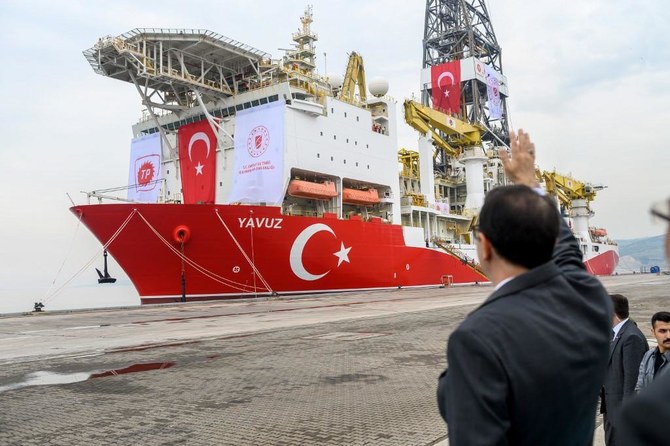
- El-Sisi hosted a meeting with his Cypriot counterpart and Greece's PM in Cairo
- The EuroAfrica Interconnector will stretch nearly 1,000 miles from Greece to Egypt through Cyprus
Great expectations: Yemenis look forward to outcomes of Riyadh dialogue
- Southern factions look to Saudi-hosted talks to defuse tensions after December’s violent escalation
- Analysts say Riyadh dialogue could help reset the southern cause — but only if militias are excluded
RIYADH: Last December marked a troubled end to the year in Yemen, particularly in its southern and eastern governorates. While much of the world marked the season with hopes for peace and stability, developments on the ground took a sharply different turn.
The Southern Transitional Council (STC), led by Aidarous Al-Zubaidi, moved to seize control of state institutions and military camps, defying expectations in Hadramout and Al-Mahra and mounting a direct challenge to the internationally recognized government.
These actions, carried out through armed force and supported by external actors, led to casualties and an escalation of tensions in both governorates.
In response, Yemen’s political leadership appealed to the Saudi-led coalition to contain the situation, called for the withdrawal of Emirati forces, and initiated operations to reassert control over military headquarters in Hadramout and Al-Mahra.
Subsequently, Rashad Mohammed Al-Alimi, chairman of the Presidential Leadership Council, asked Saudi Arabia to host a conference in Riyadh, bringing together all southern factions to discuss solutions — a request accepted by the Saudi leadership.
The initiative comes amid the Kingdom’s affirmation of the legitimacy of the southern cause, coupled with its clear rejection of any solution imposed by force.
Arab News surveyed the views of several Yemeni politicians and analysts on their expectations for the conference, convened at a critical and highly sensitive juncture, and on the key issues anticipated to dominate the dialogue.
Among them was Salah Batis, a member of the Yemeni Shura Council, a member of the Preparatory Committee for the Unified Council of the Eastern Governorates, and a prominent figure in Hadramout.
“We extend our sincere gratitude to our brothers in the Kingdom of Saudi Arabia — both leadership and people — for their steadfast support, assistance, and courageous stand alongside the people of Hadramout and the eastern governorates in particular, and Yemen as a whole,” Batis told Arab News.
“Without this support, and without the role of the Saudi Air Force, this victory would not have been achieved, security would not have been restored, and this militia would not have been removed from these sensitive areas, especially Hadramout and the eastern governorates.
“We also express our appreciation to the political leadership, represented by the chairman of the Presidential Leadership Council, Dr. Rashad Al-Alimi, and to the governor of Hadramout and commander of the Homeland Shield Forces, Salem Al-Khanbashi.
“Our gratitude further extends to the heroes of the Homeland Shield Forces, the armed forces, and the security forces who participated in the operation to take control of the camps. It was a swift and decisive operation, carried out at minimal cost, praise be to God.”
However, Batis said he opposes the inclusion of the STC in the upcoming Riyadh conference, citing its involvement in the killing and terrorizing of civilians in Hadramout and Al-Mahra.
He described the call for dialogue as “a positive step toward preserving the southern cause, which the STC had sought to hijack and undermine, nearly causing severe damage had it not been for swift and decisive intervention.”
Batis said the southern cause must represent all southerners without exception, and that no single party should monopolize it or claim exclusive representation. He said the STC had already harmed the cause by using armed violence to advance its agenda, resulting in killings.
For this reason, he said, the people of Hadramout — where many of these violations occurred — have demanded, and continue to demand, accountability for those responsible and their exclusion from the dialogue.
He accused the STC of mobilizing armed forces, invading governorates, killing tribesmen, attacking villages and civilians, storming and looting state camps, and destroying public institutions, including airports, ports, oil facilities, and government offices in Seiyun, Mukalla, and other locations.
Batis said the STC and its leadership bear full responsibility, arguing they had led and directed the armed groups toward Hadramout under the banner of southern forces.
He questioned how the people of Hadramout and the eastern governorates could accept belonging to such a region after what had occurred, noting that these forces operated under a declared leadership and a self-proclaimed supreme commander.
Batis said local communities viewed them as invading forces that killed civilians, shed blood, attacked state institutions, and seized military camps.
He added that, were it not for the decisive intervention of allied forces and local authorities — leading to the return of the camps, the repair of the damage, and the withdrawal of these militias to their original positions — the consequences would have been far more severe.
“I believe this dialogue and conference must have a clear and firm framework: no group that possesses weapons, militias, or armed forces should take part,” Batis said.
“Arms must be exclusively in the hands of the state, under the authority of the ministries of defense and interior, and sovereignty must rest solely with the state — not with parties, factions, or individuals.”
Batis warned against repeating what he described as the mistake of 2013, when the Houthi group was allowed to participate in the National Dialogue Conference while still armed and expanding its territorial control.
He recalled that by January 2014 the Houthis had seized Amran Governorate and laid siege to Sanaa, halting the drafting of the federal constitution and forcing meetings to be held at the Presidential Palace.
Batis noted that he was serving at the time as vice president of the National Authority tasked with monitoring the implementation of the dialogue’s outcomes, before the Houthis later stormed the capital and plunged the country into a crisis that continues to this day.
For his part, political analyst and activist Youssef Ismail Abdo said that any fair and equitable outcomes from the conference would help stabilize the south — particularly Hadramawt and the eastern governorates — fostering security, development, and stability, with positive implications for all of Yemen and the wider region.
Also speaking to Arab News, Dr. Nasser bin Habtour, secretary-general of the Shabwa National Council, said that “the south is home to multiple political projects, including secession and a federal state.
“The events of December demonstrated that not all southerners support secession, leaving the STC isolated in its unilateral move. In my opinion, all political options should be placed on the dialogue table so that southerners can discuss them and reach a unified vision.”
He argued that “secession is neither feasible nor appropriate at the present stage, given Yemen’s dire circumstances, with the Houthi militia controlling Sanaa and state institutions and posing a serious threat to Yemen and the wider region.”
He stressed that “restoring the Yemeni state must come first, after which all political projects can be presented to the people, who should then decide the future form of the state.”
He added: “The meeting, to be held in Riyadh, came at the request of southern political and social figures and groups who convened after recognizing both their responsibility and the danger into which the STC had placed the southern cause.
“They contacted the chairman of the Presidential Leadership Council, urging him to ask the Kingdom to host a southern dialogue conference.” He noted that “this initiative was consistent with Saudi Arabia’s longstanding role in supporting Yemen.”
“The conference must focus on repairing the damage inflicted on the southern cause by the STC’s unilateral decisions and attempts to monopolize it, as well as restoring the issue to its proper course through a consensual vision shared by the people of the south.”
Regarding the expected outcomes of the comprehensive southern national dialogue, Habtour said: “The first priority is reaching consensus on a unified southern vision that reflects the aspirations of the people of the south.”
He added: “The southern issue must be situated within the broader national struggle to restore the state from the Houthi militia, as well as integrated into the negotiation process aimed at restoring security and stability in Yemen.”
He further stressed “the importance of defining the role of southerners in the upcoming phase, particularly within the framework of a future federal state and their contribution to nation-building and development.”


