KARACHI: Mufti Muhammad Taqi Usmani, a former supreme court judge and one of the leading Islamic scholars in Pakistan, received King Abdullah (II) International Award for topping the list of 500 most persuasive Muslims in the world in the capital city of Amman, Jordan, on Monday.
The list of most influential Muslims was prepared by the Royal Islamic Strategic Studies Center, an autonomous research entity with the Royal Aal Al-Bayt Institute for Islamic Thought, Amman, Jordan.
“I am thankful to Allah for being considered for this most prestigious award,” Usmani told Arab News on phone from Amman where he received the award along with $50,000 in cash, which he said he would gift to his seminary, Darul Uloom Karachi.
Usmani, who is a leading scholar of Hadith, Islamic jurisprudence and Islamic finance, stressed that Muslims must “excel in the fields of economy and technology, besides protecting their heritage of knowledge and Deen (religion) if they are to break the chains of slavery.”
“In Today’s world, wars are fought in the fields of economy and technology. Those who spread their hands [before others] cannot expand their legs [to walk freely],” he said.
Usmani served as a Judge of the Sharia at Appellate Bench of the Supreme Court of Pakistan from 1982 to May 2002. He is also the Chairman of the Sharia Board for the Accounting and Auditing Organization for Islamic Financial Institutions (AAOIFI) and formerly served as Deputy Chairman of the Islamic Fiqh Academy, Jeddah.
His current portfolio also includes chairmanship of the Sharia Supervisory Boards of Guidance Financial Group, USA, Saudi American Bank, Jeddah, and Citi Islamic Investment Bank, Bahrain; vice chairmanship of Shari’ah Supervisory Board of Abu Dhabi Islamic Bank; membership of the Shari’ah Supervisory Boards of Al-Baraka Group, Jeddah, First Islamic Investment Bank, Bahrain, and the Islamic Unit of the United Bank of Kuwait, among others.
Justice Usmani holds Alimiyyah and Takhassus degrees from Darul Uloom, Karachi, a Master's degree from Punjab University and an LLB from Karachi University.


![]()

Pakistan’s Mufti Taqi Usmani declared most persuasive Muslim by Jordan
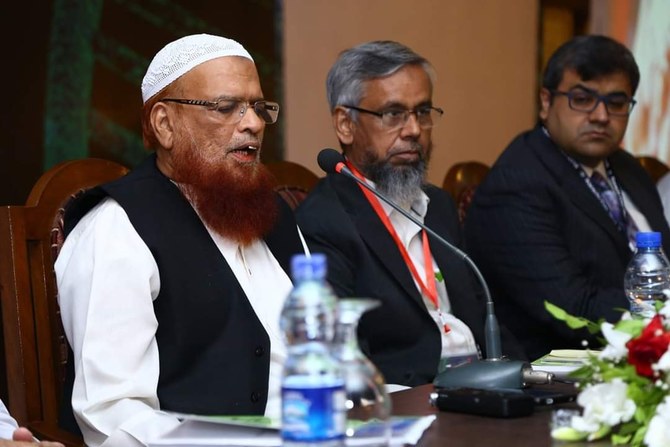
Pakistan’s Mufti Taqi Usmani declared most persuasive Muslim by Jordan
- Usmani tops the list of 500 most persuasive Muslims in the world, according to the Royal Islamic Strategic Studies Center
- He is a leading scholar of Hadith, Islamic jurisprudence and Islamic finance
Latest updates





© 2026 SAUDI RESEARCH & PUBLISHING COMPANY, All Rights Reserved And subject to Terms of Use Agreement.