

Sudan’s PM vows to take steps to boost Saudi investment

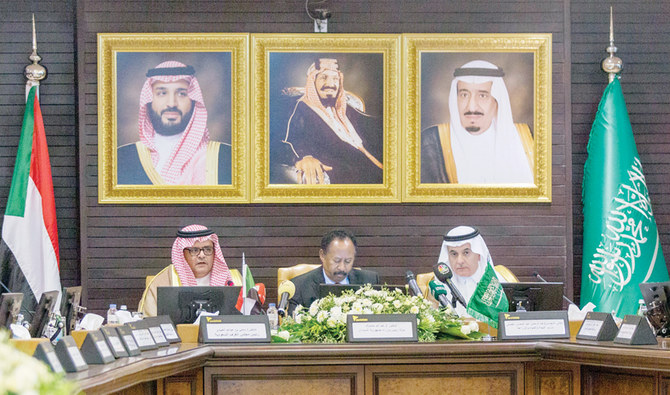
Sudanese PM Abdalla Hamdok met with Saudi businessmen at the Council of Saudi Chambers in Riyadh. (Photo/Supplied)
Updated 08 October 2019
Follow

Sudan’s PM vows to take steps to boost Saudi investment

  • Single-window system to be introduced for investors

RIYADH: Sudanese Prime Minister Abdalla Hamdok met with Saudi business owners on Monday at the headquarters of the Council of Saudi Chambers (CSC).
The meeting was attended by Saudi Minister of Environment, Water and Agriculture Abdulrahman Al-Fadhli, Saudi Minister of State for African Affairs Ahmed Qattan, Sudanese Minister of Finance Ibrahim Al-Badawi, Sudanese Minister of Industry and Trade Madani Abbas, CSC Chairman Sami Al-Obaidi, Saudi Ambassador to Sudan Ali Jafar, Sudanese Ambassador to Saudi Arabia Abdul Azim Al-Karouri and executives of major Saudi companies.
Hamdok praised the strategic relations between Saudi Arabia and Sudan. He thanked King Salman and the government for their keenness to ensure that Saudi-Sudanese relations are at the best level and that trade increases.
“We look forward to cooperating with Saudi Arabia in the fields of agriculture, industry, services, infrastructure and energy.”
The prime minister stressed that Saudi investors are ambassadors, and the success of their businesses will reflect a bright image and increase the confidence of international investors in Sudan.
Hamdok announced that a Saudi-Sudanese economic forum will be held to discuss promising investment opportunities and increase cooperation between the two countries.
Al-Fadhli said that the Kingdom and Sudan have capabilities and resources that can provide promising investment opportunities in many economic sectors.
“We are counting on the role of the private sector to maximize the gains and provide solutions to the obstacles that prevent the depletion of goods, services and investments between the two countries so that government agencies can overcome them,” he said.

FASTFACT

• The volume of reciprocal trade stood at about SR4.6 billion ($1.2 billion) in 2018.

• Sudan was Saudi Arabia’s seventh most important Arab trading partner in 2018.

• Saudi investments in Sudan have grown considerably over the past years.

The chairman of the CSC stressed that relations have developed in the fields of trade and investment, pointing out that the volume of reciprocal trade stood at about SR4.6 billion ($1.2 billion) in 2018, making Sudan the Kingdom’s seventh most important Arab trading partner.
Al-Obaidi said: “Saudi investments in Sudan have grown considerably over the past years, with the service sector accounting for the highest proportion of these investments at 49.5 percent, followed by the agricultural sector at 32.5 percent and the industry sector accounting for 28 percent.”
Al-Badawi said the single-window system for investors and the unified federal tax system will be implemented soon to avoid conflicts between Sudan and other nations.
Al-Badawi added that the build-operate-transfer system is the appropriate investment system for Sudan in the field of infrastructure projects.
Abbas said that Saudi investors have greater experience and their proposed solutions to investment obstacles in Sudan are in line with the country’s Emergency Economic Recovery Plan.


Threat to Kingdom’s security is ‘red line’ that will be ‘addressed and neutralized,’ Saudi envoy says

Updated 14 January 2026
Follow

Threat to Kingdom’s security is ‘red line’ that will be ‘addressed and neutralized,’ Saudi envoy says

  • Abdulaziz Alwasil tells UN Security Council the situation in southern Yemen is ‘a just cause with social and historic dimensions’ that can only be resolved through dialogue
  • Recent military activity in the south was unilateral, resulting in an escalation that harms the interests of Yemeni people and undermines efforts to address issues in the south, he said

NEW YORK CITY: Any attempt to threaten Saudi Arabia’s national security is a “red line” and will be met with decisive action, the Kingdom’s ambassador to the UN told the Security Council on Wednesday.

Speaking during a meeting of the council to discuss Yemen, Abdulaziz Alwasil said the situation in the south of the country is “a just cause with social and historic dimensions” that can only be resolved through dialogue.

“We stress that any attempt to threaten our national security is a red line, and we will not hesitate to take the necessary actions and steps to address it and neutralize it,” he added.

Alwasil reaffirmed Saudi Arabia’s support for Yemeni President Rashad Al-Alimi, the Presidential Leadership Council, and the Yemeni government in their efforts to achieve security, stability, development and peace while preserving national unity.

He said military activity by Southern Transitional Council forces in Hadramout and Al-Mahra on Dec. 2, 2025, was unilateral, did not have the approval of the Presidential Leadership Council, and was not carried out in coordination with the Coalition to Restore Legitimacy in Yemen.

It had resulted in an unjustified escalation that harmed the interests of the Yemeni people, undermined efforts to address the issues in the south, and ran counter to the coalition’s objectives, Alwasil added.

The Kingdom, working with its coalition partners, the Presidential Leadership Council and the Yemeni government, had moved to contain the situation by dispatching a military force to coordinate arrangements with the Southern Transitional Council in Aden, he said.

The aim was to ensure the return of the southern council’s forces to their previous positions outside of Hadramout and Al-Mahra, and the handover of camps to legitimate government forces and local authorities in line with agreed procedures, Alwasil added.

He expressed regret over the military operations that took place in Hadramout and Al-Mahra, close to Saudi Arabia’s southern border, which he said posed a direct threat to the Kingdom’s national security, as well as the security of Yemen and regional stability. Such steps were extremely dangerous, he added, and contradicted the principles on which the Coalition to Restore Legitimacy in Yemen had been founded.

Alwasil welcomed a prisoner and detainee exchange agreement signed in Muscat on Dec. 23, which he described as an important humanitarian measure to alleviate suffering and build confidence.

He praised Oman for hosting and sponsoring the consultations and supporting negotiations, and commended the efforts of UN’s special envoy for Yemen, Hans Grundberg, the International Committee of the Red Cross and all others that has played a part.

Regarding the political efforts to resolve the crisis, Alwasil said Saudi Arabia welcomed President Al-Alimi’s call for an inclusive conference in Riyadh to bring together all stakeholders to discuss just solutions to the situation in southern Yemen.

Preparations for the conference have begun, he added, in cooperation with the Yemeni government and southern representatives, reflecting the close ties between the two countries and their shared interests in stabilizing Yemen.

He urged all southern stakeholders to participate actively and constructively in the talks, to help find comprehensive and just solutions that meet the legitimate aspirations of the people of southern Yemen.

Alwasil called on all Yemeni forces and stakeholders to cooperate and intensify their efforts to reach a lasting political settlement that would ensure security and stability.

He described the southern issue as “a just cause with social and historic dimensions,” adding that “the only way to address it is through dialogue that leads to a comprehensive political solution” based on nationally and internationally agreed terms of reference.