

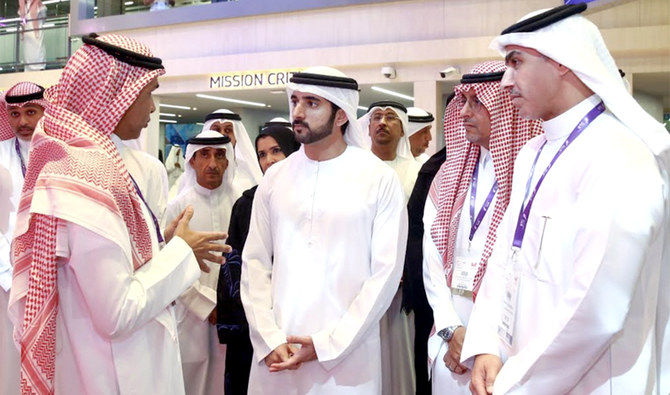
STC digitization plans on show at GITEX

Sheikh Hamdan bin Mohammed bin Rashid Al-Maktoum, crown prince of Dubai, toured the STC booth at GITEX 2019 in Dubai.
Updated 07 October 2019
Follow

STC digitization plans on show at GITEX

The 39th GITEX Technology Week, the largest regional IT exhibition and conference, kicked off on Sunday at the Dubai World Trade Centre showcasing the latest trends and product innovations from across the world.

The event, which runs until Thursday, was officially opened by Sheikh Hamdan bin Mohammed bin Rashid Al-Maktoum, crown prince of Dubai and chairman of Dubai Executive Council.

Saudi Telecom Company (STC), which is participating in the exhibition, welcomed Sheikh Hamdan to its booth, in the presence of STC Chairman Mohammed bin Khaled Abdullah Al-Faisal and STC Group CEO Nasser Al-Nasser. 

Sheikh Hamdan was briefed on the company’s latest ICT sector services and solutions, in line with its role as an enabler of digital services and transformation in the Kingdom.

Riyadh Muawad, senior vice president of B2B at STC, said the company chose the theme “Tomorrow’s Solutions Today” for this year to showcase its services and innovative solutions in the digitization of government and private sectors, cloud computing, big data analysis and cybersecurity solutions, in addition to its journey toward customer experience enrichment. The telecom giant is also showcasing solutions related to 5G, the last of which were rolled out during the Hajj this year.

Muawad pointed out that these services reflect the valuable role of the STC Group in enabling digital solutions and the digital transformation of the Kingdom in line with Vision 2030. 

STC will also be outlining future digitization plans, the role of data centers in improving service efficiency, and the analysis of big data and its importance, helping it deliver tomorrow’s solutions today.

It will also be shedding light on its major cloud, IoT, digital, and IT services, and updates to its telecom infrastructure, making it one of the most powerful networks delivering digital services.

During the exhibition, STC will be highlighting the Kingdom’s progress in digital transformation as one of the Saudi Vision 2030 programs, where STC is considered to be a key enabler of the Kingdom’s transformation in the public and private sectors.

Through its strategy, STC works primarily on the growth of services, platforms and digital infrastructure, taking into account the greater value of its existing assets — its employees, brand, customer base, technological assets, and business partners — to ensure that available resources are sufficient to invest in future opportunities.

This year’s GITEX edition features 4,500 companies representing 100 countries. The event offers global suppliers a unique opportunity to enter fast-growing markets.


More crop per drop: NADEC and EF Polymer deploy breakthrough technology to cut agricultural water use by 40%

Updated 14 January 2026
Follow

More crop per drop: NADEC and EF Polymer deploy breakthrough technology to cut agricultural water use by 40%

Following a strategic technology-scouting framework led by Universal Materials Incubator, the National Agricultural Development Company has entered into a partnership to launch large-scale field trials of EF Polymer, marking a significant step in deploying deep-technology solutions to strengthen the Kingdom’s food and water security.

The collaboration initiates field trials of EF Polymer’s proprietary solution — a 100 percent organic, biodegradable powder that performs like a “soil battery” upcycled from food waste. Engineered to address water scarcity in arid and semi-arid regions, the material can absorb up to 50 times its own weight in water and gradually release moisture directly to plant roots. This mechanism has the potential to reduce irrigation water use by up to 40 percent, while enhancing crop yield and long-term agricultural productivity.

Beyond water efficiency, EF Polymer improves nutrient retention by minimizing fertilizer leaching, thereby reducing overall fertilizer requirements. After approximately one year in the soil, the material fully biodegrades into organic carbon, organic matter, and trace nutrients such as magnesium, calcium, and nitrogen — contributing directly to improved soil health and long-term fertility.

The solution is affordable, easy to apply, and suitable for a wide range of crops, making it viable both for individual farmers and for industrial-scale agricultural operations such as NADEC’s. 

EF Polymer has already achieved significant commercial adoption across multiple global markets, including Japan, the US, India and Turkiye, where it is actively used by farmers and agribusiness operators to improve water efficiency, soil health, and crop resilience under varying climatic conditions.

Its organic credentials are certified by OMRI and Ecocert, reinforcing its alignment with sustainable and regenerative agricultural practices.

The stakes for this alliance are high. By 2030, global freshwater demand is projected to exceed supply by 40 percent. In Saudi Arabia, the challenge is localized but intense: the agricultural sector alone consumes approximately 11.4 billion cubic meters of water annually. This partnership underscores NADEC’s commitment to adopting innovative, scalable technologies that conserve natural resources while supporting resilient food systems across the Kingdom.

Mohamed Al-Rajhi, VP of supply chain sector at NADEC, said: “Strategic agriculture today requires a long-term commitment to soil health and resource circularity. NADEC is leading the shift toward regenerative practices that restore our natural capital rather than merely consuming it. By diversifying our crop portfolio and investing in closed-loop nutrient management, we are insulating our operations against global price volatility and environmental shifts.”

“We are aggressively deploying AI-driven irrigation systems and satellite-based crop monitoring to optimize every drop of water and every hectare of land. This strategic pivot toward agri-digitization allows us to mitigate climate risks in real-time while significantly reducing our carbon footprint. Our commitment to sustainability is our greatest competitive advantage, ensuring that NADEC remains the cornerstone of the Middle East’s agri-food sector for decades to come. These trials focus on strategic scalable crops like wheat and olive trees to ensure the future of the Kingdom’s food security is both sustainable and locally rooted,” he added.

Strategic trial milestones:

  • Wheat: Trials have commenced to demonstrate water retention in this water-intensive crop.
  • Olive and blueberry: Specialized testing is scheduled for March to evaluate yield improvements and nutrient efficiency.

This collaboration supports Saudi Vision 2030 goals of reducing non-renewable groundwater use by 90 percent.