

In Morocco, heroin addiction sweeps cannabis corridor

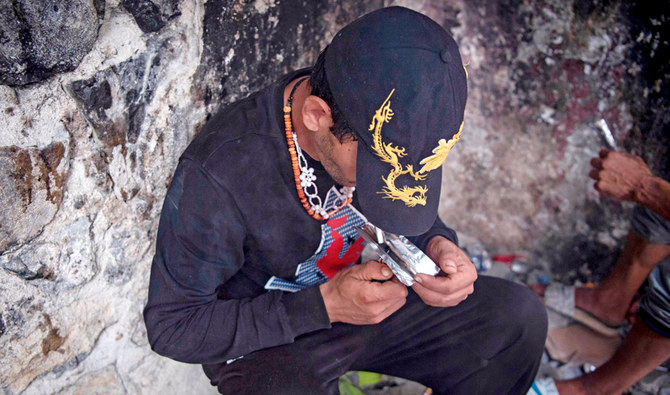
A Moroccan addict smokes heroin in a squat behind a police station in the Moroccan city of Mediek near Tetouan. (AFP)
Updated 06 October 2019
Follow

In Morocco, heroin addiction sweeps cannabis corridor

  • The spread of heroin is facilitated by the “great population mobility” between southern Europe and northern Morocco

TETOUAN, MOROCCO: In a filthy squat in a beach town in northern Morocco, drug users inject and smoke heroin, a relatively recent scourge plaguing a region long known for cannabis and contraband.

Rachid says he does nothing with his life, except heroin.

“I shoot up four or five times a day,” the 34-year-old said, breathing raggedly.

He shows his arms, scarred from a decade of injecting, before taking a sniff of glue to “prolong the high.”

Half-a-dozen others are shooting up or smoking heroin alongside Rachid in the squat, located behind a police station in Mediek, a Mediterranean resort near the city of Tetouan.

A dose of the powerful opiate they heat on aluminim foil sells for between €2.8 and €6.5 ($3-7) for a tenth of a gram.

Every week, a team from the Association for the Fight Against AIDS (ALCS) comes to the squat to hand out syringes to prevent the spread of diseases like HIV and hepatitis.

The sale and consumption of heroin is illegal in Morocco, but thanks to the efforts of ALCS in Tetouan, “it is very rare that users are arrested for their own personal consumption,” said Dr. Mohamed El-Khammas.

He runs the harm reduction program launched by ALCS in 2009, which combines awareness raising, distribution of materials like clean needles and screening.

“The idea is not to moralize, but to help the user to reduce negative effects,” Al-Khammas said.

In this region, known worldwide for its hashish produced in the Rif mountains, heroin use is a relatively recent development that is growing exponentially, experts say.

“It’s a public health priority, especially as the heroin being sold is very bad quality: It is mixed with talcum powder, paracetamol and glue,” Al-Khammas said.

The typical user is a “single man, aged 30-35 with little or no education who has never worked or works on an occasional basis,” according to a 2014 report from the National Observatory on Drugs and Addiction (ONDA).

The northern urban centers of Tetouan, Tangier and Nador are Morocco’s worst affected areas.

The spread of heroin is facilitated by the “great population mobility” between southern Europe and northern Morocco, and the increased use of “well-established cannabis routes” by traffickers from Latin America to smuggle cocaine and heroin to Europe, ONDA said.

Those drug barons also barter heroin for cannabis in the Rif, according to ALCS staff.

The number of heroin users in Morocco is unknown.

According to ALCS, there are likely several thousand heroin users in Tetouan alone, a city of 380,000 people, which was once the seat of the Spanish administration under the dictator Francisco Franco.

Hassna, a 46-year-old ALCS caseworker, distributes clean drug paraphernalia from her backpack to users gathered in the Mediek squat.

“We urge them not to share syringes, we accompany them to health centers and we try to convince them to take care of themselves,” she said.

Rachid said he is “incapable of quitting.”

But he does want access to methadone: “That’s all we ask,” he said.

This opioid substitute is distributed by addiction treatment centers in Tetouan, but in “insufficient amounts,” Rachid said.

“Withdrawal is terrible, you have cramps, anxiety,” said his companion Mohamed, a waxen-faced 24-year-old with a syringe buried in his tattooed arm.

Every evening, an ALCS medical vehicle is parked in a different location, with a doctor, nurse and field workers on hand.

Once a week, the team parks near a cemetery overlooking Tetouan, a common spot for users. One of them, a 56-year-old named Said, said he “lost everything” because of heroin.

“I am at rock bottom,” he said.

“The hardest part is on the social level,” 37-year-old Abdelilah said.

“I lost 30 kilos because of this crap. When an old friend sees me in the street, he looks away.”


Turkish, Greek leaders voice desire to resolve issues

Updated 3 sec ago
Follow

Turkish, Greek leaders voice desire to resolve issues

  • Greek Prime Minister Kyriakos ​Mitsotakis, ‌Turkish ⁠President ​Tayyip Erdogan say ⁠they discussed their issues 'in an open and sincere way'
  • The NATO allies but historic rivals try to build on warming relations
ANKARA: The leaders of Turkiye and Greece voiced their ​desire to resolve longstanding maritime disputes hobbling ties during discussions in Ankara on Wednesday, as the NATO allies and historic rivals try to build on warming relations.
The neighbors have been at odds over a range of issues for decades, primarily maritime boundaries and rights in the Aegean, an area widely believed to hold energy resources and with key implications for airspace and military activity.
Following years of heightened tensions, a 2023 declaration on friendly relations prompted a thaw in rhetoric, though their maritime issues have remained unresolved and the two sides still disagree over ‌regional matters.
Speaking at ‌a press conference in Ankara with Greek Prime Minister Kyriakos ​Mitsotakis, ‌Turkish ⁠President ​Tayyip Erdogan said ⁠they had discussed their issues in the Aegean and eastern Mediterranean “in an open and sincere way” during the talks.
“While the issues may be thorny, they are not unsolvable on the basis of international law. I saw that we were in agreement with my friend Kyriakos,” Erdogan said.
He added that the two countries would continue working to achieve their goal of reaching $10 billion in bilateral trade.
Mitsotakis said he hoped circumstances would allow the sides to solve a dispute on ⁠the demarcation of maritime and exclusive economic zones in the Aegean ‌and eastern Mediterranean.

If not now when?

“It is time to ‌remove any substantial and formal threats to our relations, if ​not now, when?” Mitsotakis said.
“Destiny has ‌appointed us to live in the same neighborhood. We cannot change geography, but we can ‌make it an ally, choosing convergence, dialogue and trust in international law... to build a future of peace, progress and prosperity for our people.”
Despite the positive tone, Greece’s foreign minister earlier said Athens planned to extend its territorial waters further, including potentially in the Aegean.
Shortly after, Ankara said it had issued ‌a maritime notice urging Greece to coordinate research activities in areas of the Aegean that Turkiye considers part of its continental shelf.
In ⁠1995, Turkiye’s parliament ⁠declared a casus belli — a cause for war — should Greece unilaterally extend its territorial waters beyond six nautical miles in the Aegean, a stance Athens says violates international maritime law. Greece says it wants only to discuss demarcation of maritime zones.

Migrant flows

Mitsotakis also said the flows of migrants in the Aegean Sea had decreased by almost 60 percent last year due to cooperation between the two countries, adding this should be strengthened.
Fifteen migrants died in a shipwreck off the Greek island of Chios last week after their boat collided with a Greek coast guard vessel and sank in the Aegean Sea off the Turkish coast.
Turkiye is a transit country for migrants seeking to reach the European Union via Greece. Ankara says the EU has not ​fully delivered on commitments under a 2016 migration ​deal and Athens wants Turkiye to do more to curb irregular crossings.