PARIS: France's anti-terrorism prosecutor said its investigation had detected signs of "latent radicalization" in the attacker who knifed four co-workers to death at the police headquarters in Paris this week.
The assailant, an IT worker at the headquarters, went on a rampage on Thursday, killing three police officers and an administrative worker, and wounding at least one other, before being shot dead by police.
Officials have not said there was a terrorism motive behind the attack, but handing a case to anti-terrorism prosecutors usually indicates a terrorism link is the focus of inquiries.
The anti-terrorism prosecutor, Francois Ricard, said his office had taken over the probe because of signs the crime was premeditated, of the attacker's desire to die and of the nature of injuries found on at least one of the victims.
"The context of latent radicalisation" and messages of exclusively religious character the attacker sent to his wife shortly before the crime were added factors, Ricard told a news conference.
The investigation also revealed contacts between the attacker and several individuals who are likely to belong to an Islamist Salafist movement, Ricard said.
The killer, 45, has been identified by officials only as Mickael H.
Ricard said that during a "deadly journey" the attacker first stabbed two police officers. A third police officer was killed in another office and an administrative worker died on the stairs.
The attacker was born on the French island of Martinique and had worked at the police headquarters for several years. He converted to Islam about 10 years ago, Ricard said.

Paris police attacker had contacts with extremists
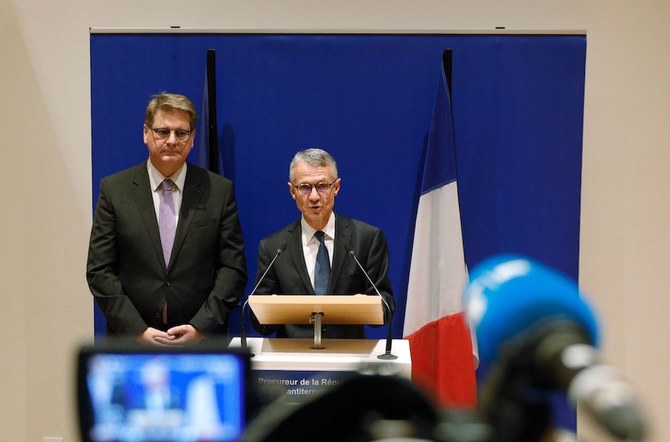
- Investigation had detected signs of 'latent radicalization' in the attacker
- The killer identified only as Mickael H knifed four co-workers to death at the police headquarters in Paris
Bangladesh’s leading contender for PM returns after 17 years in exile
DHAKA: Millions of supporters crowded the streets of Dhaka on Thursday to welcome Tarique Rahman, acting chairman of the Bangladesh Nationalist Party, who has returned to his country after more than 17 years in exile.
Rahman, the son of ailing former Prime Minister Khaleda Zia, waved to the large crowds from the front of a BNP bus escorted by security, as people lined the route from the capital’s airport to a reception venue, waving national and party flags, chanting slogans and carrying banners and flowers.
His return comes in the wake of former Prime Minister Sheikh Hasina’s ouster last year and as Bangladesh gears up to hold general elections in February, for which he is emerging as a leading contender to become prime minister.
“As a member of the BNP, I want to say in front of you that I have a plan for the people of my country, for my country,” Rahman said as he addressed a throng of supporters in Dhaka.
“This plan is for the interest of the people of the country, for the development of the country and for changing the fate of the people. For this, I need support from each and every one of this country. If you people stand beside us, God willing, we would be able to implement those plans.”
The 60-year-old lived in London after he fled Bangladesh in 2008 over what he called a politically motivated persecution.
After facing multiple criminal convictions in Bangladesh, including money laundering and charges linked to an alleged plot to assassinate Hasina, courts acquitted him following Hasina’s removal from office, clearing the legal obstacles that delayed his return.
Rahman’s homecoming is “significant” as it comes as Bangladesh is going through a “very critical political crisis,” said analyst Prof. Dilara Choudhury.
“People of Bangladesh, they are expecting that there will be free and fair elections, and whoever wins will form the government and forward to the transition. In that sense, his return is significant.”
Bangladesh will hold parliamentary elections on Feb. 12, its first vote since a student-led uprising removed Hasina and her Awami League-led government from power in August 2024.
The South Asian nation of nearly 175 million people has since been led by interim leader Muhammad Yunus, a Nobel Prize-winning economist, who took over governance after Hasina fled to India, where she is now in self-exile.
As the Yunus-led administration has banned Awami League from all activities, meaning the former ruling party would not be able to join the upcoming race, the BNP is on course to win the largest number of parliamentary seats, according to a survey published in December by the US-based International Republican Institute.
“I believe a new era in our politics will start with the arrival of Tarique Rahman in the country,” political analyst Mahbub Ullah told Arab News.
“He will take the realms of his party with his own hand and he will do all kinds of things to organize the party and lead the party to victory in the next election.”


