Turkish drill ship violates our rights: Cyprus

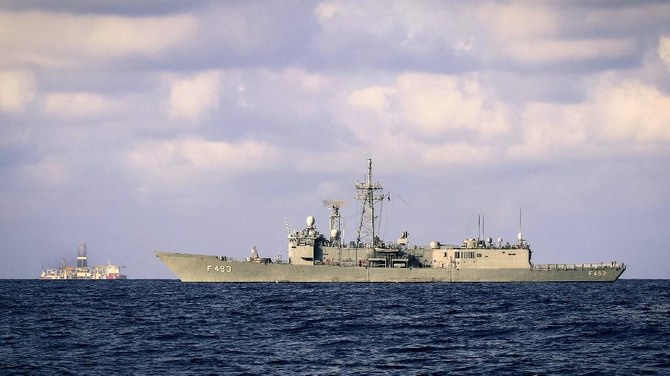
The Turkish army frigate Gelibolu, right, and the drilling vessel Fatih, left, which was deployed to search for gas and oil in waters considered part of the EU state’s exclusive economic zone maneuver in the Mediterranean Sea, off the coast of Cyprus in this September 25, 2019 photo. (AFP)
Updated 04 October 2019
Follow

Turkish drill ship violates our rights: Cyprus

  • Turkey has sent an oil and gas drilling ship to waters off southern Cyprus where Greek Cypriot authorities have already awarded exploration rights
  • The Cypriot presidency accused Turkey of ‘bullying tactics of an era long gone’

ATHENS: Cyprus on Friday said Turkey’s action in sending a drill ship to an area Nicosia has licensed for offshore hydrocarbons exploration was a ‘severe escalation’ of what it called Ankara’s violations of the island’s sovereign rights.
Turkey has sent an oil and gas drilling ship to waters off southern Cyprus where Greek Cypriot authorities have already awarded exploration rights to Italian and French companies.
In a strongly-worded statement, the Cypriot presidency accused Turkey of ‘bullying tactics of an era long gone’ and called on Turkey to withdraw its assets from the area.
“This new provocation is exemplary of Turkey’s defiance of the European Union’s, and the international community’s, repeated calls to cease its illegal activities,” it said.
The statement also urged Turkey to respect the sovereign rights of the Republic of Cyprus to explore and exploit its natural resources within its maritime zones.
“It is yet another proof of the utterly provocative and aggressive behavior of Ankara, which has chosen to speedily and irreversibly depart from international legality, thus putting security and stability in the Eastern Mediterranean at risk.”
On Friday morning the drill ship, the Yavuz, had stopped about 51 nautical miles southwest of Cyprus.
Turkey has already drilled two wells in waters to the island’s east and west, triggering strong protests from Nicosia and the European Union.
Turkey says some of the areas where Cyprus is exploring are either on its own continental shelf, or in zones where Turkish Cypriots have equal rights over any finds with Greek Cypriots.
The island was split in a Turkish invasion in 1974 triggered by a brief Greek-inspired coup.
The internationally recognized Greek Cypriot government represents Cyprus in the European Union, while a breakaway Turkish Cypriot state in the north is recognized only by Ankara.


Washington presses Syria to shift from Chinese telecom systems

Updated 5 sec ago
Follow

Washington presses Syria to shift from Chinese telecom systems

  • Syria is exploring the possibility of procuring Chinese technology
  • It was unclear whether the United States ⁠pledged financial or logistical support to Syria to do so

DAMASCUS: The United States has warned Syria against relying on Chinese technology in its telecommunications sector, arguing it conflicts with US interests and threatens US national security, according to three sources familiar with the matter.
The message was conveyed during an unreported meeting between a US State Department team and Syrian Communications Minister Abdulsalam Haykal in San Francisco on Tuesday. Washington has been coordinating closely with Damascus since 2024, when Syria’s now President Ahmed Al-Sharaa ousted longtime leader Bashar Assad, who had a strategic partnership with China.
Syria is exploring the possibility of procuring Chinese technology to support its telecommunications towers and the infrastructure of local Internet service providers, according to a Syrian businessman involved in the procurement talks.
“The US side asked for clarity on the ministry’s plans regarding Chinese telecom equipment,” said ⁠another source briefed on ⁠the talks.
But Syrian officials said infrastructure development projects were time-critical and that Damascus was seeking greater vendor diversity, the source added.
SYRIAN OFFICIALS CITE US EXPORT CONTROLS AS TELECOMS BARRIER
Syria is open to partnering with US firms but the matter was urgent and export controls and “over-compliance” remained an issue, according to person familiar with the meeting in San Francisco.
A US diplomat familiar with the discussions told Reuters that the US State Department “clearly urged Syrians to use American technology or technology from allied countries in the telecoms sector.”
It was unclear whether the United States ⁠pledged financial or logistical support to Syria to do so.
Responding to Reuters questions, a US State Department spokesperson said: “We urge countries to prioritize national security and privacy over lower-priced equipment and services in all critical infrastructure procurement. If it seems too good to be true, it probably is.”
The spokesperson added that Chinese intelligence and security services “can legally compel Chinese citizens and companies to share sensitive data or grant unauthorized access to their customers’ systems” and promises by Chinese companies to protect customers’ privacy were “entirely inconsistent with China’s own laws and well-established practices.”
China has repeatedly rejected allegations of it using technology for spying purposes.
The Syrian Ministry of telecommunications told Reuters any decisions related to equipment and infrastructure are made “in accordance with national technical and security standards, ensuring data protection and service continuity.”
The ministry said it is also prioritizing the diversification of partnerships and technology sources to ⁠serve the national interest.
Syria’s telecom ⁠infrastructure has relied heavily on Chinese technology due to US sanctions imposed on successive Assad governments over the civil war that grew from a crackdown on anti-government protests in 2011.
Huawei technology accounts for more than 50 percent of the infrastructure of Syriatel and MTN, the country’s only telecom operators, according to a senior source at one of the companies and documents reviewed by Reuters. Huawei did not immediately respond to a request for comment.
Syria is seeking to develop its private telecommunications sector, devastated by 14 years of war, by attracting foreign investment.
In early February, Saudi Arabia’s largest telecom operator, STC, announced it would invest $800 million to “strengthen telecommunications infrastructure and connect Syria regionally and internationally through a fiber-optic network extending over 4,500 kilometers.”
The ministry of telecommunications says that US restrictions “hinder the availability of many American technologies and services in the Syrian market,” emphasizing that it welcomes expanding cooperation with US companies when these restrictions are lifted.
Syria has inadequate telecommunications infrastructure, with network coverage weak outside city centers and connection speeds in many areas barely exceeding a few kilobits per second.