

North Korea tests ‘submarine-launched missile’ ahead of nuclear talks with US

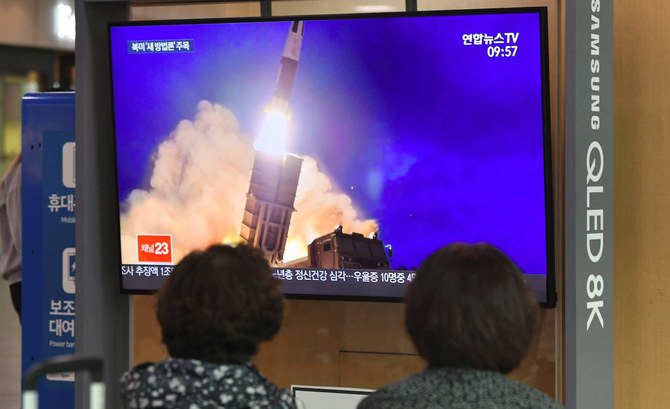
People watch a television news screen showing file footage of a North Korean missile launch, at a railway station in Seoul on October 2, 2019. (AFP)
Updated 03 October 2019
Follow

North Korea tests ‘submarine-launched missile’ ahead of nuclear talks with US

  • It was the 11th test-launch of missiles and rockets this year by the reclusive east Asian state
  • The missile was launched a day after Pyongyang announced it would return to the negotiating table with the US to discuss its nuclear disarmament plans

SEOUL: North Korea on Wednesday test-fired a missile from waters off its east coast just hours after agreeing to resume nuclear talks with the US.

It was the 11th test-launch of missiles and rockets this year by the reclusive east Asian state.

However, the missile was fired at sea, indicating the weapons system could have been a submarine-launched ballistic missile (SLBM), a development that would pose greater threats to regional stability, South Korean defense authorities told Arab News.

The missile was launched a day after Pyongyang announced it would return to the negotiating table with the US to discuss its nuclear disarmament plans.

“The missile is presumed to be an SLBM since it was believed to be fired at sea,” South Korean Defense Minister Jeong Kyeong-doo told lawmakers during a parliamentary session. “We’re analyzing the details of the missile, which is seen as a variant of the Pukguksong SLBM.”

The Pukguksong is currently under development in North Korea with the first version of the SLBM tested three times in 2016. So far, the North is believed to have developed two versions with a maximum flight range of around 1,300 kilometers.

Last July, North Korean leader Kim Jong Un inspected a newly built submarine presumed to have three missile launch tubes that could fire SLBMs.

According to the Joint Chiefs of Staff (JCS), the latest missile was fired from off the east coast near to the city of Wonsan into the sea at 7:11 a.m. and flew around 450 kilometers at a maximum altitude of some 910 kilometers.

It is not clear whether the missile was launched from a submarine, a ship, or a platform on the water.

Along with its intercontinental ballistic missile (ICBM), North Korea’s SLBM program is considered one of the biggest threats to the US and its Asian allies due to its radar-evading characteristics.

“Submarine-launched missiles are hard to detect in advance before they emerge from the water,” Kim Dae-young, a weapons analyst at the Korean Research Institute for National Strategy, told Arab News. “With the SLBM, North Korea could extend the range of its nuclear arsenal.”

Experts say the latest version of the Pukguksong is expected to have a firing range of 2,000 to 3,000 kilometers, which could reach western parts of the US continent as well as Hawaii.

“The latest missile was fired at a high angle, and if it had been fired at a normal angle, it would have flown up to 2,000 kilometers,” said Kim Dong-yup, a professor at South Korean Kyungnam University’s Far East Institute.

The presidential National Security Council (NSC) expressed “strong concern” about the SLBM test that could compromise efforts to revive the denuclearization talks that have been stalled for a year.

“The NSC members expressed strong concern about the latest missile launch ahead of the resumption of nuclear talks between the US and North Korea,” Seoul’s presidential office, the Blue House, said in a statement. “We’re in close consultation with the US over the motive and background of North Korea.”

On Tuesday, North Korean First Vice Minister of Foreign Affairs Choe Son-hui said Pyongyang and Washington had agreed to resume working-level discussions on Saturday, according to a statement carried by North Korea’s official Korean Central News Agency, with the two sides having “preliminary contact” the day before. The time and venue have yet to be disclosed.

The denuclearization talks have so far failed to yield fruit, mainly due to disagreements over sanctions on the communist state. North Korea has demanded they be lifted step by step in return for its disarmament efforts, while the US insisted sanctions remained in place until all denuclearization was completed.

“It seems that the North sends a clear message that it would keep modernizing its weapons systems, especially as long as the US keeps the sanction regime against the North,” said Prof. Kim. “I wonder if (US) President (Donald) Trump would devalue the SLBM test, too, in spite of the missile’s greater threat to the US.”

Some government sources believe the SLBM test could be a response to the deployment of F-35 stealth fighters in South Korea.

On Tuesday, the flight of F-35 jets for the South Korean Air Force were made public for the first time to mark the 71st Armed Forces Day.

The North has been sensitive about F-35 deployment in the South due to the US aircraft’s stealth features that can penetrate into enemy areas without detection.

South Korea plans to acquire 40 F-35A jets, built by Lockheed Martin, with a plan for 20 more additional orders.



Modi’s rooftop solar push slowed by reluctant lenders, states

Updated 5 sec ago
Follow

Modi’s rooftop solar push slowed by reluctant lenders, states

  • The shortfalls represent the latest challenge to India’s efforts to nearly double clean energy capacity to 500 gigawatts by 2030

SINGAPORE/MUMBAI/BHUBANESWAR, India: Indian Prime Minister Narendra Modi’s push to accelerate the rollout of rooftop solar power is falling short of targets despite ​heavy subsidies due to loan delays and limited support from state utilities, vendors and analysts say.
The shortfalls represent the latest challenge to India’s efforts to nearly double clean energy capacity to 500 gigawatts by 2030, and come as the government plans to suspend clean energy tendering targets amid a mounting backlog of awarded projects yet to be built.
Challenges to plans to increase solar uptake may mean India maintains its reliance on coal-fired power.
India’s Ministry for New and Renewable Energy created its subsidy program for residential solar panel installations in February 2024, covering up to 40 percent of the costs.
But residential installations at 2.36 million are well below the ministry’s target of 4 ‌million by March, ‌according to data from the program’s website.
“Banks’ reluctance to lend and states’ ​hesitance ‌to ⁠promote the schemes ​could ⁠derail India’s efforts to transition away from coal,” said Shreya Jai, the lead energy analyst at research firm Climate Trends in New Delhi.
Roughly three in five rooftop solar applications filed on the scheme’s website are yet to be approved while about 7 percent have been rejected, according to government data on the program, known as the PM Surya Ghar.
In a statement to Reuters about the pending applications, the renewable energy ministry pointed to accelerating installations which have benefited over 3 million households, and said the scheme enables state-owned utilities to reduce subsidy payouts to keep residential power bills in ⁠check.
“The loan rejection rate varies across states,” the statement said.
Under PM Surya Ghar, ‌consumers apply and select a vendor who handles paperwork and arranges bank ‌financing for solar panels. After loan approval and installation, the vendor ​submits proof, after which the government subsidy is credited ‌to the bank.

BANK DELAYS
However, banks have been rejecting or delaying loans for numerous reasons including lack of ‌documentation, which they say is necessary to protect public funds.
“We are working with the government to push for some standard documentation, because it is necessary to avoid bad loans. Currently if loans go bad, banks can take away these panels but what will we do with these panels?” said a senior official at a major government-owned bank.
Chamrulal Mishra, a solar vendor in ‌the eastern Indian state of Odisha, said applications are often rejected because the customer has missed electricity payments or because land records are still in the name ⁠of deceased relatives.
Residents there dispute ⁠the claims that they have missed payments, which they attribute to administrative errors after a change in utility ownership decades prior.
A spokesperson for India’s Department of Financial Services, which regulates the country’s banks, said they have responded to consumer feedback to allow co-applicants for loans to clear up title claims and the simplification of documentation requirements.
The Renewable Energy Association of Rajasthan said some banks are making collateral demands for loans under 200,000 Indian rupees ($2,208.87), despite scheme guidelines not requiring them to, which is constraining solar power additions.
State Bank of India and Punjab National Bank, some of the country’s largest lenders, did not reply to requests for comment on the matter.
State-owned utilities are also not promoting rooftop solar as much, as they are concerned about the loss of revenue as sales move off the electric grid.
“Wealthier households typically have high electricity consumption, tariffs and reliable roof access. When they shift from ​the grid, it leaves a larger financial burden,” ​said Niteesh Shanbog, an analyst at Rystad Energy.