JEDDAH: Oil prices stabilized on Monday after Saudi Crown Prince Mohammed bin Salman called for diplomatic solutions to the crisis with Iran and the war in Yemen.
Armed conflict with Iran would be catastrophic for global growth, the crown prince said. “Oil supplies will be disrupted and prices will jump to unimaginably high numbers that we haven’t seen in our lifetimes. This means a total collapse of the global economy, and not just Saudi Arabia or the Middle East.
“The political and peaceful solution is much better than the military one.”
The price of oil had been edging upwards after an attack on Saudi oil facilities last month, widely blamed on Iran. Prices fell by 1 percent on Monday after the crown prince spoke.
In an interview with journalist Rosie O’Donnell on the CBS show “60 Minutes,” he also answered tough questions on the war in Yemen, the treatment of Saudi women in jail and the murder of journalist Jamal Khashoggi.
“If Iran stops its support of the Houthi militia, then the political solution would be much easier,” the crown prince said. “Today we open all initiatives for a political solution in Yemen.”
The crown prince was pressed on claims that Saudi female activists had been tortured in prison, which he promised to investigate.
“If this is correct, it is very heinous,” he said. “Islam forbids torture. The Saudi laws forbid torture. Human conscience forbids torture. And I will personally follow up on this matter.”
Khashoggi’s murder last year in the Saudi consulate in Istanbul was “a heinous crime,” he said.
“But I take full responsibility as a leader in Saudi Arabia, especially since it was committed by individuals working for the Saudi government. This was a mistake. And I must take all actions to avoid such a thing in the future.”
Khashoggi’s son Salah said on Monday his father’s death was being exploited by enemies of Saudi Arabia and its leadership, and he had the “utmost confidence in the Kingdom’s justice system.”
“My father … never tolerated any abuse or attempt to harm (the Kingdom), and I will not accept his memory or his cause being taken advantage of to achieve that,” he said.


Oil prices stabilize as Saudi crown prince talks peace
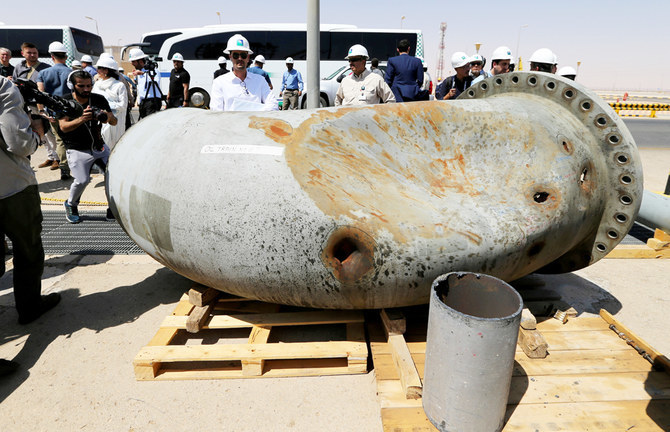
Oil prices stabilize as Saudi crown prince talks peace

- Crown Prince Mohammed bin Salman called for diplomatic solutions to the crisis with Iran and the war in Yemen
- He expressed his views in an interview with CBS News on Tuesday

Sustainability Forum Middle East spotlights Saudi role in driving climate finance deployment
MANAMA: Saudi Arabia’s growing influence over sustainable finance and climate-aligned investment was a central theme at the Sustainability Forum Middle East, as regional banks, investors, and policymakers signaled a shift from climate pledges to market execution.
The fourth edition of the forum, held in Bahrain under the theme “Advancing Alignment, Innovation, and Implementation for Energy and Climate Transformation,” brought together more than 500 participants and over 50 speakers from government, finance, energy, and industry.
While the agenda covered climate diplomacy and national strategies, the dominant conversations this year centered on capital deployment, bankability, technology, and the commercial realities of the energy transition.
Saudi Arabia’s role in shaping that transition was repeatedly highlighted, particularly through its efforts to structure green finance instruments, integrate sustainability into Vision 2030 programs, and scale renewable energy ambitions. Global banks at the forum pointed to the kingdom as a key driver of demand for credible sustainable finance frameworks in the Gulf.
“Saudi Arabia has demonstrated clear leadership through Vision 2030 and its green financing frameworks,” Lina Osman, managing director and head of sustainable finance for the Middle East, Africa and Pakistan at Standard Chartered, told Arab News.
“The Public Investment Fund’s green bond issuance is a clear demonstration of the value of the opportunity that is available in Saudi Arabia and how Saudi Arabia is seizing that opportunity,” she added.
Osman also noted that Saudi Arabia’s target of sourcing 50 percent of its electricity from renewables represents a “true demonstration of leadership in sustainability,” adding that financing instruments will need to evolve to serve those ambitions.
She said the bank has been customizing sustainable finance structures for Gulf Cooperation Council clients as the market becomes more sophisticated and sector-specific.
Organizations at the forum said the region has moved beyond ESG signaling and into discussions about return profiles, risk pricing, and revenue impact.
“Financial institutions are now focused on how sustainability generates value — reducing costs, building resilience, and boosting revenue. Previously, it was mostly window dressing,” said Ian McCallum, chief sustainability officer at Bank ABC.
Speaking to Arab News, he added that Saudi Arabia is playing a “significant role in shaping the direction of sustainable finance by continuing to strengthen ESG regulatory and disclosure requirements.”
Speakers from private markets and venture capital also pointed to Saudi Arabia as an emerging market for climate technologies that are moving from pilot phase to commercialization.
Investors highlighted carbon removal, energy optimization, and AI-enabled climate solutions as areas where the Kingdom’s scaling capacity and demand for industrial decarbonization make deployment feasible.
Beyond finance, the forum examined how the GCC can accelerate industrial decarbonization through AI integration, carbon capture, supply chain reform, and the expansion of renewables.
Panels explored how sovereign strategies and industrial policy are aligning across the region, with Saudi Arabia’s energy transition goals seen as an anchor for cross-border capital flows.
The event saw memorandums of understanding and multi-sector partnerships intended to translate national ambitions into deployable projects.
Organizers said the agreements reflect a shift toward implementation, positioning the Gulf as a market where climate action is increasingly tied to competitiveness, industrial growth, and long-term economic resilience.


