QAIM, Iraq: Iraq and Syria on Monday opened a key border crossing between the two neighboring countries, seven years after it was closed during Syria’s civil war and the battle against Daesh.
The opening of the crossing linking the Iraqi town of Qaim and Syria’s Boukamal is expected to strengthen trade between the two Arab countries.
But it is also a boost to Iran’s influence in the region, allowing Iran-backed militias in Iraq easier access to eastern Syria at a time of soaring tensions in the region between Tehran and Washington following the collapse of Iran’s nuclear deal with world powers. The area has been a point of friction between US-backed Kurdish fighters, and Syrian government troops and their Iranian-backed allies.
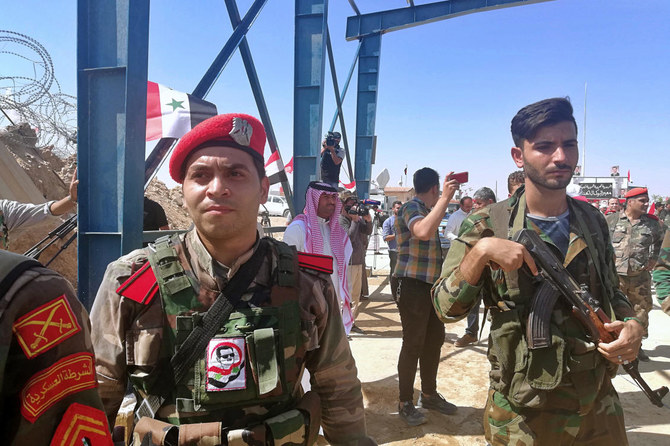
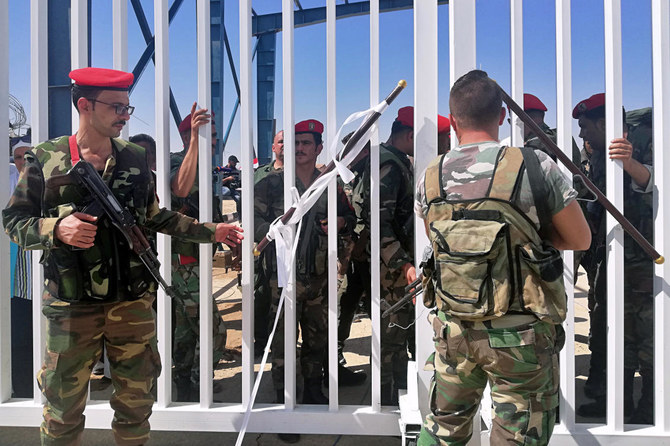
In a symbolic gesture, Syrian Interior Minister Maj. Gen. Mohammed Khaled Rahmoun, accompanied by Syrian troops, crossed onto the Iraqi side of the border, where troops from both countries hugged and took selfies. Scores of Iraqis and Syrians who live in the border towns also attended the ceremony.
“The opening of this border crossing is the result of victories achieved by our people in Syria and Iraq against terrorist organizations,” Rahmoun said.
The Boukamal crossing was closed in 2012 as rebels fighting to topple Syrian President Bashar Assad seized large parts of eastern Syria.
Qaim and Boukamal were then controlled by Daesh until 2017, when Syrian and Iraqi troops captured the towns from the extremists. The group’s territorial defeat was announced in Syria earlier this year.
Kadhim Mohammed, who represented Iraq’s prime minister at the ceremony, said the opening of the border “opens a new page that represents reconstruction.”
The border brings further relief to Assad’s government after border crossings with Jordan and the Israeli-occupied Golan Heights manned by UN peacekeepers were reopened last year. After eight years of war, Assad — with strong backing from Russia and Iran — has recaptured most of the country from rebels, and there is growing support within the Arab League for Damascus’ readmission.
Iraqi authorities had set up tents for Monday’s ceremony amid tight security, with troops deployed around the crossing. Despite their official defeat, Daesh sleeper cells are still blamed for deadly attacks on both sides of the border.
“The opening of Boukamal-Qaim crossing is a victory for Syrian and Iraqi friendship against takfiri terrorism,” read a banner placed on the Syrian side of the border, a reference to Daesh’s extremist ideology. The group once controlled large parts of Syria and Iraq where its leader Abu Bakr Al-Baghdadi declared a so-called caliphate in 2014. The group lost its last sliver of land in eastern Syria in March.
Opening the borders, however, could benefit Iran as it tries to secure a land route to the Mediterranean through Iraq, Syria and Lebanon. Tehran enjoys wide influence through its allies in all three countries.
Omar Abu Laila, a Europe-based Syrian activist from the eastern province of Deir Ezzor that borders Iraq, told The Associated Press that the opening of the crossing will not chiefly benefit residents of the region, but Iran and the militias allied with it.
“The opening of the crossing will be a means for Iranians, Shiite militia and Hezbollah to boost their activities,” he said. “The opening of the crossing is an Iranian defiance to America and the international community.”
Some 800 freight trucks are expected to cross from Syria once the crossing has been opened, Syria’s state news agency said.
Qaim was once a thriving stopover on the highway linking Damascus and Baghdad. Long before a hard border materialized in the latter half of the 20th century, tribes sent their grooms and brides across the frontier to marry, extending the branches of their families on both sides.
The opening of the crossing was postponed several times in recent weeks. Earlier in September, Syria blamed Israel for a nighttime airstrike on an arms depot and posts of Iranian-backed militias in Boukamal that opposition activist said killed at least 18 fighters.
Israel considers Iran to be its greatest enemy, and as Syria’s civil war winds down, it has repeatedly warned that it will not allow Iranian troops — who have been fighting alongside Assad’s forces — to maintain a permanent presence in postwar Syria.
Syria and Iraq have three key border crossings between them, with Boukamal the only one controlled by the Assad’s government. The second one is controlled by US-backed Kurdish-led fighters known as the Syrian Democratic Forces, while the third crossing, the nearby Tanf, is held by US-backed Syrian rebels.


Iraq and Syria open border crossing closed since 2012

Iraq and Syria open border crossing closed since 2012

- Opening of the crossing linking the Iraqi town of Qaim and Syria’s Boukamal expected to strengthen trade between the two Arab countries
- Qaim and Boukamal were controlled by the Daesh group until 2017


Libya holds funeral for military officials killed in plane crash
- Prime Minister Abdul Hamid Dbeibah praises Gen. Mohammed Ali Ahmad Al-Haddad for organizing the military
TRIPOLI: Libya on Saturday held a military funeral for the military chief of western Libya and four of his officers who died in a plane crash in Turkiye.
The bodies arrived at Tripoli International Airport in caskets draped with Libyan flags and were carried in a funeral procession with soldiers holding their photographs.
The private jet with Gen. Mohammed Ali Ahmad Al-Haddad, four other military officers, and three crew members crashed on Tuesday after taking off from Ankara, Turkiye’s capital, killing everyone on board. Libyan officials said a technical malfunction on the plane caused the crash, but the investigation is still ongoing in coordination with Turkiye.
Libya plunged into chaos after the country’s 2011 uprising toppled and killed longtime leader Muammar Qaddafi. The country split, with rival administrations in the east and west.
Prime Minister Abdul Hamid Dbeibah’s government governs the country from Tripoli, and Prime Minister Ossama Hammad’s administration governs the east.
Dbeibah praised Al-Haddad during a funeral speech for organizing the military “despite overwhelming darkness and outlaw groups.”
Al-Haddad played a crucial role in the ongoing, UN-brokered efforts to unify Libya’s military, which has split, much like Libya’s institutions.
“Our martyrs weren’t just military leaders but also statesmen who were wise and disciplined and carried responsibility and believed that the national Libyan army is the country’s shield and ... that building institutions is the real path toward a stable and secure Libya,” Dbeibah said.
The burial will take place on Sunday in Misrata, about 200 km east of Tripoli, officials said.
The crash took place as the delegation was returning to Tripoli from Ankara, where it was holding defense talks aimed at boosting military cooperation.
A funeral ceremony was also held at Murted airfield base near Ankara, attended by the Turkish military chief and the defense minister.
Military chief Gen. Selcuk Bayraktaroglu also accompanied the bodies on the plane to Libya, Turkish public broadcaster TRT reported.
Two French crew members of a Falcon 50 jet died in the crash, a French diplomatic source said.
The source did not identify the French crew members but said the French Foreign Ministry was in contact with their families and providing them with assistance.
The Dassault Falcon 50 is a French-made long-range business jet.
The one that went down was chartered by a Malta-based private company, Harmony Jets, which, according to its website, performs maintenance in Lyon, France.
Harmony Jets declined to give information about the nationalities or identities of the crew on its plane.
Airport Haber, a Turkish site specialized in aeronautical news, said the pilot and copilot were both French and cited a Greek newspaper report that a Greek cabin attendant had joined the company two months ago.
France’s BEA, which handles civil aviation investigations, said on X that it was participating in the probe into the crash launched by Turkiye.
Turkiye’s transport minister, Abdulkadir Uraloglu, said the flight recorders would be analyzed in a “neutral” country.
Turkish Justice Minister Yilmaz Tunc said contact had been made with Germany to carry out that.


