Egypt loosens security after thwarting calls for protests

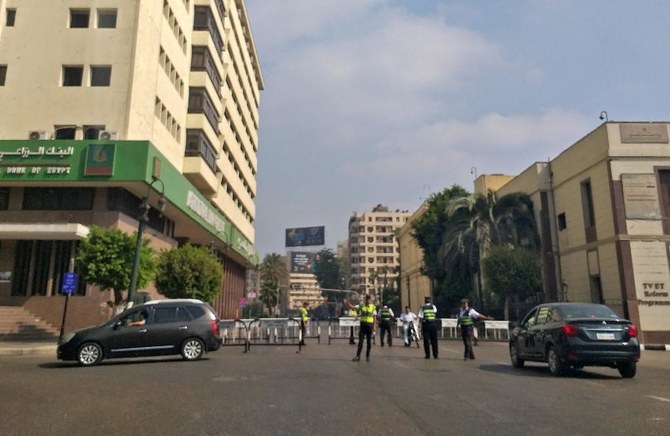
Tahrir Square was reopened after it was blocked off by Egyptian security forces. (AFP)
Updated 28 September 2019
Follow

Egypt loosens security after thwarting calls for protests

  • The subway and Tahrir square are reopened
  • El-Sisi is warning against “deceitful” attempts to undermine his rule

CAIRO: Egypt has loosened security measures in the capital, Cairo, a day after it sealed off the main square and downtown thoroughfares to thwart a possible protest against the country’s president.
Tahrir Square, the epicenter of the pro-democracy uprising in 2011, was reopened Saturday to normal traffic, as were subway stations in the area that had been closed the day before.
Headlines in pro-government dailies ran comments from President Abdel-Fattah El-Sisi warning against “deceitful” attempts to discredit his rule.
Egypt has witnessed a harsh security clampdown following rare demonstrations in several cities last weekend, which were broken up by police.
Lawyers say more than 2,000 people have been arrested since then, though Egypt’s general prosecutor said his office has questioned no more than 1,000 people over the latest protests.


Iran offers concessions on nuclear program

Updated 7 sec ago
Follow

Iran offers concessions on nuclear program

  • Atomic energy chief says it will dilute enriched uranium if US eases sanctions

TEHRAN: Iran offered on Monday to dilute its highly enriched uranium if the US lifts sanctions.

Mohammad Eslami, head of the country’s Atomic Energy Organization, did not specify whether this included all sanctions on Iran or only those imposed by the US.

The new move follows talks on the issue in Oman last week that both sides described as positive and constructive.

Diluting uranium means mixing it with blend material to reduce the enrichment level, so that the final product does not exceed a given enrichment threshold.
Before US and Israeli strikes on its nuclear facilities in June last year, Iran had been enriching uranium to 60 percent, far exceeding the 3.67 percent limit allowed under the now-defunct nuclear agreement with world powers in 2015.
According to the UN’s nuclear watchdog, Iran is the only state without nuclear weapons that is enriching uranium to 60 percent.
The whereabouts of more than 400 kg of highly enriched uranium that Iran possessed before the war is also unknown. UN inspectors last recorded its location on June 10. Such a stockpile could allow Iran to build more than nine nuclear bombs if enrichment reached 90 percent.
Supreme leader Ayatollah Ali Khamenei urged Iranians on Monday to resist foreign pressure.
“National power is less about missiles and aircraft and more about the will and resolve of the people,” Khamenei said. “Show it again and frustrate the enemy.”
Nevertheless, despite this defiance, Iran has signaled it could come to some kind of deal to dial back its nuclear program and avoid further conflict with Washington.