

Opposition’s underground network unearthed in Syria

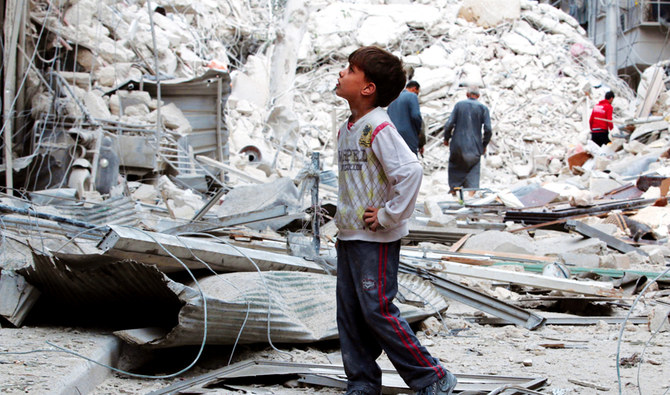
A boy inspects a damaged site after airstrikes in the Tariq Al-Bab neighborhood of Aleppo, Syria. (Reuters)
Updated 26 September 2019
Follow

Opposition’s underground network unearthed in Syria

  • The red-brick entrance to this underground base still bears the scars of the battle

LATAMINAH, SYRIA: Tunnels run for hundreds of meters, connecting caves strewn with mattresses that formed what the Syrian army and its Russian allies say was a vast opposition underground network.

The road leading to the entrance of the tunnels in Lataminah in northwestern Syria is lined with the charred shells of cars and armored vehicles.

According to the Russian army, which organized a press tour of the site for dozens of journalists, the network of caves dug into a rocky outcrop could shelter up to 5,000 people.

“We think this network was dug about four years ago with sophisticated machinery, of a kind which is not available in Syria,” a Syrian army colonel said as he led reporters into the tunnels, escorted by Russian demining experts.

The red-brick entrance to this underground base still bears the scars of the battle that saw Russian-backed regime forces retake the area in the province of Hama earlier this year.

“Those who fought here retreated to the north. First to Khan Sheikhun and then further into Idlib province when our forces took the city,” the colonel said.

In some places, the tunnels are barely big enough to stand in but connect large rooms carved out of the rock, including a prayer room, a drone workshop, a bathroom and even a prison.

Military officials told AFP reporters that the total size of the underground network, in which crates of amunition were found, has not yet been fully assessed.

It was used primarily by fighters from opposition groups, among them the alliance known as Hayat Tahrir Al-Sham that now dominates the entire Idlib enclave.

The caves provided shelter to those fighters from the intensive air strikes Russian and Syrian aircraft usually conduct as a prelude to any ground advance.

In some of the caves, empty food cans and crumpled plastic water bottles, jerricans and decaying clothes give a glimpse of daily life in the dark hideout.

Some rooms were done up with tile panels and a coat of paint while others have fully cemented walls, over which Syrian forces have since scribbled slogans praising Syria’s Bashar Assad.

One room was even equipped with an old TV, wired up with cables that run around one kilometer from the nearby town of Lataminah.

The room which officers believe was used as a prison was dug out no less than 400 meters deep into the maze of tunnels and caves.

Blood stains are still visible on the ground, as are tiny separate cells with rusting doors.

The Russian army said it has uncovered around 10 such underground networks across northwestern Syria and others in the desert region of Palmyra.

Officers said the Lataminah cave was a local hub for the manufacture of drones that jihadist fighters used against regime and Russian forces.

The massive Russian military base of Hmeimim, which lies in the neighboring province, has been repeatedly targeted by rebel drone attacks.


Last Christians gather in ruins of Turkiye’s quake-hit Antakya

Updated 25 December 2025
Follow

Last Christians gather in ruins of Turkiye’s quake-hit Antakya

  • Saint Peter’s, one of the world’s oldest rock churches, is a sacred rallying point for the isolated Christians still left in quake-hit Antakya in southeastern Turkiye

ANTAKYA: Saint Peter’s, one of the world’s oldest rock churches, is a sacred rallying point for the isolated Christians still left in quake-hit Antakya in southeastern Turkiye, the city known in ancient times as Antioch.
“Since the earthquake, our community has scattered,” said worshipper Mari Ibri.
“Those who remain are trying to regroup. We each had our own church but, like mine, they have been destroyed.”
The landscape around the cave remains scarred by the disaster nearly three years ago, when two earthquakes devastated Hatay province on February 6, 2023 and its jewel, Antakya, the gateway to Syria.
Sad fields of rubble and the silhouettes of cracked, abandoned buildings still scar the city — all enveloped in the ever-present grey dust.
Since the earthquakes, Antakya city has emptied and the Christian community has shrunk from 350 families to fewer than 90, Father Dimitri Dogum told AFP.
“Before, Christmas at our house was grandiose,” Ibri recalled.
“Our churches were full. People came from everywhere.”
Ibri’s own church in the city center was rendered inaccessible by the earthquakes.
Now she and other worshippers gather at the cave on December 24 — Christmas Eve in some Christian calendars.
It is here, they believe, that Peter, the disciple Jesus assigned to found the Christian church, held his first religious service in the 1st century.
The rock church was later enlarged and 11th-century crusaders added a pale stone facade.
It is now a museum, opened to the faithful only on rare occasions.
Christmas Eve is one.
The morning sun was still glowing red in the sky when Fadi Hurigil, leader of Antakya’s Orthodox Christian community, and his assistants prepared the service.
They draped the stone altar and unpacked candles, holy oil, chalices and plastic chairs.
Out in front they placed figurines of Christ and three saints near a bottle of rough red wine, bread baskets and presents for the children.
The sound system played a recording of the bells of Saint Peter and Paul church, which now stands empty in Antakya city center.
“That was my church,” said Ibri, crossing herself. “They recorded the peals.”
Around one hundred worshippers soon squeezed into the incense-filled cave and at least as many congregated outside.
A large police contingent looked on. Sniffer dogs had already inspected the cave and esplanade.
“It’s normal,” said Iliye, a 72-year-old from Iskenderun, 60 kilometers (40 miles) further north. “We’re a minority. It’s to protect us.”
The slow chanting of Orthodox hymns heralded the start of the two-hour service, conducted entirely in chants sung in Arabic and Turkish by Dogum and another cleric.
“It’s very moving for us to be here in the world’s first cave church, where the first disciples gathered,” the priest said.
“There used to be crowds here,” he added.
“In 2022, there were at least 750 people outside, Christians and non-Christians alike.”
Since the earthquakes, the gathering has been much smaller, although it is now starting to grow again.
At the end of the service, when Christmas carols fill the air, Dogum and Hurigil cut a huge rectangular cake.
The Nativity scene at its center — Mary, baby Jesus, the ox and the ass — was edged with whipped cream.
“There’s the religious dimension but it’s also important that people can gather here again,” a worshipper said.
“After February 6, our fellow citizens scattered. But they’re starting to come back. We’re happy about that.”