US deploys 200 troops, missiles to bolster Saudi Arabia’s defenses

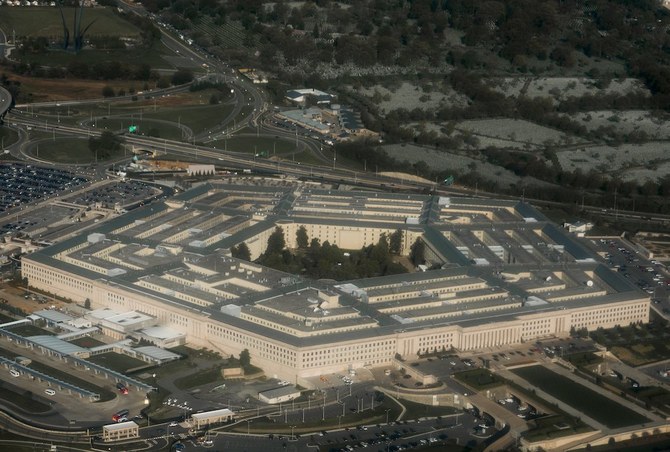
The Pentagon says it will deploy to Saudi Arabia one Patriot battery, four Sentinel radars and some 200 support personnel. (File/AFP)
Updated 27 September 2019
Follow

US deploys 200 troops, missiles to bolster Saudi Arabia’s defenses

  • Team from America, Europe, Kingdom and UN to report on Sept. 14 oil attacks
  • US officials called it an unprecedented Iranian attack on Saudi oil facilities

JEDDAH: The US announced on Thursday the deployment of 200 troops as well as Patriot missiles to Saudi Arabia to help the country’s defense in the wake of last month’s attacks on oil installations blamed on Iran.

The Defense Department said the deployment would involve one battery of the surface-to-air missiles, along with four Sentinel radars used for air and missile defense systems.

In addition, two more Patriot batteries and one THAAD ballistic missile interception system are being readied in case a decision is made to also supply them to the Saudis, Pentagon spokesman Jonathan Hoffman said.

“This deployment will augment the Kingdom’s air and missile defense of critical military and civilian infrastructure,” he said.

It comes “in light of recent attacks on the Kingdom of Saudi Arabia,” he said.

“It is important to note these steps are a demonstration of our commitment to regional partners, and the security and stability in the Middle East,” he added.

Opinion

This section contains relevant reference points, placed in (Opinion field)

“Other countries have called out Iranian misadventures in the region, and we look for them to contribute assets in an international effort to reinforce Saudi Arabia’s defense.”

The US has pointed to Iran being behind the combination drone and cruise missile attacks on Sept. 14 which heavily damaged two Saudi oil installations, forcing the key oil supplier to slash output.

Meanwhile, a team made up of representatives from the US, Europe, Saudi Arabia and the UN will investigate the Sept. 14 attacks on Saudi oil facilities, US Assistant Secretary of State for Near Eastern Affairs David Schenker said. He told Al Arabiya TV that there are discussions with Europe about the possibility of forming a maritime alliance in the Gulf area.

Separately, the US imposed new sanctions on certain Chinese entities and people who it accused of knowingly transferring oil from Iran in violation of Washington’s curbs on Tehran. 

Sanctions have also been slapped on five Chinese nationals and six entities, including two Cosco Shipping Corporation subsidiaries, the US Treasury Department announced.

“The more Iran lashes out the greater our pressure will and should be,” US Secretary of State Mike Pompeo said. “That path forward begins now with two new actions.”

He said Washington was also ramping up efforts to educate countries on the risks of doing business with Iran’s Revolutionary Guard Corps entities and that it will punish those who continue to engage with them in violation of sanctions.

“We are committed to holding the Iranian regime accountable, and we will continue to deny funding to this regime that uses its wealth and resources to enrich itself, while depriving the Iranian people of opportunity,” said a US government statement. 

It added: “All entities must conduct appropriate due diligence to stay clear of sanctioned Iranian entities and sectors. No company or nation should be willing to expose itself to the risk of sanction by possibly supporting Iran’s destabilizing activities.”

It said the Iranian regime “must cease its destabilizing activities or face greater economic pressure and diplomatic isolation.”


Dammam airport introduces advanced navigation technology

Updated 5 sec ago
Follow

Dammam airport introduces advanced navigation technology

  • General Aviation Terminal at King Fahd International Airport is big step forward for facilities

DAMMAM: King Fahd International Airport — the largest airport in the world by area, according to Guinness World Records — has implemented a cutting-edge navigation system, the first of its kind in Saudi Arabia.

The Category III Instrument Landing System upgrade project allows aircraft to land automatically in low-visibility and foggy conditions, ensuring flight continuity while enhancing operational efficiency and strengthening safety reliability.

Prince Saud bin Naif bin Abdulaziz, the governor of Eastern Province, inaugurated the General Aviation Terminal and the upgrade of the ILS on Monday.

The General Aviation Terminal at King Fahd International Airport represents a significant step forward for the airport’s facilities.

The project spans more than 23,000 sq. meters, ensuring operational efficiency and the swift completion of travel procedures through the main terminal.

It includes aircraft parking areas covering 12,415 sq. meters, with capacity for four aircraft simultaneously, in addition to support services and car parking spanning 6,665 sq. meters — contributing to smooth traffic flow and providing a travel experience aligned with the highest international standards.

The project also includes upgrading the western runway to 4,000 meters, along with an additional 4,000 meters of taxiway, equipped with more than 3,200 lighting units operating under a unified system with advanced technologies to meet modern operational requirements and accommodate all types of aircraft.

These developments will contribute to increasing passenger capacity and air traffic growth in the Kingdom, in line with the objectives of the National Transport and Logistics Strategy.

Abdulaziz bin Abdullah Al-Duailej, the president of the General Authority of Civil Aviation, said that the Aviation Program had derived from the strategy.

He said: “It (the program) embodies the ambitious goals of Vision 2030, aiming to establish the Kingdom as a global logistics platform linking three continents; an international destination for tourism and business; and a leading aviation hub in the Middle East.”

The authority has implemented several initiatives to develop the general aviation sector and create an attractive investment environment by improving regulatory frameworks.

These efforts have successfully attracted leading global companies, with Universal Aviation named as the operator for the terminals at King Fahd International Airport and King Abdulaziz International Airport in Jeddah.

Mohammed bin Ali Al-Hassany, the CEO of Dammam Airports, said that the General Aviation Terminal and the ILS upgrade represented “a major leap for Saudi airports.”

He added that preparing the operational environment on the western runway had been the result of close cooperation between the GACA, Saudi Airports Holding Company, Dammam Airports, the National Center for Meteorology, and the Saudi Air Navigation Services Company, with each entity fulfilling its role to ensure operational readiness, safety and efficiency.

Dammam Airports manages and operates three airports in Eastern Province: King Fahd International Airport in Dammam, Al-Ahsa International Airport, and Qaisumah Airport in Hafar Al-Batin.

Arab News spoke to Gregory Evans, chairman of the board at Universal Weather and Aviation, who was present during the ceremony on Monday.

He said: “We operate Dammam’s only GA terminal with dedicated, private aviation hangars, providing secure, climate-protected aircraft storage that safeguards your assets and ensures predictable availability.

“Around the world, the number of business jets, private jets, has really exploded over the last 15 years, and what’s going on in Saudi Arabia is going on in other parts of the world, where you have more and more private jet operators coming into places like Dammam and Riyadh and Jeddah and other locations — but they don’t have the infrastructure.

“They don’t have where to park; they don’t have where to put their planes in hangars, believe it or not. This is the first hangar in Saudi Arabia for private jets.

“It’s an incredible day to be able to bring that kind of service to the country, as well as FBOs (fixed-base operators).”

The team also plans to operate additional hangars for private jets in Jeddah and Riyadh.

Evans said: “We have three projects really going on at the same time. We have Riyadh going on, and Jeddah. Because the DACO (Dammam Airports Company) people work very quickly, it is Dammam first. I wouldn’t say I chose Dammam; Dammam chose us.”