

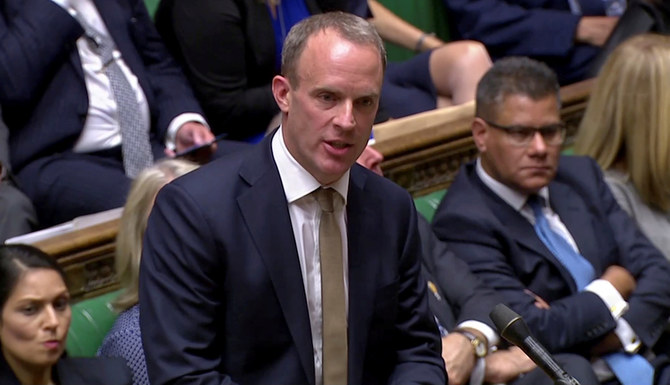

LONDON: Iran has undertaken “serious and systemic” breaches of international law, the UK’s foreign secretary Dominic Raab said on Thursday.
Raab said he hoped Britain could still work with Iran, but that could only happen if Iran “showed the respect required for the basic principles of the rules-based international system.”
The foreign secretary cited the recent attacks on Saudi Aramco facilities to highlight how Iran’s behavior destabilizes the region. “Iran’s violations are not mere technical breaches of international rules. They are serious and systemic, destabilising actions, which undermine the international rule of law. And those actions must have consequences,” he said.
“Iran’s record of respect for the basic rules of international law is woeful and it is getting worse,” he told UK’s parliament.
“Take the recent attacks on the Aramco facilities in Saudi Arabia, eighteen drones and seven cruise missiles hit an oil field and a processing facility.
“As the UK government, we took our time to assess the facts carefully and independently. We are now confident that Iran was responsible. The evidence is clear, and there is no plausible alternative explanation.
“We have condemned the attacks in coordination not just with Saudi Arabia and the US but also with our European partners,” he added.
Addressing the UK’s House of Commons, Raab said the attack on Aramco also reiterated the need to prevent Iran gaining nuclear weapons.
“Iran’s attacks on the Aramco facilities are a reminder of the importance of ensuring that Iran never gains access to nuclear weapons,” he said.
The foreign secretary also mentioned the Maritime Security Construct (IMSC), and the UK’s work with the US, Saudi Arabia and Bahrain to ensure freedom of navigation in the region.
“And, as the attack on Aramco demonstrates, we must also bring into scope Iran’s wider destabilising activities. That includes putting an end to Iran’s violations of the freedom of navigation, which are disrupting shipping in the Strait of Hormuz, and undermining the international law of the sea,” he said.
Raab used his speech to urge an end to Iranian interference in Yemen, which he said has led to the greatest humanitarian crisis in the world and which has stoked further conflict through support for the Houthi militia.
“A political solution is the only viable way to bring peace to that terrible conflict. Iran must start to play a constructive instead of a destructive role in that conflict,” he said.
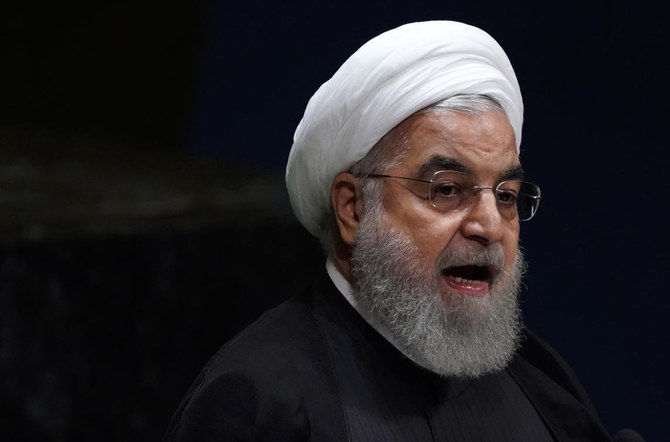
Raab also made reference to the number of UK dual-nationals imprisoned in Iran, confirming that prime minister Boris Johnson raised the issue with Iranian president Rouhani on the sidelines of the UN General Assembly.
“Today, there are a range of UK dual-nationals languishing in jail in Iran, typically arrested on spurious charges, denied due process and subject to mistreatment contrary to the basic tenets of international human rights law. This practice causes great anguish and suffering not just to those detained, but also to their families.
“Iran’s behavior is unlawful, cruel and it is totally unacceptable. I have raised all of these cases, along with Iran’s wider conduct with Foreign Minister Zarif,” he said.
“So, Iran’s record of respect for the basic rules of international law is woeful. And it is getting worse. Let’s be clear about this and the Iranian government’s responsibility for the plight of its own people. It is a matter of political choice. Their government’s choice,” he added.


