

WATCH: Soyuz spacecraft carrying the UAE’s first astronaut Hazza Al-Mansoori dock with International Space Station

1 / 10
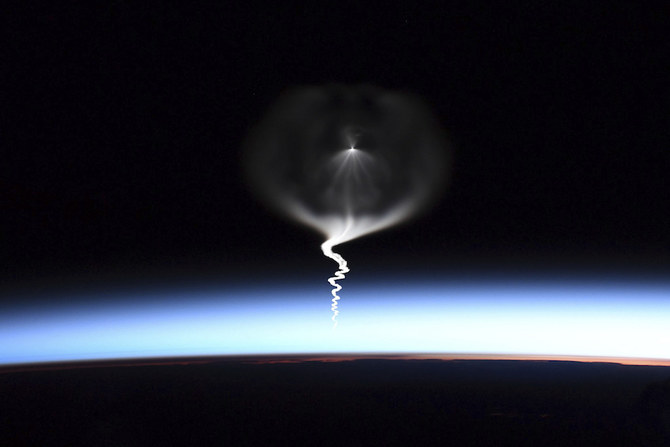
This photo provided by NASA astronaut Christina Koch shows the launch of a Russian Soyuz rocket, as seen from the International Space Station on Wednesday, Sept. 25, 2019. (Christina Koch/NASA via AP)
2 / 10
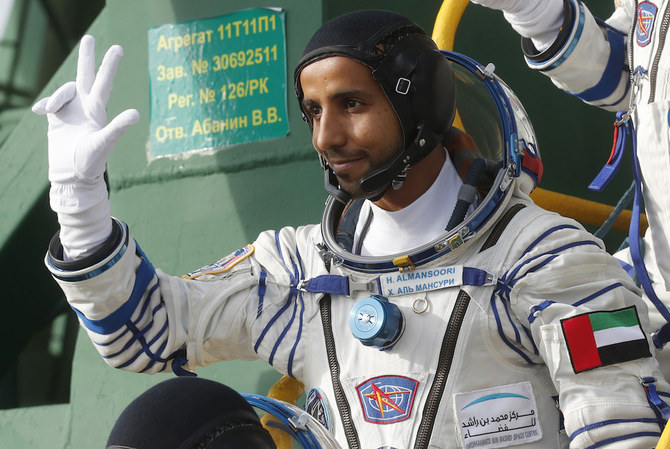
International Space Station (ISS) crew member, UAE astronaut Hazza Al-Mansoori waves as he boards the Soyuz MS-15 spacecraft before its blasts off for the ISS, on Wednesday at the Russian-leased Baikonur cosmodrome in Kazakhstan. (AFP)
3 / 10
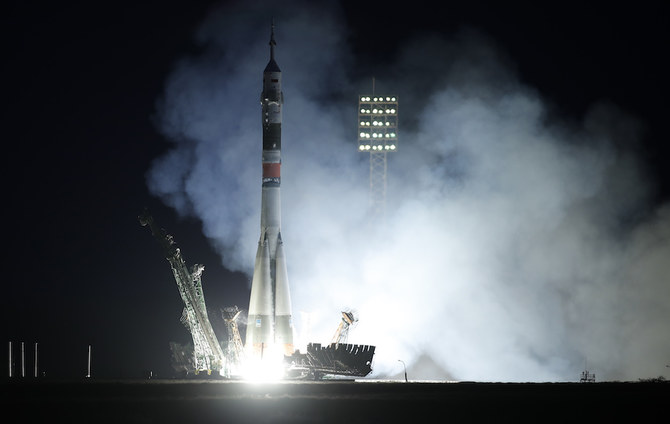
The Soyuz-FG rocket booster with Soyuz MS-15 space ship carrying a new crew to the International Space Station, ISS, blasts off at the Russian leased Baikonur cosmodrome, Kazakhstan, Wednesday, Sept. 25, 2019. The Russian rocket carries U.S. astronaut Jessica Meir, Russian cosmonaut Oleg Skripochka, and United Arab Emirates astronaut Hazza Al-Mmansoori. (AP)
4 / 10
the Soyuz MS-15 spaceship carrying a new crew to the International Space Station (ISS) streaks into the sky during liftoff at the Russian leased Baikonur cosmodrome. (AP/Nasa)
5 / 10
The Soyuz-FG rocket booster with Soyuz MS-15 space ship carrying a new crew to the International Space Station, ISS, blasts off at the Russian leased Baikonur cosmodrome, Kazakhstan, Wednesday, Sept. 25, 2019. The Russian rocket carries U.S. astronaut Jessica Meir, Russian cosmonaut Oleg Skripochka, and United Arab Emirates astronaut Hazza Al-Mmansoori. (AP)
6 / 10
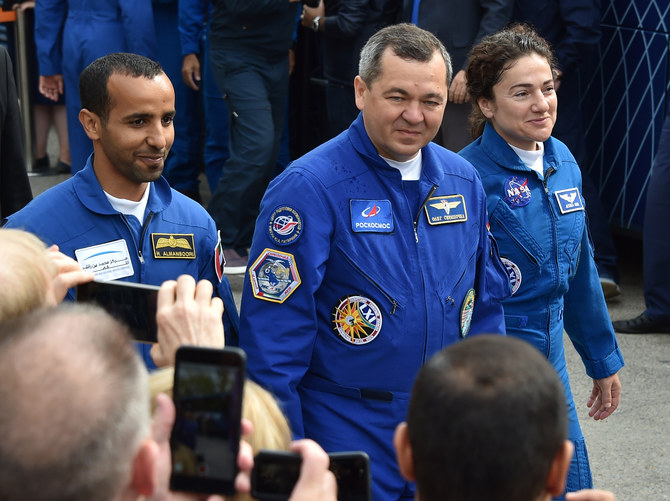
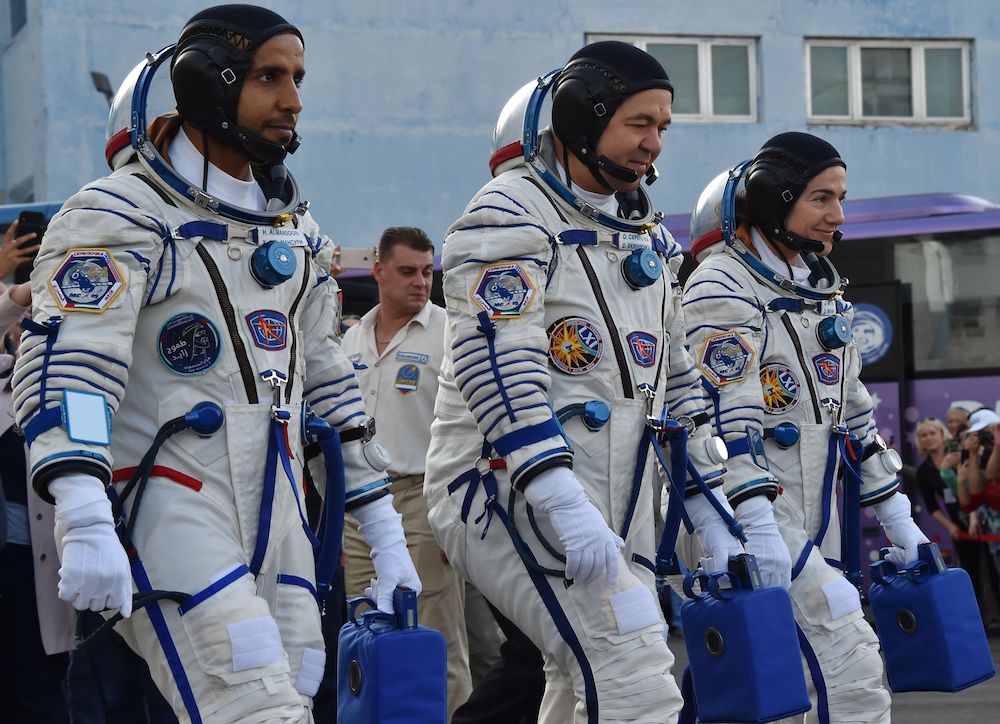
Members of the main crew to the International Space Station (ISS) (from L) United Arab Emirates' astronaut Hazza Al-Mansoori, Russian cosmonaut Oleg Skripochka and US astronaut Jessica Meir report to Roscosmos chief Dmitry Rogozin (R) arrive to board a Soyuz rocket to the ISS, at the Russian-leased Baikonur cosmodrome in Kazakhstan on September 25, 2019. (AFP)
7 / 10
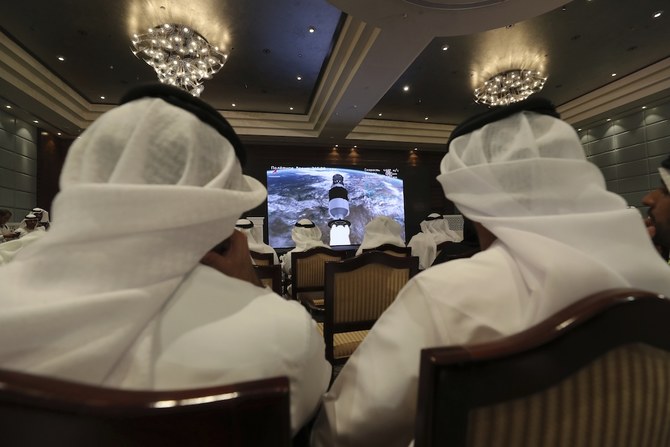
Emiratis in Abu Dhabi watch a live broadcast of a Russian Soyuz MS-15, that took off from the Baikonur Cosmodrome in Kazakhstan, carrying Emirati Astronaut Hazza Al-Mansoori and two other astronauts heading to the International Space Station. (AP)
8 / 10
People watch screens showing a Soyuz MS-15 spacecraft lifting off from Baikonur Cosmodrome in Kazakhstan carrying 35-year-old Emirati astronaut Hazza Al-Mansoori to spend eight days aboard the International Space Station, at Mohammed Bin Rashid Space Centre (MBRSC) in Dubai on September 25, 2019. (AFP)
9 / 10
Emirati astronaut Hazza Al Mansouri waves to people as he leaves his hotel for a pre-launch preparation at the Russian-leased Baikonur cosmodrome in Kazakhstan on Sept. 25, 2019. He’s the first Arab on the International Space Station. (Vyacheslav Oseledko/AFP)
10 / 10
Members of the main crew to the International Space Station (ISS), (From L) United Arab Emirates' astronaut Hazza Al Mansouri, Russian cosmonaut Oleg Skripochka and US astronaut Jessica Meir leave their hotel. (Vyacheslav Oseledko/AFP)
Updated 26 September 2019
Follow

WATCH: Soyuz spacecraft carrying the UAE’s first astronaut Hazza Al-Mansoori dock with International Space Station

  • Abu Dhabi Crown Prince says Al-Mansoori has taken the UAE to new heights
  • The Soyuz docked with the ISS over the southern pacific after a six hour journey into space


MISSION CONTROL, Moscow: The Soyuz MS-15 spacecraft carrying the first Emirati astronaut docked with the International Space Station on Wednesday after launching into space six hours earlier from the Baikonur Cosmodrome in Kazakhstan.

Hazza Al-Mansoori from the UAE, Jessica Meir from the US and veteran Russian commander Oleg Skripochka, took off a few minutes before 5pm Saudi time (2pm GMT) to carry them to the International Space Station.

They docked with the ISS at 10:42 p.m. Saudi time (7:42 p.m. GMT) above the southern Pacific Ocean, and the hatch between the two will be opened about two hours later.

The team at the RKA Mission Control Center, located in Korolyov near Moscow, Russia, congratullated the three crew members on a successful and "simply amazing" docking.

Arab News witnessed an exciting day of action inside Mission Control, with a dramatic blast off earlier in teh day. Staff applauded as the spacecraft passed through its crucial phases and passed through the earth's upper atmosphere. 

Abu Dhabi Crown Prince Sheikh Mohammed bin Zayed said he was proud to see Al-Mansoori head towards the International Space Station taking the UAE to “new heights”.

Just hours ahead of the launch, Al-Mansoori tweeted that he was filled with an “indescribable feeling of glory.

“Today I carry the dreams and ambition of my country to a whole new dimension,” he said.

The center, which has an active control room for the International Space Station, checked the spacecraft’s trajectory until its successful docking about six hours after take off. Al-Mansoori’s watched the launch from the Baikonur Cosmodrome. 

In the UAE, Emiratis closely followed the launch, which was played on big screens in Dubai.
“We are very proud of him,” said an Emirati, who had driven with a friend from the emirate of Ajman to Dubai to watch the liftoff on a big screen at City Walk.  

The launch places the UAE’s first astronaut in space as part of the country’s ambitious space program, and he will be the Arab world’s third. The first, Saudi Prince Sultan bin Salman, travelled to space in 1985 aboard NASA’s Discovery space shuttle.
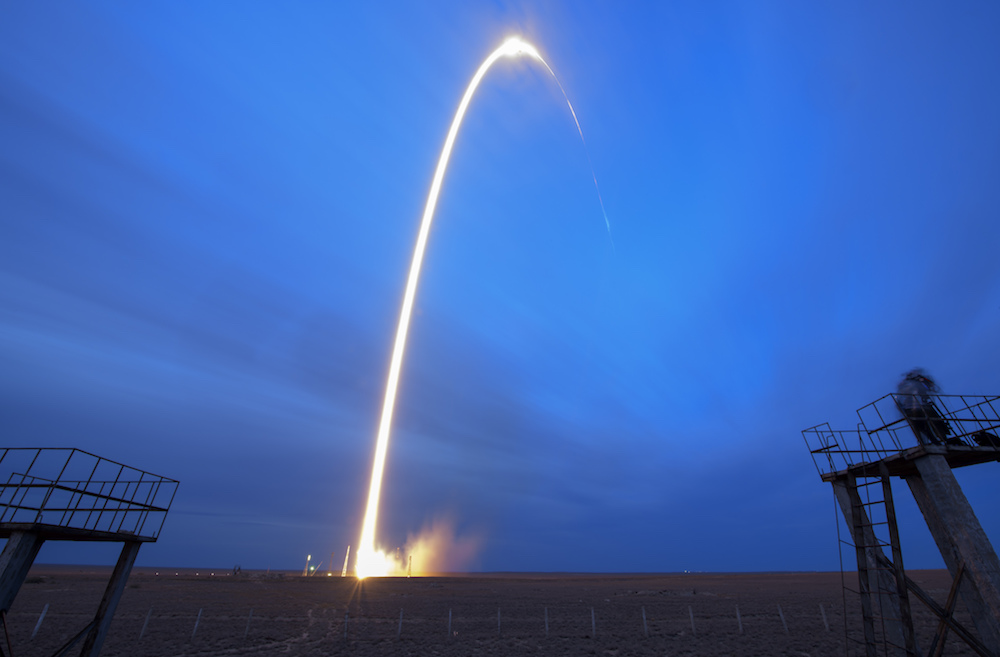


the Soyuz MS-15 spaceship carrying a new crew to the International Space Station (ISS) streaks into the sky during liftoff at the Russian leased Baikonur cosmodrome. (AP/Nasa)

With the help of Russia's Roscosmos State Corporation for Space Activities’ “spaceflight participant” program, Al-Mansoori, along with a number of non-NASA astronauts, is being given a change to fly into space for a few days and participate in various scientific activities on the ISS.

Baikonur, built at the height of the Cold War in the 1950s, is a busy spaceport with numerous commercial, military and scientific missions being launched regularly. A partnership between NASA and the RKA and various other space agencies has seen the launch of many astronauts from there throughout the years. 
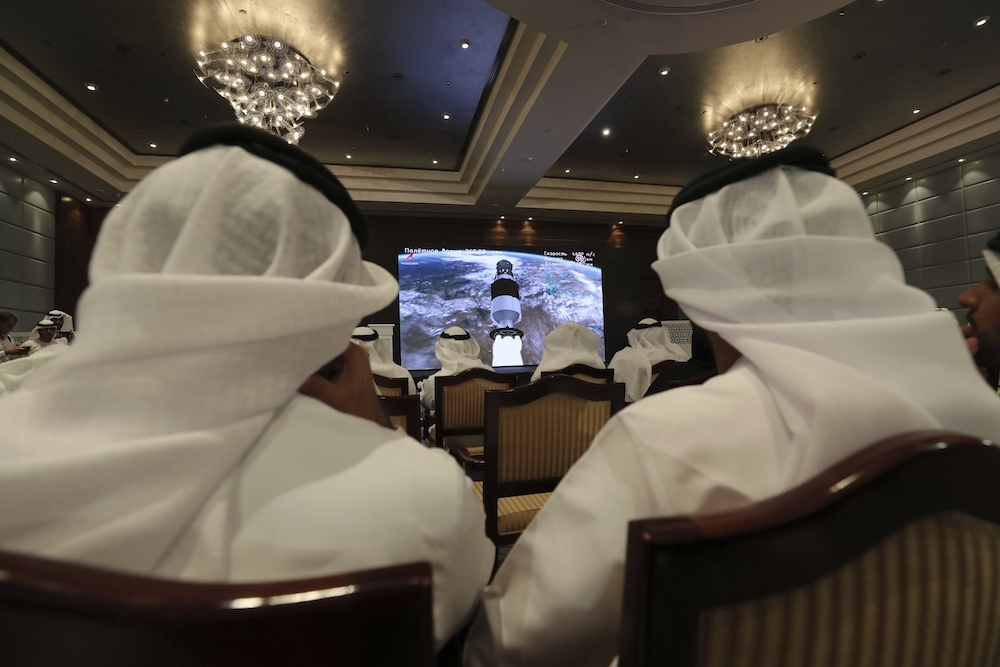


Emiratis in Abu Dhabi watch a live broadcast of a Russian Soyuz MS-15, that took off from the Baikonur Cosmodrome in Kazakhstan, carrying Emirati Astronaut Hazza Al-Mansoori and two other astronauts heading to the International Space Station. (AP)

The number of international astronauts, with exception of the Chinese, riding the Soyuz rockets increased greatly in 2011 after the retirement of NASA’s space shuttle program, with countries shifting reliance to Russia to get their crew up to the ISS. 

The Russian Soyuz spacecraft and rockets are well-regarded for their ability to launch in about any weather, which was considered a hindrance with NASA’s space shuttles.

Russia’s space program long predates those of other space agencies. In fact, it kicked off the first space race by launching the world’s first satellite, Sputnik on Oct. 4, 1957.

On April 12, 1961, Soviet cosmonaut Yuri Gagarin became the first human to travel into space, with his flight lasting 108 minutes as he circled the Earth for a little more than one orbit aboard the Vostok spacecraft.

When a Saudi went to space
Prince Sultan bin Salman speaks exclusively to Arab News about his 1985 NASA mission and how he became the first Arab, Muslim and royal in space

Enter


keywords

35 have been killed and 1,200 held in Iran’s economic protests

People walk as shops are closed during protests in Tehran's centuries-old main bazaar, Iran, Tuesday, Jan. 6, 2026. (AP)
Updated 7 sec ago
Follow

35 have been killed and 1,200 held in Iran’s economic protests

  • Demonstrations show no sign of stopping
  • Govt acknowledges hardships, urges dialogue

DUBAI: The death toll in violence surrounding protests in Iran has risen to at least 35 people, activists said on Tuesday, as the demonstrations showed no signs of stopping.

The figure came from the US-based Human Rights Activists News Agency, which said more than 1,200 people have been detained in the protests, which have been ongoing for more than a week.
It said 29 protesters, four children and two members of Iran’s security forces have been killed. Demonstrations have reached over 250 locations in 27 of Iran’s 31 provinces,
The group, which relies on an activist network inside of Iran for its reporting, has been accurate in past unrest.
The semiofficial Fars news agency reported late on Monday that some 250 police officers and 45 members of the Guard’s all-volunteer Basij force have been hurt in the demonstrations.
 The authorities have acknowledged the economic hardships but accused networks linked to foreign powers of stoking the protests. 
On Tuesday, Iran’s police chief vowed to “deal with the last of these rioters.”
The shopkeepers’ protest continued on Tuesday in the bazaar, with about 150 people focusing on economic demands, Fars reported.
The protests have spread to some cities in western and southern Iran but do not match the scale of unrest that swept the nation in 2022-23 over the death of Mahsa Amini, who died in police custody for violating Iran’s dress code.
However, even though smaller, these protests have quickly expanded ‌from an economic ‌focus to broader frustrations, with some protesters chanting against the country’s clerical rulers.
The police chief, Ahmadreza Radan, was quoted on Tuesday by state media as saying they had drawn a distinction between protesters and rioters, the latter facing arrests on site or following identification by intelligence units.
“I pledge that we will deal with the last of these rioters. It is still time for those who were deceived by foreign services to identify themselves and draw on the Islamic Republic’s greatness,” Radan said.
Fars said ​Tuesday’s gathering of shopkeepers on Saadi street in Tehran ended without “expanding the police’s presence.”
Mohammad, 63, a jewelry shop owner in the bazaar, said there was a heavy presence of riot police and plainclothes security forces inside and around the area.
“They were forcing shopkeepers who were on strike to open their shops. I did not see it myself, but I heard there were clashes outside the bazaar and police fired tear gas,” he said by phone. 
Footage shared on Telegram on Tuesday appeared to show dozens of security forces on motorbikes patrolling the street and the unidentified person who took the clip can be heard saying the security forces had fired tear gas.
President Masoud Pezeshkian has promised reforms to help stabilize the monetary and banking systems and protect purchasing power.
The government has announced a subsidy reform, removing preferential currency exchange rates for importers in favor of direct transfers to Iranians to boost their purchasing ‌power for essential goods. The measure will come into force on Jan. 10.
The central bank chief was also replaced on Dec. 29.
The rial fell further to 1,489,500 on Tuesday, representing a 4 percent fall since the protests started.