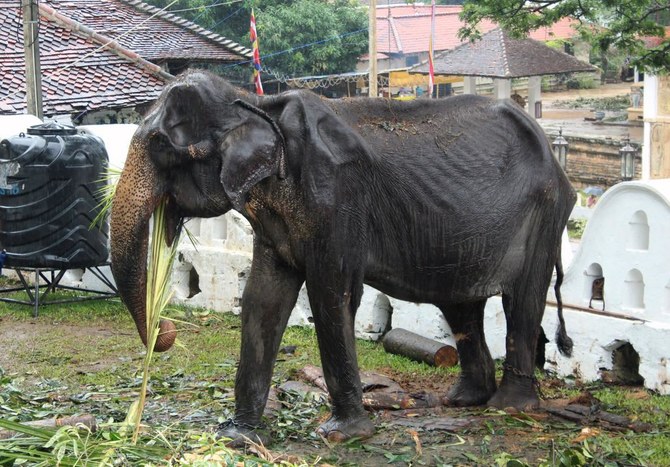
Skeletal elephant dies in Sri Lanka weeks after parade outcry

A 70-year-old Sri Lankan elephant named Tikiri, whose emaciated state prompted an outcry in August after she was made to march in a Buddhist parade and collapsed, sparking an investigation by wildlife authorities, has died. (AFP)
Updated 25 September 2019
Follow

Skeletal elephant dies in Sri Lanka weeks after parade outcry

  • Elephant expert Jayantha Jayewardene said the jumbo had been ill-treated
  • The animal was withdrawn from the finale of the annual Temple of the Tooth pageant in Kandy last month

COLOMBO: An emaciated 70-year-old elephant that caused a social media outcry after being forced to take part in an annual Buddhist pageant in Sri Lanka has died, officials said Wednesday.
The government has ordered an autopsy for Tikiri, a domesticated Asian elephant that died Tuesday night in Kegalle, 80 kilometers (50 miles) east of the capital Colombo, a wildlife department official said.
Elephant expert Jayantha Jayewardene said the jumbo had been ill-treated.
“Tikiri was severely undernourished,” Jayewardene told AFP. “It is a wonder that she lived this long.”
The animal was withdrawn from the finale of the annual Temple of the Tooth pageant in Kandy last month after a social media firestorm erupted against parading the feeble animal.
Animal lovers lambasted authorities for forcing the aged beast to parade several kilometers wearing elaborate attire at the hugely popular night festival.
Lek Chailert, the founder of the Save Elephant Foundation, wrote on social media that spectators did not realize how weak Tikiri was because of her costume.
After the public outcry, Wildlife Minister John Amaratunga ordered an investigation into why Tikiri was made to participate in the annual parade despite her failing health, but the outcome was not made known.
The Temple of the Tooth, Buddhism’s holiest shrine on the island, holds the annual festival with traditional drummers and dancers as well as nearly 100 elephants.
Many rich Sri Lankans keep elephants as pets, but there have been numerous complaints of ill-treatment and cruelty.
Guinness World Records says the average age of an Asian elephant is around 60 years, while the oldest on record was Lin Wang, a bull who carried supplies for the Japanese army in what was then Burma during World War II before dying in a Taiwan zoo in 2003 aged 86.


Fans bid farewell to Japan’s only pandas

Updated 25 January 2026
Follow

Fans bid farewell to Japan’s only pandas

TOKYO: Panda lovers in Tokyo said goodbye on Sunday to a hugely popular pair of the bears that are set to return to China, leaving Japan without the beloved animals for the first time in half a century.
Loaned out as part of China’s “panda diplomacy” program, the distinctive black-and-white animals have symbolized friendship between Beijing and Tokyo since the normalization of diplomatic ties in 1972.
Some visitors at Ueno Zoological Gardens were left teary-eyed as they watched Japan’s only two pandas Lei Lei and Xiao Xiao munch on bamboo.
The animals are expected to leave for China on Tuesday following a souring of relations between Asia’s two largest economies.
“I feel like seeing pandas can help create a connection with China too, so in that sense I really would like pandas to come back to Japan again,” said Gen Takahashi, 39, a Tokyo resident who visited the zoo with his wife and their two-year-old daughter.
“Kids love pandas as well, so if we could see them with our own eyes in Japan, I’d definitely want to go.”
The pandas’ abrupt return was announced last month after Japan’s conservative premier Sanae Takaichi hinted Tokyo could intervene militarily in the event of any attack on Taiwan.
Her comment provoked the ire of Beijing, which regards the island as its own territory.
The 4,400 lucky winners of an online lottery took turns viewing the four-year-old twins at Ueno zoo while others gathered nearby, many sporting panda-themed shirts, bags and dolls to celebrate the moment.
Mayuko Sumida traveled several hours from the central Aichi region in the hope of seeing them despite not winning the lottery.
“Even though it’s so big, its movements are really funny-sometimes it even acts kind of like a person,” she said, adding that she was “totally hooked.”
“Japan’s going to be left with zero pandas. It feels kind of sad,” she said.
Their departure might not be politically motivated, but if pandas return to Japan in the future it would symbolize warming relations, said Masaki Ienaga, a professor at Tokyo Woman’s Christian University and expert in East Asian international relations.
“In the future...if there are intentions of improving bilateral ties on both sides, it’s possible that (the return of) pandas will be on the table,” he told AFP.