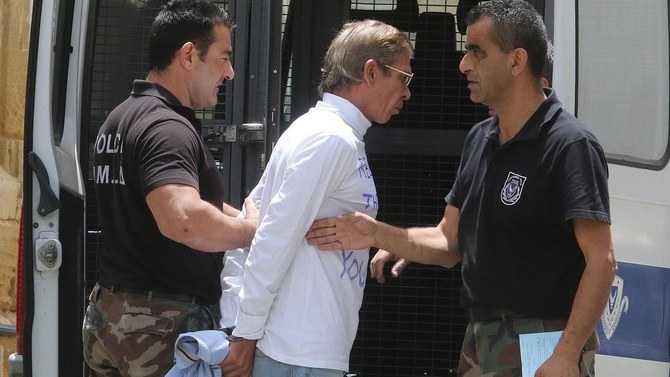
CAIRO: An Egyptian court on Tuesday handed a life sentence to an Egyptian man who hijacked an airliner to Cyprus in 2016 using a fake explosive belt.
The charges included using intimidation and threats to seize a plane and abduct its passengers for a terrorist purpose, according to a judicial source.
Seif Eldin Mustafa has the right to appeal within 60 days.
Mustafa commandeered a domestic Alexandria-Cairo flight with 72 passengers and crew on board in March 2016, ordering it to land at Larnaca airport in Cyprus.
Mustafa had taken control of the plane by showing flight attendants what appeared to be a belt stuffed with plastic wires and a remote control. He then asked for the release of all female prisoners held in Egypt, and also to have contact with his Cypriot ex-wife.
He surrendered to Cypriot authorities about six hours after he landed, having gradually released all passengers and crew unharmed.
The Cypriot authorities handed him over to Cairo after a court ruling cleared the way for his extradition.
Cypriot courts had heard appeals since 2016 against the extradition of the 61-year-old to Cairo, rejecting his arguments that he would not receive a fair trial in Egypt.

Egypt hands life sentence to Egyptian plane hijacker
Baghdad says it will prosecute Daesh militants being moved from Syria to Iraq
- The US military started the transfer process on Friday with the first Daesh prisoners moved from Syria to Iraq
BAGHDAD: Baghdad will prosecute and try militants from the Daesh group who are being transferred from prisons and detention camps in neighboring Syria to Iraq under a US-brokered deal, Iraq said Sunday.
The announcement from Iraq’s highest judicial body came after a meeting of top security and political officials who discussed the ongoing transfer of some 9,000 IS detainees who have been held in Syria since the militant group’s collapse there in 2019.
The need to move them came after Syria’s nascent government forces last month routed Syrian Kurdish-led fighters — once top US allies in the fight against Daesh — from areas of northeastern Syria they had controlled for years and where they had been guarding camps holding Daesh prisoners.
Syrian troops seized the sprawling Al-Hol camp — housing thousands, mostly families of Daesh militants — from the Kurdish-led force, which withdrew as part of a ceasefire. Troops last Monday also took control of a prison in the northeastern town of Shaddadeh, from where some Daesh detainees had escaped during the fighting. Syrian state media later reported that many were recaptured.
Now, the clashes between the Syrian military and the Kurdish-led Syrian Democratic Forces, or SDF, sparked fears of Daesh activating its sleeper cells in those areas and of Daesh detainees escaping. The Syrian government under its initial agreement with the Kurds said it would take responsibility of the Daesh prisoners.
Baghdad has been particularly worried that escaped Daesh detainees would regroup and threaten Iraq’s security and its side of the vast Syria-Iraq border.
Once in Iraq, Daesh prisoners accused of terrorism will be investigated by security forces and tried in domestic courts, Iraq’s Supreme Judicial Council said.
The US military started the transfer process on Friday with the first Daesh prisoners moved from Syria to Iraq. On Sunday, another 125 Daesh prisoners were transferred, according to two Iraqi security officials who spoke to The Associated Press on condition of anonymity in line with regulations.
So far, 275 prisoners have made it to Iraq, a process that officials say has been slow as the US military has been transporting them by air.
Both Damascus and Washington have welcomed Baghdad’s offer to have the prisoners transferred to Iraq.
Iraq’s parliament will meet later on Sunday to discuss the ongoing developments in Syria, where its government forces are pushing to boost their presence along the border.
The fighting between the Syrian government and the SDF has mostly halted with a ceasefire that was recently extended. According to Syria’s Defense Ministry, the truce was extended to support the ongoing transfer operation by US forces.
The Daesh group was defeated in Iraq in 2017, and in Syria two years later, but Daesh sleeper cells still carry out deadly attacks in both countries. As a key US ally in the region, the SDF played a major role in defeating Daesh.
During the battles against Daesh, thousands of extremists and tens of thousands of women and children linked to them were taken and held in prisons and at the Al-Hol camp. The sprawling Al-Hol camp hosts thousands of women and children.
Last year, US troops and their partner SDF fighters detained more than 300 Daesh militants in Syria and killed over 20. An ambush in December by Daesh militants killed two US soldiers and one American civilian interpreter in Syria.


