


LONDON: Fresh details of some of Britain’s biggest Cold War spy scandals, including the network of Soviet agents who stole naval intelligence secrets, emerged in newly released secret files Tuesday.
The Portland spy ring, believed to have helped the Soviet Union build a new class of submarines in the 1960s, marked a turning point in Cold War espionage in Britain, say historians.
The network was run by Konon Molody, a deep-cover KGB officer posing as a Canadian businessman named Gordon Lonsdale.
Since he lacked the diplomatic immunity given to intelligence personnel using genuine identities, he was arrested and sentenced to 25 years in prison for espionage in 1961.
This was the first time Britain’s MI5 domestic intelligence service unearthed an “illegal” spy running other operatives.
MI5 files released by the National Archives reveal how, during a series of prison interviews, Molody offered to disclose information and even to become a double agent, in return for his release.
“He wished... to make a deal with us,” said a 1961 MI5 memo.
“Lonsdale’s own idea was that he might be exchanged for some British agents held by the Russians, or even that he might be allowed to escape.”
Officials declined his offer, but in 1964 Molody was part of the most high-profile spy swaps of the Cold War, trading places with a Briton, Greville Wynne, held in Moscow.
It later turned out that he had not been telling his interrogators the whole story.
‘Great-granny spy’
Molody/Lonsdale was questioned in prison by MI5 officer Charles Elwell in early 1961. Elwell had done the most to catch him, said Professor Christopher Andrew, a historian of Britain’s intelligence agencies.
The pair struck up a cordial relationship, sharing bags of cherries or strawberries as Molody described his disillusionment with life as an “illegal” KGB spy.
But Molody never revealed the true extent of his activities to Elwell — for he had briefly run Melita Norwood, another Soviet agent embedded in Britain, who later became known as the “great-granny spy.”
Norwood has been described as the most important British female agent ever recruited by the KGB. She passed on secrets believed to have helped the Soviets speed up development of the atomic bomb.
Her identity remained hidden for decades more, and she was only exposed when KGB archivist Vasili Mitrokhin defected to Britain in 1992, bringing thousands of files he had meticulously copied.
The British authorities decided not to prosecute her and she died in 2005 having escaped any punishment.
‘Incompetent spy’
The Portland network was named after a southwest English Royal Navy base for “underwater detection” research.
It unraveled after local police received a tip-off from staff that a clerk, Harry Houghton, was “acting suspiciously.”
Investigators discovered that he and another clerk Ethel Gee — who were having an affair — were passing copies of classified documents to his handler Lonsdale/Molody.
Molody took a dim view of the spy’s skills, the MI5 files show.
“Lonsdale regards Houghton as an incompetent fool, who was incapable of even operating the camera (he) had given him,” Elwell wrote.
An American couple, Morris Cohen and his wife Leontina, were also caught.
Masquerading as antiquarian booksellers Peter and Helen Kroger, they had managed communications with Moscow from a bungalow in suburban northwest London.
Arrested in January 1961 and jailed, they were sent to Moscow eight years later as part of another spy swap, getting a heroes’ welcome in Moscow.
In the MI5 files, Cohen was described as “a sententious bore... whose life appears to be governed by a rancid idealism and who swims about in aura of glutinous bonhomie and bookish sentimentality.”
His wife was deemed “even less alluring” and “the dominant figure in the marriage... (who) looks and probably behaves like an embittered crazy fanatic.”
‘Ablest of all’
The National Archives also disclosed details on Arnold Deutsch — “the ablest of all the Soviet illegals,” according to Andrew.
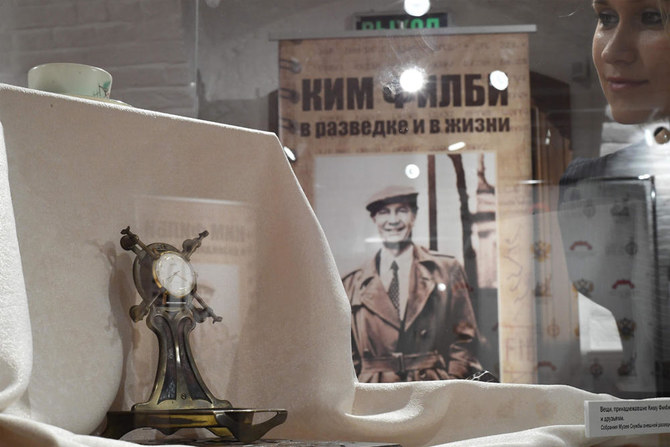
Deutsch is credited with having recruited MI6 officer Kim Philby and the other members of the notorious “Cambridge Five” spy-ring in the mid-1930s.
His file contains Philby’s account of his recruitment in London’s Regent’s Park in 1934, told 30 years later to an MI6 colleague just before he dramatically defected to Moscow.
“One of my earliest tasks was to give him details of all my Communist friends in Cambridge. This I did,” the memo said.


