

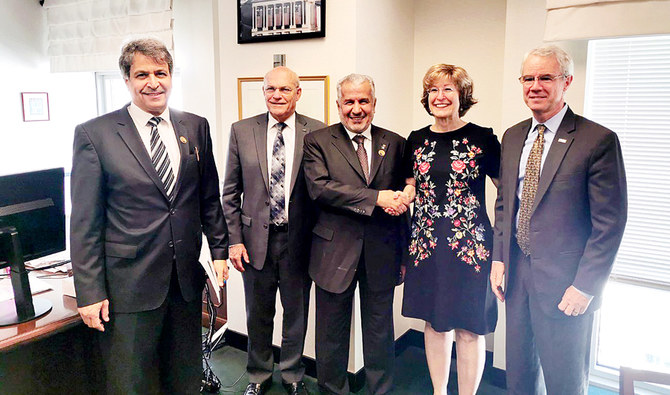
KSRelief chief meets USAID officials in Washington

KSRelief General Supervisor Dr. Abdullah Al-Rabeeah, second left, meets USAID officials in Washington. (SPA)
Updated 23 September 2019
Follow

KSRelief chief meets USAID officials in Washington

  • Al-Rabeeah said that the amount of Saudi assistance presented to Yemen since 2015

Dr. Abdullah Al-Rabeeah, general supervisor of the King Salman Humanitarian Aid and Relief Center (KSRelief), met the deputy administrator of the US Agency for International Development (USAID), Bonnie Glick, and a number of officials in Washington.

The meeting discussed the importance of cooperation between KSRelief and USAID and ways to develop this cooperation in the future to alleviate the suffering of countries in need and develop humanitarian working mechanisms to ensure the delivery of aids to their beneficiaries.

Al-Rabeeah also attended a dialogue session at the Middle East Institute (MEI) in Washington, in the presence of MEI’s President Paul Salem, Senior Vice President Gerald Feierstein and a number of the institute’s members.

During the session, a presentation was made about the Kingdom’s relief and humanitarian efforts that have been implemented by KSRelief in many countries since it was founded in 2015.

Al-Rabeeah said that the amount of Saudi assistance presented to Yemen since 2015 has reached $14.5 billion, more than $2 billion of which was donated through KSRelief.

He spoke about some of the center’s qualitative projects in Yemen such as the Saudi Project for Landmine Clearance (Masam) which has extracted 89,761 as of September 2019, and the establishment of centers that provide artificial limbs for the victims of mines and missiles and rehabilitate them to adapt to help them lead a normal life.

Al-Rabeeah drew attention to the project to rehabilitate children under 18 years old who were recruited by Houthi militias and thrown into warzones.

He noted that the children were reintegrated back into society and presented, along with their parents, with psychological, social and educational services from specialized experts.

Afterward, Al-Rabeeah answered the audience’s questions which focused on the challenges facing Saudi humanitarian work. He confirmed that the Kingdom strives to provide humanitarian work with transparency and neutrality and include all regions of Yemen.


Saudi Arabia’s KAUST named FIFA’s first research institute in MENA

The canal in the King Abdullah University of Science and Technology campus. (Shutterstock)
Updated 10 February 2026
Follow

Saudi Arabia’s KAUST named FIFA’s first research institute in MENA

  • KAUST President Prof. Sir Edward Byrne said that the university’s selection as the fifth FIFA Research Institute in the world — and the first in the region — marks a significant achievement, reflecting Kingdom’s growing presence in international football

RIYADH: FIFA has designated the King Abdullah University of Science and Technology as its first research institute in the Middle East and Asia to support the development of innovative football research, the Saudi Press Agency reported on Tuesday.

The recognition highlights KAUST’s commitment to integrating sports, academic research and industry through advanced, high-level initiatives grounded in rigorous scientific methodologies, contributing to the advancement of football studies.

KAUST President Prof. Sir Edward Byrne said that the university’s selection as the fifth FIFA Research Institute in the world — and the first in the region — marks a significant achievement, reflecting Saudi Arabia’s growing presence in international football.

The accreditation aligns with national efforts to invest in research and development and promote the knowledge economy, supporting Saudi Vision 2030’s goals of building an advanced sports system based on innovation and sustainability.

The collaboration’s first project focuses on developing advanced AI algorithms to analyze historical FIFA World Cup broadcast footage, transforming decades of match videos into structured, searchable data, according to the KAUST website.

This work opens new opportunities to apply state-of-the-art computer vision techniques and deepen understanding of how football has evolved over time.

The second project uses player and ball tracking data from the FIFA World Cup 2022 in Qatar and the FIFA Women’s World Cup 2023 in Australia and New Zealand to compile comprehensive datasets capturing in-game dynamics.

These datasets provide deeper insights into human movement, playing techniques and performance dynamics through AI-driven analysis.