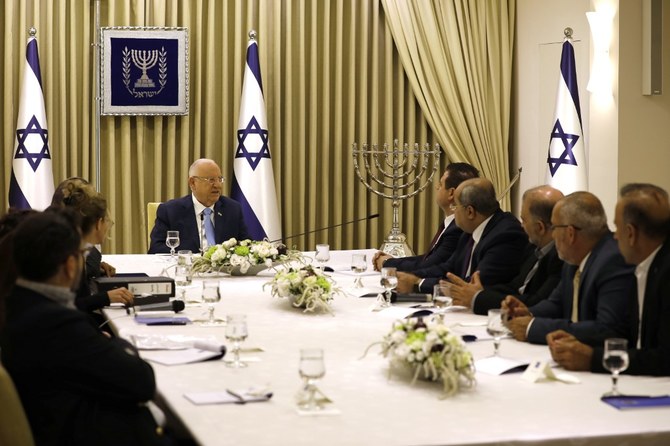
JERUSALEM: Israel's president met Prime Minister Benjamin Netanyahu and his main opponent Benny Gantz together on Monday as he pressures their two parties to form a unity government after last week's election.
The key meeting was the first between the rival leaders since the deadlocked vote, the results of which threatened Netanyahu's long domination of Israeli politics.
But the veteran premier has shown no sign of willingly giving up his post.
President Reuven Rivlin ushered both men into his office in Jerusalem around 8:00 pm (1700 GMT) after shaking each of their hands.
It was not clear how long the meeting would last, but no major breakthroughs were expected Monday evening since Rivlin is yet to announce who he will choose to try to form a government.
Rivlin called for the meeting after wrapping up consultations with political parties elected to parliament to hear their recommendations for who should form the next government.
Gantz's centrist Blue and White alliance finished with 33 seats out of 120 in the September 17 elections, while Netanyahu's right-wing Likud won 31.
Despite Gantz's slim lead, neither has a clear path to a majority coalition.
Both Netanyahu and Gantz, who had no previous political experience when he mounted his challenge to the premier, have backed calls for a unity government.
Gantz however says he should lead it since his party is the largest. A compromise seems a long way off.
The standoff has even raised the possibility of yet another election -- which would be the third in a year after April polls also ended inconclusively with Netanyahu unable to form a governing coalition.
Rivlin has said he will do all he can to avoid another election, and Monday's meeting may see him seek to play a mediator role.
Netanyahu on Monday reiterated his call for Gantz to join him in a unity government, again acknowledging he was unable to form the right-wing coalition he hoped for.
"The only government that can be formed in these conditions is a united and large one between us," Netanyahu said at a meeting of Likud lawmakers.
"The only way to reach it is to sit down and talk."
Rivlin has said clearly that he wants both Likud and Blue and White in a unity government to form a "stable" coalition -- but how to reach such an accord remains unclear.
The end of the Netanyahu era would be an extraordinary moment in Israeli politics.
He has been prime minister for a total of more than 13 years, the most in Israeli history. But he also faces potential corruption charges in the weeks ahead, pending a hearing set for early October.
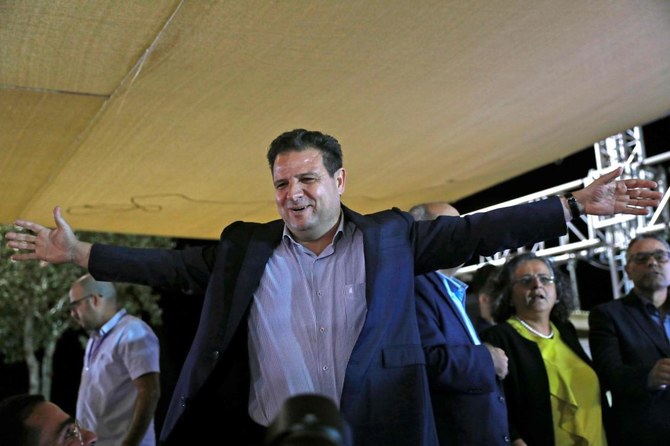
The meeting at the president's office followed a dramatic day on Sunday, when Israeli Arab parties broke with longstanding precedent and said they were endorsing Gantz for prime minister.
In announcing the move, the mainly Arab Joint List alliance said its decision was not meant as an endorsement of the policies of the ex-military chief, but as a way of helping oust Netanyahu.
Netanyahu has repeatedly been accused of political rhetoric and actions amounting to racism toward Israel's Arab population.
The Joint List won 13 seats in the election, making it the third-largest force in parliament.
Rivlin is expected to designate a candidate to try to form a government on Wednesday, when final official election results are delivered to him.
That person would then have 28 days to do so, with a possible two-week extension.
If all attempts fail, Rivlin can then assign the task to someone else.
In Rivlin's consultations, Gantz received the endorsements of 54 parliament seats, while Netanyahu received 55.
Those totals do not include eight seats for ex-defence minister Avigdor Lieberman's nationalist Yisrael Beitenu party, which has endorsed neither candidate for now and could emerge as a kingmaker.
Gantz and Lieberman met on Monday, their first talks since the election.
"We exchanged opinions and viewpoints and if needed, will speak again in the future," Gantz said in a statement.
The tally also does not include three seats for one of the Arab parties that unlike the rest of the Joint List alliance, did not agree to endorse Gantz.


![]()
![]()

Israeli president meets Netanyahu, Gantz in bid to break deadlock
Israeli president meets Netanyahu, Gantz in bid to break deadlock
- The key meeting comes as the deadlocked vote results threaten Benjamin Netanyahu’s long tenure in office
- Israeli Arab parties broke with longstanding precedent to endorse Benny Gantz for prime minister


Latest updates


© 2026 SAUDI RESEARCH & PUBLISHING COMPANY, All Rights Reserved And subject to Terms of Use Agreement.