Pakistan PM flies to US on Saudi crown prince’s special plane

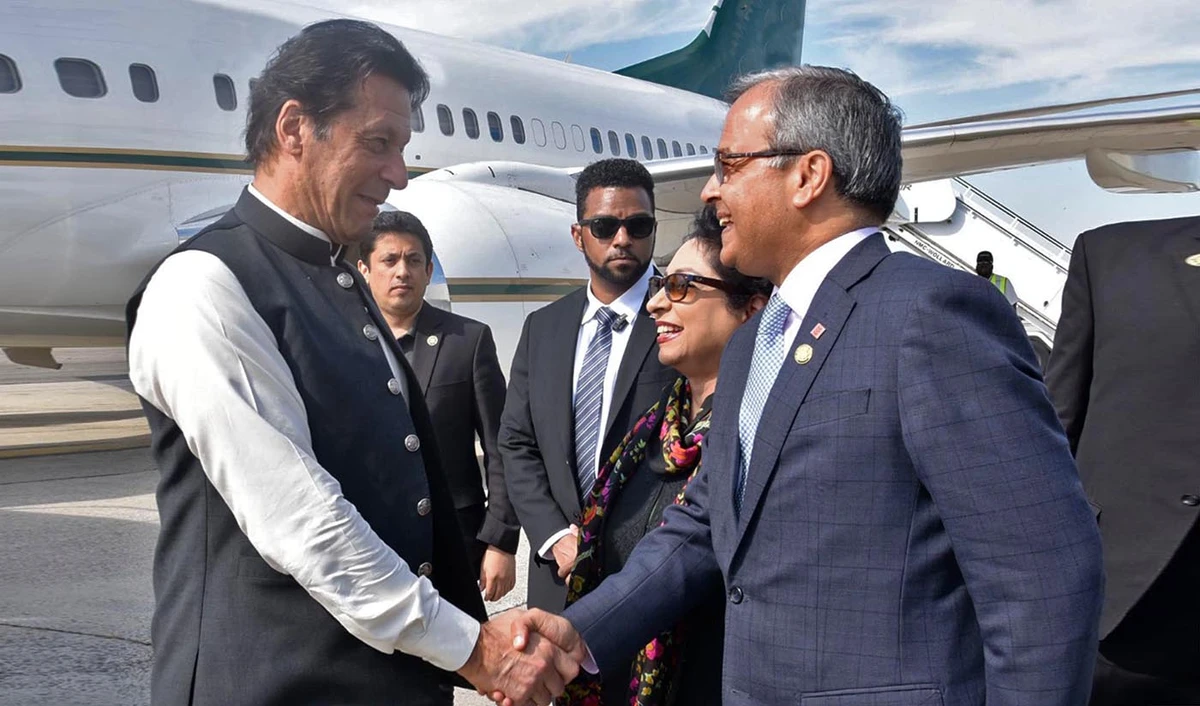
Pakistan's Ambassador to the United States Dr. Asad M. Khan and Maleeha Lodhi, the country's representative to the United Nations, receives Prime Minister Imran Khan in New York who will attend the 74th session of the United Nations General Assembly. (PID)
Updated 22 September 2019
Follow

Pakistan PM flies to US on Saudi crown prince’s special plane

  • Adviser commends Mohammed bin Salman’s ‘magnanimous’ gesture
  • Khan’s visit to the Kingdom prior to trip to Washington significant, experts say

ISLAMABAD: Prime Minister Imran Khan’s media adviser on Sunday praised the “magnanimous” gesture of Saudi Crown Prince Mohammed bin Salman who stopped the Pakistani premier from using a commercial airliner to fly to the United States and arranged a special plane for him to go to New York.
“This happens in bilateral relations,” Iftikhar Durrani told Arab News. “Prime Minister Imran Khan went to Saudi Arabia on a commercial flight. It was the magnanimity of Saudi Crown Prince Mohammed bin Salman that he offered a special plane to him for his travel from Saudi Arabia to the United States.”
Khan began his week-long visit to the US on Saturday to attend the 74th United Nations General Assembly session and participate in a host of other activities, including a meeting with President Donald Trump.
Durrani said the PM would take a commercial plane while flying back home since “he is always concerned about public money.”
“Pakistan is deeply respected in the Muslim world,” he continued. “Imran Khan’s stature is also acknowledged as a statesman in the whole world due to his social work and philanthropy.”
He said there was a lot in common between the prime minister and the Saudi crown prince. “When the Saudi leader visited Islamabad, he said that the Kingdom wanted to work with Pakistan for a while but was waiting for such leadership. So the two leaders have a chemistry. They like each other.”
Dr. Mussarrat Amin, an international relations expert, told Arab News that Saudi Arabia and Pakistan had close ties and the Kingdom had always assisted the South Asian country in times of need.
“Recently, Saudi Arabia helped Pakistan overcome economic crisis,” she noted. “Khan’s earlier visit to the US was also arranged by the crown prince which produced positive results for Pakistan.”
She added that Saudi Arabia was in a position to help Pakistan in its diplomatic engagements with the Trump administration. Amin claimed this was also the reason why Khan visited the Kingdom before flying to New York.
“The Saudis can influence the United States to play a mediatory role between Pakistan and India,” Amin said. “People in this country expect great things from the Kingdom when it comes to the Kashmir issue.”
Both Pakistani and Indian prime ministers are scheduled to address the UN General Assembly on September 27.
While Khan on Sunday is scheduled to meet US politicians, diplomats and businessmen – such as Senators Chuck Schumer and Lindsey Graham, Ambassador Zalmay Khalilzad, and David Fenton and George Soros – his first informal engagement on Monday will be with British Prime Minister Boris Johnson on breakfast.
The Pakistani prime minister will also meet Chinese Vice President Wang Qishan and President Trump on the same day.
Pakistan’s former ambassador, Ali Sarwar Naqvi, told Arab News this was a very important visit for the country since the prime minister would interact with highest level of global leadership in the US.
“This visit provides an opportunity to sensitize the international community over the Kashmir issue,” Naqvi, who also represented his country at the UN, pointed out. “The prime minister’s meeting with President Trump will be very useful, especially for Kashmir issue, as it will give him the opportunity to make the US president realize the grave situation in Kashmir due to the communications blackout and curfew that have been in place for the last 48 days.”
Naqvi also appreciated Saudi crown prince’s gesture, saying it showed the warmth between the two countries. He added that Khan’s visit to Saudi Arabia ahead of his US trip was significant.
“PM Khan reached out to the Saudi crown prince to stop escalation of situation in this region due to India’s actions in Kashmir,” he said.
Pakistan expands pilgrim travel system for Iran, Iraq with licenses to 67 new operators

Updated 9 sec ago
Follow

Pakistan expands pilgrim travel system for Iran, Iraq with licenses to 67 new operators

  • New system requires all Iraq-Iran pilgrimages to be organized by licensed groups under state oversight
  • Long-running “Salar” model relied on informal caravan leaders, leading to overstays and missing pilgrims

ISLAMABAD: Pakistan has issued registration certificates to 67 additional licensed pilgrimage companies, expanding a tightly regulated travel system designed to curb overstays, undocumented migration and security risks linked to religious travel to Iran and Iraq, the ministry of religious affairs said on Tuesday.

The move is part of a broader overhaul of Pakistan’s pilgrim management framework after authorities confirmed that tens of thousands of Pakistani pilgrims had overstayed or gone missing abroad over the past decade, raising concerns with host governments and triggering diplomatic pressure on Islamabad to tighten oversight.

“The dream of safe travel for pilgrims to Iran and Iraq through better facilities and a transparent mechanism is set to be realized,” the religious affairs ministry said in a statement, quoting Federal Minister for Religious Affairs Sardar Muhammad Yousaf, who announced that 67 new Ziyarat Group Organizers had been registered.

Pakistan’s government has dismantled the decades-old “Salar” system, under which informal caravan leaders arranged pilgrimages with limited state oversight. The model was blamed for weak documentation, poor accountability and widespread overstays, particularly during peak pilgrimage seasons. 

Under the new framework, only licensed companies are allowed to organize pilgrimages, and they are held directly responsible for ensuring pilgrims return within approved timelines.

Authorities say pilgrimages to Iran and Iraq will be conducted exclusively under the new system from January 2026, marking a full transition to regulated travel. The religion ministry said it has now completed registration of 24 operators in the first phase and 67 more in the second, with remaining applicants urged to complete documentation to obtain licenses.

The religious affairs ministry said a digital management system is being developed with the National Information Technology Board to monitor pilgrim movements and operator compliance, while a licensed ferry operator has also secured approval to explore future sea travel options.

The overhaul has been accompanied by tighter coordination with host countries. Earlier this month, Pakistan and Iraq agreed to share verified pilgrim data and restrict entry to travelers cleared under the new system, following talks between interior ministers in Islamabad and Baghdad. Pakistan has also barred overland pilgrim travel for major religious events, citing security risks in its southwestern Balochistan province, meaning travel to Iran and Iraq is now limited to approved air routes.

Officials say the reforms are aimed at balancing facilitation with accountability, as tens of thousands of Pakistani pilgrims travel annually to key Shia shrines, including Karbala and Najaf in Iraq and Mashhad and Qom in Iran. Travel peaks during religious occasions such as Arbaeen, when millions of worshippers converge on Iraq, placing heavy logistical and security demands on regional authorities.

The government says the new system is intended to restore confidence among host countries while ensuring safer, more transparent travel for Pakistani pilgrims.