

Pakistan records ‘wettest April’ in more than 60 years — weather agency

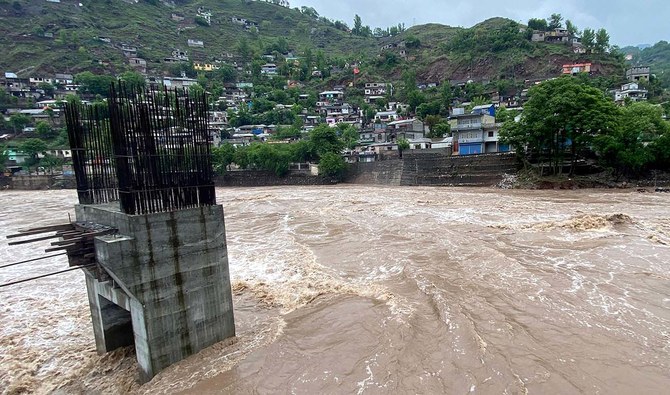
A general view of an overflowing Jhelum River after heavy rainfall in Muzaffarabad in Pakistan-administered Kashmir on April 29, 2024. (AFP/File)
Short Url
Updated 04 May 2024
Follow

Pakistan records ‘wettest April’ in more than 60 years — weather agency

  • Pakistan’s metrology department says April rainfall was recorded at 59.3 millimeters, ‘excessively above’ the normal average of 22.5 millimeters
  • There were at least 144 deaths in thunderstorms and house collapses due to heavy rains in what the report said was the ‘wettest April since 1961’

ISLAMABAD: Pakistan experienced its “wettest April since 1961,” receiving more than twice as much rain as usual for the month, the country’s weather agency said in a report.

April rainfall was recorded at 59.3 millimeters, “excessively above” the normal average of 22.5 millimeters, Pakistan’s metrology department said late Friday in its monthly climate report.

There were at least 144 deaths in thunderstorms and house collapses due to heavy rains in what the report said was the “wettest April since 1961.”

Pakistan is increasingly vulnerable to unpredictable weather, as well as often destructive monsoon rains that usually arrive in July.

In the summer of 2022, a third of Pakistan was submerged by unprecedented monsoon rains that displaced millions of people and cost the country $30 billion in damage and economic losses, according to a World Bank estimate.

“Climate change is a major factor that is influencing the erratic weather patterns in our region,” Zaheer Ahmad Babar, spokesperson for the Pakistan Meteorological Department, said while commenting on the report.

While much of Asia is sweltering dure to heat waves, Pakistan’s national monthly temperature for April was 23.67 degrees Celsius (74 degrees Fahrenheit) 0.87 degrees lower than the average of 24.54, the report noted.


Pakistan says responding to Afghan ‘offensive operations’ after border fire as tensions escalate

Updated 26 February 2026
Follow

Pakistan says responding to Afghan ‘offensive operations’ after border fire as tensions escalate

  • Afghan Taliban spokesperson says “large-scale offensive operations” launched against Pakistani military bases
  • Pakistan says Afghan forces opened “unprovoked” fire across multiple sectors along shared border

ISLAMABAD: Afghanistan’s Taliban authorities said on Thursday they had launched “large-scale offensive operations” against Pakistani military bases and installations, prompting Pakistan to say its forces were responding to what it described as unprovoked fire along the shared border.

The escalation follows Islamabad’s weekend airstrikes targeting what it said were Tehreek-e-Taliban Pakistan (TTP) and Daesh militant camps inside Afghanistan in response to a wave of recent bombings and attacks in Pakistan. Islamabad said the strikes killed over 100 militants, while Kabul said dozens of civilians were killed and condemned the attacks as a violation of its sovereignty.

In a post on social media platform X, Afghan government spokesperson Zabihullah Mujahid said Afghanistan had launched “large-scale offensive operations” in response to repeated violations by the Pakistani military.


Pakistan’s Ministry of Information said Afghan forces had initiated hostilities along multiple points of the frontier.

“Afghan Taliban regime unprovoked action along the Pakistan–Afghanistan border given an immediate, and effective response,” the ministry said in a statement.

The statement said Pakistani forces were targeting Taliban positions in the Chitral, Khyber, Mohmand, Kurram and Bajaur sectors, claiming heavy Afghan casualties and the destruction of multiple posts and equipment. It added that Pakistan would take all necessary measures to safeguard its territorial integrity and the security of its citizens.


Separately, security officials said Pakistani forces had carried out counterattacks in several border sectors.

“Pakistan’s security forces are giving a befitting reply to the unprovoked Afghan aggression with full force,” a security official said, declining to be named. 

“The Pakistani security forces’ counter-attack destroyed Taliban’s hideouts and the Khawarij fled,” they added, referring to TTP militants. 

The claims from both sides could not be independently verified.

Cross-border violence has intensified in recent weeks, with Pakistan blaming a surge in suicide bombings and militant attacks on militants it says are based in Afghanistan. Kabul denies providing safe havens to anti-Pakistan militant groups.

The clashes mark the third major escalation between the neighbors in less than a year. Similar Pakistani strikes last year triggered weeklong clashes before Qatar, Türkiye and other regional actors mediated a ceasefire in October.

The 2,600-kilometer (1,600-mile) frontier, a key trade and transit corridor linking Pakistan to landlocked Afghanistan and onward to Central Asia, has faced repeated closures amid tensions, disrupting commerce and humanitarian movement. Trade between the two nations has remained closed since October 2025.