TEHRAN: Iran’s President Hassan Rouhani said on Sunday that the presence of foreign forces creates “insecurity” in the Gulf, after the US ordered the deployment of more troops to the region.
“Foreign forces can cause problems and insecurity for our people and for our region,” Rouhani said in a televised speech at an annual military parade, adding that Iran would present to the UN a regional cooperation plan for peace.
Tensions escalated between arch-foes Iran and the United States after devastating September 14 attacks on Saudi oil installations that Washington and Riyadh have blamed on Tehran.
Following the attacks, the United States announced on Friday that it was sending reinforcements to Saudi Arabia at “the kingdom’s request.”
In his speech on Sunday, Rouhani called on the foreign powers in the Gulf region to “stay away.”
“If they’re sincere, then they should not make our region the site of an arms race,” he said.
“Your presence has always brought pain and misery for the region. The farther you keep yourselves from our region and our nations, the more security there will be for our region.”
Rouhani said Iran would present a plan for peace to the United Nations in the coming days.
“In this sensitive and important historical moment, we announce to our neighbors, that we extend the hand of friendship and brotherhood to them,” he said.

Foreign forces raise Gulf ‘insecurity’: Iran’s Rouhani
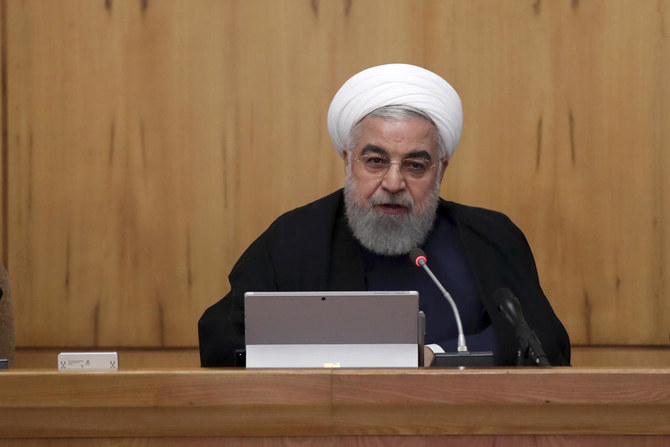
- ‘Foreign forces can cause problems and insecurity for our people and for our region’
- Hassan Rouhani calls on the foreign powers in the Gulf region to ‘stay away’
Gaza’s Rafah crossing with Egypt to open next week, Palestinian official says
- Palestinian technocrat leader backed by Washington to administer the enclave makes announcement
DAVOS: Gaza’s border crossing with Egypt will reopen next week after largely being shut during the Israel-Hamas war, the Palestinian technocrat leader backed by Washington to administer the enclave announced on Thursday.
Ali Shaath made the announcement by video link during an event in Davos hosted by President Donald Trump, who convened a group of leaders to formally launch a “Board of Peace” initially focused on cementing Gaza’s ceasefire.
A key unfulfilled element of the ceasefire, brokered by Trump in October, has been the reopening of Gaza’s main gateway to the world to allow the entry and exit of Palestinians.
“I am pleased to announce the Rafah crossing will open next week in both directions. For Palestinians in Gaza, Rafah is more than a gate. It is a lifeline and symbol of opportunity,” Shaath said.
“Opening Rafah signals that Gaza is no longer closed to the future and to the war,” Shaath said.
There was no immediate comment from Israel, which has controlled the Rafah crossing since 2024.
The ceasefire deal left Israel in control of more than half of Gaza, including the area that abuts the border crossing. Hamas controls the remainder of the enclave.
Ali Shaath made the announcement by video link during an event in Davos hosted by President Donald Trump, who convened a group of leaders to formally launch a “Board of Peace” initially focused on cementing Gaza’s ceasefire.
A key unfulfilled element of the ceasefire, brokered by Trump in October, has been the reopening of Gaza’s main gateway to the world to allow the entry and exit of Palestinians.
“I am pleased to announce the Rafah crossing will open next week in both directions. For Palestinians in Gaza, Rafah is more than a gate. It is a lifeline and symbol of opportunity,” Shaath said.
“Opening Rafah signals that Gaza is no longer closed to the future and to the war,” Shaath said.
There was no immediate comment from Israel, which has controlled the Rafah crossing since 2024.
The ceasefire deal left Israel in control of more than half of Gaza, including the area that abuts the border crossing. Hamas controls the remainder of the enclave.
© 2026 SAUDI RESEARCH & PUBLISHING COMPANY, All Rights Reserved And subject to Terms of Use Agreement.


