

US sending more troops to Gulf, as Iran begins to feel the sanction pinch

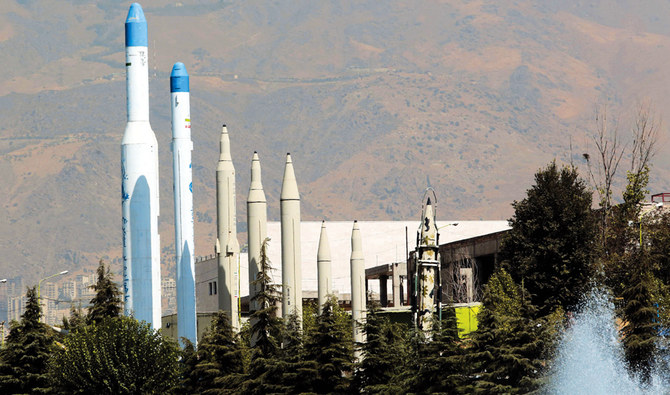
Iran flexes military muscles by putting missiles on display at a museum during the unveiling of an exhibition in Tehran on Saturday. (AFP)
Updated 21 September 2019
Follow

US sending more troops to Gulf, as Iran begins to feel the sanction pinch

  • Tehran carried out weekend attacks on rival Saudi Arabia’s oil infrastructure, which triggered a spike in global crude prices

WASHINGTON, DUBAI: The US announced on Friday that it was sending military reinforcements to the Gulf region following attacks on Saudi oil facilities that it attributes to Iran, just hours after President Donald Trump ordered new sanctions on Tehran.

Separately, Iran’s foreign minister on Saturday denounced renewed US sanctions against its central bank as an attempt to deny ordinary Iranians access to food and medicine.

Iran denies involvement in the attacks, which initially halved oil output from Saudi Arabia. Responsibility was claimed by Yemen’s Houthi militants, an Iranian-aligned group fighting an Arab alliance in Yemen’s civil war.

“But this is dangerous and unacceptable as an attempt at blocking ... the Iranian people’s access to food and medicine,” Foreign Minister Mohammad Javad Zarif told reporters in remarks shown on state television.

Zarif was speaking after arriving in New York for the annual UN General Assembly next week.

Sanctions ‘toughest’

Trump said the sanctions were the toughest-ever against another country, but indicated he did not plan a military strike, calling restraint a sign of strength.

The Treasury Department renewed action against Iran’s central bank after US officials said Tehran carried out weekend attacks on rival Saudi Arabia’s oil infrastructure, which triggered a spike in global crude prices.

Those attacks, combined with an Iranian attack on an American spy drone in June, represented a “dramatic escalation of Iranian aggression,” Secretary of Defense Mark Esper said.

The Pentagon chief announced that the US would send military reinforcements to the Gulf region at the request of Saudi Arabia and the UAE.

“In response to the kingdom’s request, the president has approved the deployment of US forces, which will be defensive in nature, and primarily focused on air and missile defense,” Esper said.

However Joint Chiefs of Staff Joe Dunford categorized the deployment as “moderate,” with the number of troops not expected to reach thousands.

Meanwhile, there were reports on social media that a number of Iranian servers and websites — including those of some petrochemical firms — were under a cyberattack. There was no immediate official comment, and the websites of the main state oil company NIOC appeared to be functioning normally. Residents said their Internet access was not affected.

NetBlocks, an organization that monitors internet connectivity, said its data showed “intermittent disruptions” to some internet services in Iran starting from Friday evening.

But the group said the impact was limited, affecting only specific providers, and the cause was unclear. 

“Data are consistent with a cyber-attack or unplanned technical incident on affected networks as opposed to a purposeful withdrawal or shutdown incident,” it said in a tweet.

The fresh sanctions target the Central Bank of Iran, which was already under other US sanctions, the National Development Fund of Iran — the country’s sovereign wealth fund — and an Iranian company that US officials say is used to conceal financial transfers for Iranian military purchases.


Israel’s hostage forum releases AI-generated video of last Gaza captive

Updated 23 December 2025
Follow

Israel’s hostage forum releases AI-generated video of last Gaza captive

  • The Gaza ceasefire, which came into effect in October, remains fragile with both sides alleging violations, and mediators fearing that Israel and Hamas alike are stalling

JERUSALEM: An Israeli group representing the families of Gaza hostages released on Tuesday an AI-generated video of Ran Gvili, the last captive whose body is still being held in the Palestinian territory.
The one-minute clip, created whole cloth using artificial intelligence, purports to depict Gvili as he sits in a Gaza tunnel and appeals to US President Donald Trump to help bring his body back to Israel.
“Mr President, I’m asking you to see this through: Please bring me home. My family deserves this. I deserve the right to be buried with honor in the land I fought for,” says the AI-generated image of Gvili.
Gvili was 24 at the time of Hamas’s October 7, 2023 attack on Israel.
He was an officer in Israel’s Yasam elite police unit and was on medical leave when he learnt of the attack.
He decided to leave his home and brought his gun to counter the Hamas militants.
He was shot in the fighting at the Alumim kibbutz before he was taken to Gaza.
Israeli authorities told Gvili’s parents in January 2024 that he had not survived his injuries.
The AI clip was released by the Hostages and Missing Families Forum, the main group representing those taken captive to Gaza.
The Forum said it was published with the approval of Gvili’s family.
“Seeing and hearing Rani speak in his own voice is both moving and heartbreaking. I would give anything to hear, see and hold him again,” Gvili’s mother Talik said, quoted by the Forum.
“But all I can do now is plead that they don’t move to the next phase of the agreement before bringing Rani home — because we don’t leave heroes behind.”
The Gaza ceasefire, which came into effect in October, remains fragile with both sides alleging violations, and mediators fearing that Israel and Hamas alike are stalling.
In the first stage, Palestinian militants were expected to return all of the remaining 48 living and dead hostages held in Gaza.
Since the ceasefire came into effect on October 10, militants have released 47 hostages.
In the next stages of the truce, Israel is supposed to withdraw from its positions in Gaza, an interim authority is to govern the Palestinian territory instead of Hamas, and an international stabilization force is to be deployed.
Israeli Prime Minister Benjamin Netanyahu is expected to meet Trump in Florida later this month to discuss the second phase of the deal.