

WEEKLY ENERGY RECAP: Strength in adversity

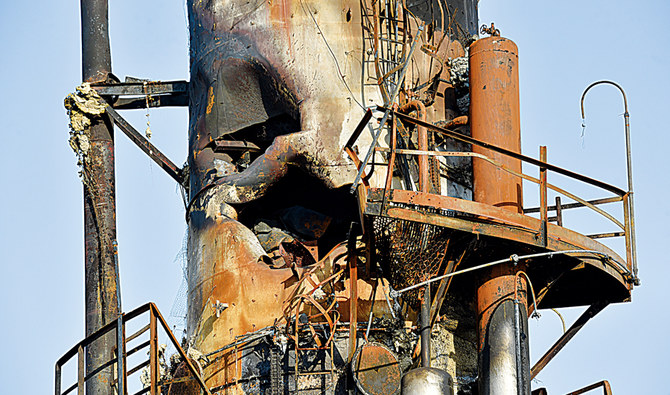
Damage at Saudi Arabia’s Abqaiq oil processing plant. (AFP)
Updated 22 September 2019
Follow

WEEKLY ENERGY RECAP: Strength in adversity

  • Saudi Aramco was able to continue with its deliveries which reassured the market

The week started with the largest “force majeure” in the history of the oil industry following the attacks on Saudi Aramco oil and gas facilities in Abqaiq and Khurais. 

It represented a supply disruption of some 5.7 million barrels per day (bpd). 

Still, Saudi crude oil exports were suspended for only 36 hours before resuming. Brent crude’s price started the week on levels not seen since late April, above $70.

The market calmed down after Saudi Aramco customers confirmed that their near-term crude oil term allocations were not affected by the attacks and that there was sufficient stockpiles to cover for lost production.

This clearly demonstrated the robust and resilient infrastructure of Saudi Aramco oil and gas facilities.

The immediate risk management response greatly mitigated the losses despite suggestions from parts of the oil industry media that the attacks highlighted the vulnerability of Saudi oil supplies.

Saudi Aramco was able to continue with its deliveries which reassured the market and was the main factor in the gradual retreat of the oil price over the week.

Brent softened to $64.28 per barrel and WTI fell to $58.09 — but that was still up almost $4 from a week earlier.

That represented the biggest weekly gain this year since, with prices moving mostly in a very narrow band until this week.

Elsewhere, the US EIA reported that Cushing oil stocks were at their lowest level since October 2018. 

Storms in Texas also triggered the shutdown of some pipeline and terminal capacity, but the impact on the market is not yet clear as it coincides with a period of extensive refinery turnarounds in the region.

Softening crude oil futures show that the physical market is more concerned than the paper market as Arabian Gulf sour crude grades continue to strengthen. 

Platts reported that the backwardation (where the spot price of oil is higher than the future price) in the Dubai forward price structure rose to a six-year high of $2.90 per barrel. 

• Faisal Faeq is an energy and oil marketing adviser. He was formerly with OPEC and Saudi Aramco. Twitter:@faisalfaeq


Saudi Arabia, Japan trade rises 38% between 2016 and 2024, minister says

Updated 11 January 2026
Follow

Saudi Arabia, Japan trade rises 38% between 2016 and 2024, minister says

RIYADH: Trade between Saudi Arabia and Japan has increased by 38 percent between 2016 and 2024 to reach SR138 billion ($36 billion), the Kingdom’s investment minister revealed.

Speaking at the Saudi-Japanese Ministerial Investment Forum 2026, Khalid Al-Falih explained that this makes the Asian country the Kingdom’s third-largest trading partner, according to Asharq Bloomberg.

This falls in line with the fact that Saudi Arabia has been a very important country for Japan from the viewpoint of its energy security, having been a stable supplier of crude oil for many years.

It also aligns well with how Japan is fully committed to supporting Vision 2030 by sharing its knowledge and advanced technologies.

“This trade is dominated by the Kingdom's exports of energy products, specifically oil, gas, and their derivatives. We certainly look forward to the Saudi private sector increasing trade with Japan, particularly in high-tech Japanese products,” Al-Falih said.

He added: “As for investment, Japanese investment in the Kingdom is good and strong, but we look forward to raising the level of Japanese investments in the Kingdom. Today, the Kingdom offers promising opportunities for Japanese companies in several fields, including the traditional sector that links the two economies: energy.”

The minister went on to note that additional sectors that both countries can also collaborate in include green and blue hydrogen, investments in advanced industries, health, food security, innovation, entrepreneurship, among others.

During his speech, Al-Falih shed light on how the Kingdom’s pavilion at Expo 2025 in Osaka achieved remarkable success, with the exhibition receiving more than 3 million visitors, reflecting the Japanese public’s interest in Saudi Arabia.

“The pavilion also organized approximately 700 new business events, several each day, including 88 major investment events led by the Ministry of Investment. Today, as we prepare for the upcoming Expo 2030, we look forward to building upon Japan’s achievements,” he said.

The minister added: “During our visit to Japan, we agreed to establish a partnership to transfer the remarkable Japanese experience from Expo Osaka 2025 to Expo Riyadh 2030. I am certain that the Japanese pavilion at Expo Riyadh will rival the Saudi pavilion at Expo Osaka in terms of organization, innovation, and visitor turnout.”

Al-Falih also shed light on how Saudi-Japanese relations celebrated their 70th anniversary last year, and today marks the 71st year of these relations as well as how they have flourished over the decades, moving from one strategic level to an even higher one.