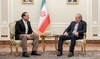
DUBAI: Iran’s foreign minister on Saturday denounced renewed US sanctions against its central bank as an attempt to deny ordinary Iranians access to food and medicine, and said the move was a sign of US desperation.
The United States on Friday imposed a new round of sanctions on Iran, some aimed at its central bank and sovereign wealth fund, following attacks on oil facilities in Saudi Arabia that Riyadh and US officials have blamed on Iran.
Iran denies involvement in the attacks, which initially halved oil output from Saudi Arabia. Responsibility was claimed by Yemen’s Houthi movement, an Iranian-aligned group fighting a Saudi-led alliance in Yemen’s civil war.
“This is a sign of US desperation ... When they repeatedly sanction the same institution, this means their attempt at bringing the Iranian nation to its knees under ‘maximum pressure’ has failed,” Foreign Minister Mohammad Javad Zarif told reporters in remarks shown on state television.
“But this is dangerous and unacceptable as an attempt at blocking ... the Iranian people’s access to food and medicine,” Zarif said, speaking after arriving in New York for the annual UN General Assembly next week.
Meanwhile, unconfirmed reports on social media said a number of Iranian websites — including those of some petrochemical firms — were under a cyberattack. There was no immediate official comment, and the websites of the main state oil company NIOC appeared to be functioning normally. Residents said their Internet access was not affected.
The fresh sanctions target the Central Bank of Iran, which was already under other US sanctions, the National Development Fund of Iran — the country’s sovereign wealth fund — and an Iranian company that US officials say is used to conceal financial transfers for Iranian military purchases.
Zarif said he would meet on Wednesday with foreign ministers of the remaining signatories to the 2015 nuclear accord, which was agreed with Britain, France, Germany China and Russia as well as the United States.
“As we have said before, the United States can only attend if it returns to the (nuclear accord) ... and ends its economic war against Iran,” Zarif said.
The United States withdrew from the accord last year and re-imposed unilateral sanctions on Iran.
“I hope the US government realizes that they are no longer the only economic superpower in the world and that there are many countries that want to benefit from the Iranian market,” Foreign Ministry spokesman Abbas Mousavi said, according to state media.

US sanctions target Iranians’ access to food, medicine: foreign minister

- The United States on Friday imposed a new round of sanctions on Iran
- Unconfirmed reports on social media said a number of Iranian websites were under a cyberattack
Israel orders Gaza families to move in first forced evacuation since ceasefire
- Residents of Bani Suhaila, east of Khan Younis, said the leaflets were dropped on Monday on families living in tent encampments in the Al-Reqeb neighborhood
CAIRO: Israeli forces have ordered dozens of Palestinian families in the southern Gaza Strip to leave their homes in the first forced evacuation since October’s ceasefire, as residents and Hamas said on Tuesday the military was expanding the area under its control.
Residents of Bani Suhaila, east of Khan Younis, said the leaflets were dropped on Monday on families living in tent encampments in the Al-Reqeb neighborhood.
“Urgent message. The area is under IDF control. You must evacuate immediately,” said the leaflets, written in Arabic, Hebrew, and English, which the army dropped over the Al-Reqeb neighborhood in the town of Bani Suhaila.
In the two-year war before the US brokered ceasefire was signed in October, Israel dropped leaflets over areas that were subsequently raided or bombarded, forcing some families to move several times.
Residents and a source from the Hamas militant group said this was the first time they had been dropped since then. The Israeli military did not immediately respond to a request for comment.
SIDES FAR APART ON NEXT PHASES
The ceasefire has not progressed beyond its first phase, under which major fighting has stopped, Israel withdrew from less than half of Gaza, and Hamas released hostages in return for Palestinian detainees and prisoners.
Virtually the entire population of more than 2 million people are confined to around a third of Gaza’s territory, mostly in makeshift tents and damaged buildings, where life has resumed under control of an administration led by Hamas.
Israel and Hamas have accused each other of major breaches of the ceasefire and remain far apart on the more difficult steps planned for the next phase.
Mahmoud, a resident from the Bani Suhaila area, who asked not to give his family name, said the evacuation orders impacted at least 70 families, living in tents and homes, some of which were partially damaged, in the area.
“We have fled the area and relocated westward. It is maybe the fourth or fifth time the occupation expanded the yellow line since last month,” he told Reuters by phone from Khan Younis, referring to the line behind which Israel has withdrawn.
“Each time they move it around 120 to 150 meters (yards) inside the Palestinian-controlled territory, swallowing more land,” the father-of-three said.
HAMAS CITES STATE OF HUMANITARIAN DISRUPTION
Ismail Al-Thawabta, director of the Hamas-run Gaza government media office, said the Israeli military had expanded the area under its control in eastern Khan Younis five times since the ceasefire, forcing the displacement of at least 9,000 people.
“On Monday, 19 January 2026, the Israeli occupation forces dropped warning leaflets demanding the forced evacuation of the Bani Suhaila area in eastern Khan Younis Governorate, in a measure that falls within a policy of intimidation and pressure on civilians,” Thawabta told Reuters.
He said the new evacuation orders affected approximately 3,000 people.
“The move created a state of humanitarian disruption, increased pressure on the already limited shelter areas, and further deepened the internal displacement crisis in the governorate,” Thawabta added.
Israel’s military has previously said it has opened fire after identifying what it called “terrorists” crossing the yellow line and approaching its troops, posing an immediate threat to them.
It has continued to conduct air strikes and targeted operations across Gaza. The Israeli military has said it views “with utmost severity” any attempts by militant groups in Gaza to attack Israel.
Under future phases of the ceasefire that have yet to be hammered out, US President Donald Trump’s plan envisages Hamas disarming, Israel pulling out further, and an internationally backed administration rebuilding Gaza.
More than 460 Palestinians and three Israeli soldiers have been reported killed since the ceasefire took effect.
Israel launched its operations in Gaza in the wake of an attack by Hamas-led fighters in October 2023 which killed 1,200 people, according to Israeli tallies. Israel’s assault has killed 71,000 people, according to health authorities in the enclave.