

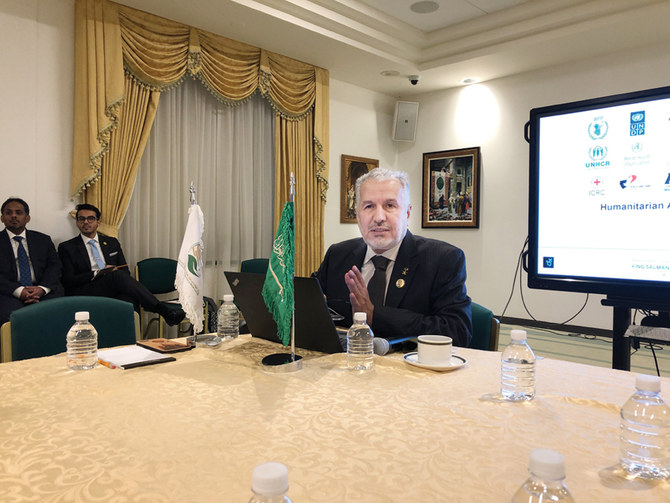

CHICAGO: The head of the King Salman Humanitarian Aid and Relief Center (KSRelief) called on the UN to pass a resolution condemning the Iranian government for its support of a wave of violence by the Houthis against civilian targets in Yemen.
Dr. Abdullah Al-Rabeeah said the violence is having a “significant negative impact” on the people of Yemen and on the humanitarian aid effort led by the Saudi government.
Referring to the recent drone strikes against the Aramco fields in Saudi Arabia that sent a shockwave through the oil industry and spiked oil and gasoline prices around the world, Al-Rabeeah said it was obvious the Houthis are not capable of mounting such high-tech strikes.
“The initial info indicates that the incident is an Iranian-made attack. We feel there is a need for an investigation by the UN,” Al-Rabeeah said. “Iran is behind many attacks against the region. The UN should take action. There should be a resolution against Iran. The involvement of the UN delivers a message.”
Although he said that the attack is still under investigation, he said that “drones are a technology that the Houthis do not have … the technology is beyond the abilities of the Houthis. There must be a country behind it.”
During a press briefing at the Saudi Embassy in Washington, DC, on Wednesday, Al-Rabeeah said as many as 20 humanitarian aid workers funded by a coalition of 80 nations led by Saudi Arabia have been injured or targeted.
He said providing humanitarian aid to the people of Yemen faces many challenges, including the targeting of women and the recruitment of children by the Iranian-backed Houthi militias.
“There is a need for the international community to unify and have the political will to fight any violations against humanitarian support,” Al-Rabeeah said.
Despite attacks by the Houthis against civilian and military targets and humanitarian aid workers, Al-Rabeeah said King Salman has made a commitment to ensure that the aid reaches civilians in areas controlled by the Houthis.
He said that the humanitarian effort has been hampered by the Houthi militia’s shelling of government-controlled civilian areas, releasing data showing 66,403 rocket attacks, 264 Scud missiles, and 233 drone assaults “that continues to increase,” such as the drone assault on the Aramco oil fields last week.
So far 113 Yemeni civilians have been killed, 1,030 have been injured and 20,357 Saudis have been displaced from border regions. Damage has been caused to 41 schools, six hospitals, and 20 mosques.
Despite the challenges, Al-Rabeeah said the humanitarian drive will continue until the conflict is brought to an end.
“We do not call for war against the region. Those attacks are not against Saudi Arabia. They are against all of us,” Al-Rabeeah said.


