
CAIRO: For more than two million people in the Gaza Strip, the struggles of daily life include coping on just three hours of electricity, while hospitals, schools, sanitation facilities and agriculture have to operate on an unreliable, limited sources of electric power controlled by politics.
For 25-year-old Majd Mashharawi, there was no doubt that something needed to change. Mashharawi was a civil engineering graduate of Gaza’s Islamic University, where one student in every six is female.
In a gender-biased culture, it meant fewer work opportunities and more obstacles. However, the engineer turned entrepreneur refused to let this stop her.
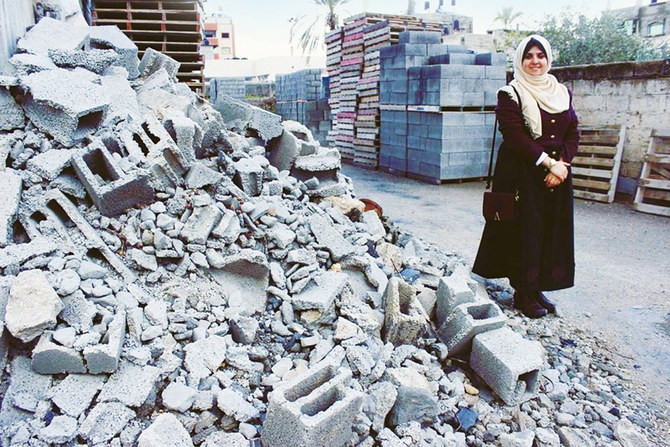
“In Gaza, we’ve been suffering the effects of a harsh blockade for longer than a decade,” she said. “We are trapped in this open-air prison with no access to clean water, proper healthcare, reliable electricity, let alone houses. For the past 50 years, because recycling methods aren’t being applied, the rubble from demolished houses ends up in landfills, then our groundwater, causing more damage.”
Since bringing construction materials into Gaza is restricted, Mashharawi and her former colleague, Rawan Abdulatif, thought: “Why don’t we create building blocks from the local material we abundantly have here in Gaza rubble?”
Mashharawi had to try 150 times before getting the right formula for “Green Cake”, an alternative to concrete as cheap as rubble. “Concrete is made of aggregate, sand and cement. After eight months of experimenting, we realized we would not be able to replace cement entirely, so we started looking at the other two ingredients,” she recalled.
“In Gaza, asphalt factories produce eight tonnes of ash every week from burning wood and coal. We turned this harmful industrial waste into a filler for our building blocks, cutting down construction material cost by 25 per cent.”
Following numerous tests for durability, fire resistance, compression and sustainability, Green Cake hit the market in 2016.
“Being a female in the construction business was even more challenging than inventing Green Cake itself,” she said. “It took a lot of determination and research to find a workshop in Gaza that would allow me to conduct and implement my so-called experiment.”
While Green Cake has yet to stand the test of time, 100,000 building blocks have been used to restore houses and factories all over the war-torn city. “This is just the beginning,” Mashharawi said. “We believe that Green Cake has a long way to go, and we won’t be able to get there without financial support.”
She did not stop there. “In a city that gets an average of 320 days of sunshine a year, our entire region is yet to resort to a more sustainable energy source, solar,” she said.
Enter Sun Box, a solar-energy kit that generates 1,000 watts of electricity, enough to power small household appliances, four lamps and a fridge for a day. The system, imported from China but installed locally, would cost a household $350.
“Sixteen percent of families in Gaza pay about $56 monthly to get alternative electrical resources. And when talking about the general population, most households pay about $15 monthly to get their alternative electrical source,” Mashharawi said.
“So, when you come to think about it, in the long run, it’s actually cheaper, more sustainable, and a reliable source of energy.”
The company, which has profit and non-profit arms, launched in November 2017 to offer solar systems for families suffering from an electricity shortage.
Sun Box provides different versions. One is for low-income families, subsidized by a crowdfunding programme, and the other is a shared system for two households.
“It’s hard to run a business that totally depends on politics. Getting the needed permits to get these panels into Gaza could be our most challenging obstacle, but we get it done,” Mashharawi said.
“We need to fight for our rights in Gaza, and in order to do that, we must have something to believe in, a passion to drive us towards the change we want to see in our world.”
• This report is being published by Arab News as a partner of the Middle East Exchange, which was launched by the Mohammed bin Rashid Al Maktoum Global Initiatives and the Bill and Melinda Gates Foundation to reflect the vision of the UAE prime minister and ruler of Dubai to explore the possibility of changing the status of the Arab region.