Aramco attack implications to go beyond region: Pakistani expats

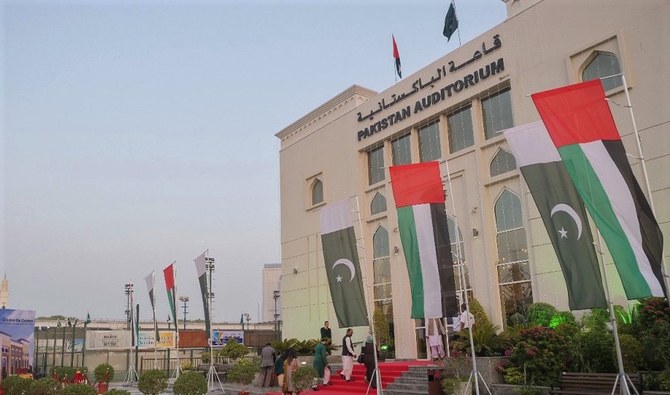
Undated photo for Pakistan Complex at the Pakistan Association, Dubai, UAE. ( Photo credit Pakistan Association Dubai)
Updated 18 September 2019
Follow

Aramco attack implications to go beyond region: Pakistani expats

  • Say the economic conditions will become challenging after this incident including in the UAE
  • As a community, feel terrible and all our support is with Saudi Arabia,” - Pakistani expat Dr Hadi Shahid

DUBAI: The economic implications of the attacks on Aramco oil facilities will be felt way further than the region, say representatives of the Pakistani community in the UAE.
Expressing concerns over the attacks that took place on Saudi Arabia’s biggest oil supply chain early on Saturday, the Pakistani community members in the UAE said that the economic outcomes will pose a challenge immediately and in the long run as well.
“Conflict is in nobody’s interest and whoever is behind the attacks, obviously has a bigger agenda,” Javed Khamisani, CEO of Allianz Hosting, an IT Services Company operating in the UAE, Pakistan and UK, told Arab News.
“We, in the UAE, are not immune to implications of the attack and the consequential increase in the oil prices. In fact, the impact will be felt globally and especially so in Pakistan which is highly dependent on imports,” said Khamisani.
Global oil prices are already 10 percent higher since the attack on the heart of Saudi Arabia’s oil infrastructure.
Ahmed Shaikhani, vice president of Pakistan Business Council (PBC) in Dubai, condemned the attack in clear terms.
“This attack should not have happened...the economic conditions are already not too viable worldwide and will further become challenging after this incident including in the UAE,” he told Arab News, adding that the common man would bear the brunt of this attack.
According to Khamisani, the disruption in oil production would drive up costs, impacting the salaried class majorly. “Transport costs will go up and it will make a huge difference to the day to day life of common man...budgets will be affected. This will happen only in the UAE, where majority of the people are from the salaried class, but even beyond the region, until Pakistan.”
However, the President of Pakistan Business Council (PBC) in Dubai, Iqbal Dawood was quite optimistic that the situation would was short lived and would be handled well.
“A disturbance has definitely been created and oil prices have gone up but I am positive that all the problems will be resolved in a proper manner since the leadership in Saudi Arabia is very strong,” he said.
The attacks on Aramco’s main crude processing facility knocked out 5.7 million barrels of daily oil production for Saudi Arabia, or more than five percent of the world’s daily crude production.
Dr. Hadi Shahid, Chartered Accountant and Managing Partner, Alliot, UAE said that “We, as a community, feel terrible and all our support is with Saudi Arabia at this point,” adding that the country’s leadership was strong and would get to the heart of the matter.
Global energy prices spiked Monday by a percentage unseen since the 1991 Gulf War after the weekend attack on key oil facilities in Saudi Arabia caused the worst disruption to world supplies on record, further fueling heightened tensions between Iran and the US.
Saudi Arabia is the world’s biggest crude exporter and one of the top producers. The attack removed half of its output- 5.7 million barrels per day (bpd), or the equivalent to five percent of global supplies.


What is Trump’s ‘Board of Peace’?

Updated 10 sec ago
Follow

What is Trump’s ‘Board of Peace’?

  • Countries asked to pay $1 billion for a permanent spot on the board
  • The board was originally conceived to oversee the rebuilding of Gaza

BRUSSELS: US President Donald Trump’s government has asked countries to pay $1 billion for a permanent spot on his “Board of Peace” aimed at resolving conflicts, according to its charter seen by AFP.

The board was originally conceived to oversee the rebuilding of Gaza, but the charter does not appear to limit its role to the occupied Palestinian territory.

WHAT WILL IT DO?

The Board of Peace will be chaired by Trump, according to its founding charter.

It is “an international organization that seeks to promote stability, restore dependable and lawful governance, and secure enduring peace in areas affected or threatened by conflict,” reads the preamble of the charter sent to countries invited to participate.

It will “undertake such peace-building functions in accordance with international law,” it adds.

WHO WILL RUN IT?

Trump will be chairman but also “separately serve as inaugural representative” of the US.

“The chairman shall have exclusive authority to create, modify, or dissolve subsidiary entities as necessary or appropriate to fulfil the Board of Peace’s mission,” the document states.

He will pick members of an executive board to be “leaders of global stature” to “serve two-year terms, subject to removal by the chairman.”

He may also, “acting on behalf of the Board of Peace,” “adopt resolutions or other directives.”

The chairman can be replaced only in case of “voluntary resignation or as a result of incapacity.”

WHO CAN BE A MEMBER?

Member states must be invited by the US president, and will be represented by their head of state or government.

Each member “shall serve a term of no more than three years,” the charter says.

But “the three-year membership term shall not apply to member states that contribute more than USD $1,000,000,000 in cash funds to the Board of Peace within the first year of the charter’s entry into force,” it adds.

The board will “convene voting meetings at least annually,” and “each member state shall have one vote.”

But while all decisions require “a majority of member states present and voting,” they will also be “subject to the approval of the chairman, who may also cast a vote in his capacity as chairman in the event of a tie.”

WHO’S ON THE EXECUTIVE BOARD?

The executive board will “operationalize” the organization’s mission, according to the White House, which said it would be chaired by Trump and include seven members:

US Secretary of State Marco Rubio

Steve Witkoff, Trump’s special negotiator

Jared Kushner, Trump’s son-in-law

Tony Blair, former UK prime minister

Marc Rowan, billionaire US financier

Ajay Banga, World Bank president

Robert Gabriel, loyal Trump aide on the National Security Council

WHICH COUNTRIES ARE INVITED?

Dozens of countries and leaders have said they have received an invitation.

They include China, India, Russia’s President Vladimir Putin, Ukraine’s Volodymyr Zelensky and Canada’s Prime Minister Mark Carney.

Egypt’s President Abdel Fattah El-Sisi and Argentina’s President Javier Milei have also confirmed an invite.

Other countries to confirm invites include Jordan, Brazil, Paraguay, Pakistan and a host of nations from Europe, Central Asia and the Middle East.

WHO WILL JOIN?

Countries from Albania to Vietnam have indicated a willingness to join the board.

Hungarian Prime Minister Viktor Orban, Trump’s most ardent supporter in the European Union, is also in.

Canada said it would take part, but explicitly ruled out paying the $1-billion fee for permanent membership.

It is unclear whether others who have responded positively — Armenia, Belarus, Kazakhstan, Morocco and Vietnam among them — would be willing to pay the $1 billion.

WHO WON’T BE INVOLVED?

Long-time US ally France has indicated it will not join. The response sparked an immediate threat from Trump to slap sky-high tariffs on French wine.

Zelensky said it would be “very hard” to be a member of a council alongside Russia, and diplomats were “working on it.”

WHEN DOES IT START?

The charter says it enters into force “upon expression of consent to be bound by three States.”