ISLAMABAD: The Taliban want to explain their position on the Afghan peace process to countries around the world in “face-to-face meetings,” the group’s political spokesperson Suhail Shaheen told Arab News on Sunday, as a Taliban delegation wrapped up a four-day visit to Moscow.
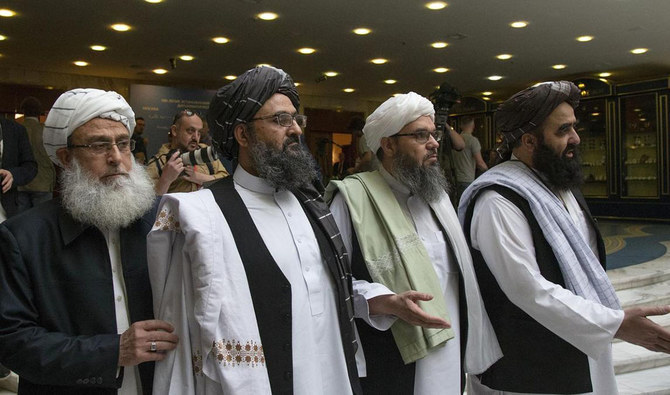
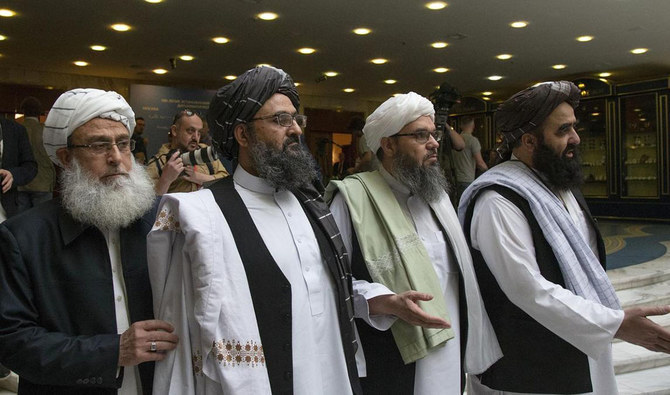
The Taliban sent a three-member delegation to Russia to discuss prospects for the withdrawal of US troops from Afghanistan following the collapse of talks with the United States this month. The delegation met with Russian officials, including President Putin’s special envoy for Afghanistan, Zamir Kabulov.
“This is our policy, to brief and explain our position to countries in face-to-face meetings, which are astonished and concerned over the situation,” Shaheen said, but added that no visit had yet been planned.
This was the group’s first foreign trip since US President Donald Trump blocked the near-final Afghan peace deal on September 7 in a series of Twitter posts, citing a Taliban attack that had killed an American soldier and 11 other people.
The Taliban delegation to Moscow was headed by Taliban chief negotiator Sher Abbas Stanekzai, and included Suhail Shaheen and a senior member, Qari Din Muhammad.
“We explained our position to Russian officials and they supported our stance on the political negotiations,” Shaheen said in a series of audio messages.
“They agreed that there is no military solution to the Afghan problem and that the issue should be resolved through political means. They said the peace deal we have finalized with the American side is a strong foundation for peace,” he said.
Russia, which has hosted meetings between the Taliban and Afghan political and civil society representatives, said this week it hoped the process could be put back on track and urged both sides to resume talks.
On Sunday, a Russian news agency quoted its foreign ministry spokesman as saying Moscow had “stressed the necessity of the resumption of talks between the United States and the Taliban movement. Taliban, in turn, reiterated its readiness to continue dialogue with Washington.”
However, it is unclear whether the talks can be resumed.
President Trump tweeted once again on Sunday with reference to the Taliban and the end of the negotiation process.
“The Taliban has never been hit harder than it is being hit right now. Killing 12 people, including one great American soldier, was not a good idea. There are much better ways to set up a negotiation. The Taliban knows they made a big mistake, and they have no idea how to recover!” the US President said on Twitter.
But Shaheen played down Trump’s statements and said military pressure would not work. He added the sensible way was to convene at the negotiation table and sign off on the peace agreement.
“Implementation of the agreement will start after it is inked and we will be bound to implement it. The world will be a witness to check if we violate or they violate,” he said. “Neither they can blame us nor do we blame them (before signing).
“There is no cease-fire now. There is no obligation before the signing so how (can) the Americans blame us for violation of the agreement,” Shaheen said and added that Taliban policy was to “solve the Afghan problem peacefully” and not militarily.
As the Taliban delegation arrived in Moscow on Sept. 12, Russian foreign ministry spokesman Maria Zakharova said during a briefing: “We are convinced that the complete end to foreign military presence is an inalienable condition of durable peace in Afghanistan.”


After Moscow, Taliban want “face-to-face” meetings in other countries
After Moscow, Taliban want “face-to-face” meetings in other countries
- Spokesman says Russia backs group’s stance on finding political solution for Afghan peace process
- Says until agreement with US is signed, there cannot be cease-fire violation

Pakistan’s Punjab to establish anti-drone units in all districts for first time
- Police to deploy jammers and surveillance drones under district police chiefs
- Province-wide ban already in place on public drone flying under Section 144
ISLAMABAD: The government of Pakistan’s largest province of Punjab has decided to establish anti-drone units in all districts of the province, a spokesman said on Friday, as authorities move to strengthen aerial surveillance and counter potential security threats.
The initiative will deploy specialized drone fleets and electronic counter-drone systems across districts, operating under the supervision of district police officers (DPOs), according to a statement issued by the Punjab Home Department.
Pakistan has faced growing aerial security concerns in recent years as drones increasingly feature in regional conflicts.
Tensions with Afghanistan escalated last week with cross-border strikes and reports of drone activity during fighting along the frontier, while the widening conflict involving neighboring Iran has heightened fears of missile and drone threats across the region. In May 2025, Pakistan and India also exchanged drone and missile strikes during a brief military confrontation, underscoring the expanding role of unmanned aerial systems in regional warfare.
“For the first time in the country’s history, decision made to establish ‘Anti-Drone Units’ in all districts of Punjab,” the Punjab Home Department spokesperson said in the statement.
“Anti-Drone Units will monitor the airspace of the district with the help of special drone fleets.”
According to the statement, anti-drone systems will also be deployed in every district and will be capable of disabling hostile or unauthorized drones through electronic jamming technology.
Section 144 is already in force across Punjab on flying outdoor drones, the statement said, adding that the provincial government has imposed a ban on public drone usage in view of security concerns.
Law enforcement and intelligence agencies are exempt from the restriction.
“Public protection, establishment of peace and security, and safeguarding of properties are the Punjab government’s top priorities,” the spokesperson said.


