

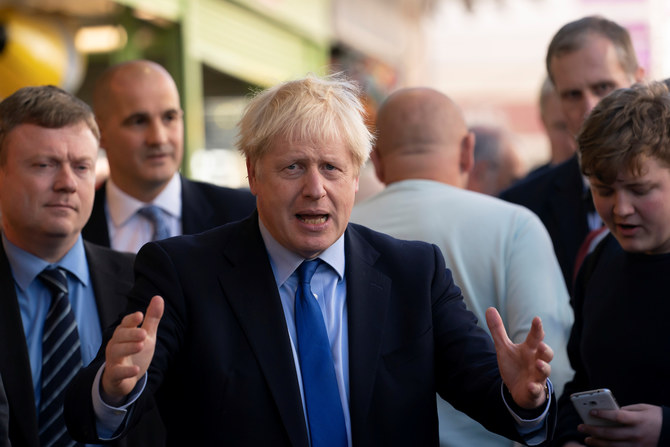

LONDON: Boris Johnson will meet EU chief Jean-Claude Juncker in Luxembourg on Monday, officials said, as the British prime minister bids to broker a Brexit compromise ahead of the October 31 deadline.
Johnson will "hold talks with President Juncker on Brexit," his Downing Street office said without providing further details.
EU spokeswoman Natasha Bertaud told reporters that the two would have a working lunch that was arranged by "common accord".
The British pound gained one percent against the dollar in Friday trading on speculation that the two sides were edging closer to a compromise over the contentious Irish border issue.
Johnson refuses to sign off on an agreement that includes the "backstop," a compromise intended to keep the frontier open for trade and crossings in all post-Brexit scenarios.
It was accepted by his predecessor Theresa May but repeatedly failed to win backing in the British parliament.
Eurosceptics fear the stop-gap measures designed for the border between EU member Ireland and the UK province of Northern Ireland would keep Britain indefinitely trapped in bloc's trade zone.
The Times reported on Friday that the DUP, a small Northern Irish party that had helped the ruling Conservatives in London form a majority in parliament since 2017, was now ready to abide by some EU rules.
But DUP leader Arlene Foster denied the report, calling it "nonsense".
"UK must leave as one nation," she tweeted.
Johnson no longer commands a working majority in the House of Commons, and lawmakers have instructed him to seek a deadline extension from Brussels if no deal emerges.
Johnson has refused, vowing to get Brexit done on schedule and insisting he would strike a new deal.
On Thursday, British Prime Minister Boris Johnson denied that he had lied to Queen Elizabeth II when requesting she suspend Parliament this month in the run-up to Brexit.
Johnson asked the British head of state to shutter Parliament for five weeks from last Tuesday, claiming it was necessary ahead of rolling out a new domestic agenda.
The unusually long suspension — known as prorogation — was widely seen as a bid to thwart opposition to a no-deal Brexit on October 31 and provoked uproar across the political spectrum as well as legal challenges.
The government was forced Wednesday to release its no-deal Brexit contingency plans after a parliamentary vote, but the opposition has accused it of withholding information.
A Scottish court this week sided with critics of the prorogation, ruling it was “unlawful” and intended to “stymie parliament.”
Asked if he had misled Queen Elizabeth over his motives for the suspension, which will see the House of Commons closed until Oct.14, Johnson said: “Absolutely not.”
“We need to get on and do all sorts of things at a national level,” he added.
Johnson’s government has appealed against Wednesday’s decision by Scotland’s highest civil court and the case is set to be heard in Britain’s Supreme Court next Tuesday.
In the meantime, Parliament remains suspended.
Northern Ireland’s High Court on Thursday dismissed several lawsuits filed there arguing the prorogation was illegal and that a no-deal Brexit would breach the terms of the province’s 1998 peace accord.
Tom Brake, Brexit spokesman for the pro-EU opposition Liberal Democrats, said the government was sitting on internal documents, messages and emails about the decision to prorogue Parliament.
“I suspect that those documents ... will confirm that the prime minister lied about the reason why,” he said.
“We all know that the reason he wanted to shut down parliament is because he didn’t want parliament holding him to account.”


