

What Israel’s Jordan Valley annexation plan means for a Palestinian state

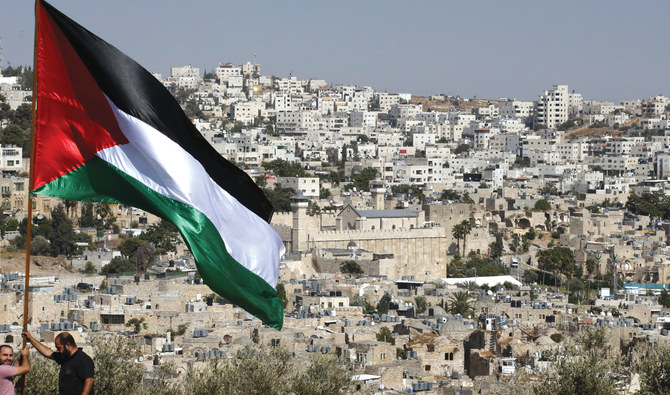
Palestinians say Netanyahu’s plan will have serious implications for a Palestinian state’s viability with regard to water, agriculture, natural resources and tourism. (AFP)
Updated 13 September 2019
Follow

What Israel’s Jordan Valley annexation plan means for a Palestinian state

  • Benjamin Netanyahu has vowed to carry out his threat if he wins the Sept 17 election
  • The annexation plan will destroy all hope of a viable state, say Palestinian officials

JERUSALEM: Israeli Prime Minister Benjamin Netanyahu’s threat to annex the Jordan Valley and the northern Dead Sea area of the occupied West Bank has left Palestinian development planners in disarray.

The threat, if implemented, will rule out the two-state solution as a political concept, and have serious implications for a Palestinian state’s viability with regard to water, agriculture, natural resources and tourism.

Netanyahu vowed on Tuesday that if he is returned to office in the Sept. 17 election, he will “immediately” extend “Israeli sovereignty over the Jordan Valley and northern Dead Sea.” The Jordan Valley accounts for about one-third of the West Bank.

Opinion polls indicate that Netanyahu’s Likud party is neck and neck with the opposition Blue and White party, and may struggle to form a coalition. His controversial pledge could get him the backing of right-wing parties.

Jad Ishaq, director general of the Applied Research Institute, said the land that Netanyahu referred to in his televised speech accounts for a big chunk of the West Bank.

“From the standpoint of Palestinian agriculture, this is the breadbasket,” Ishaq told Arab News.

Around 65,000 Palestinians and 11,000 Israeli settlers live in the Jordan Valley and northern Dead Sea area, according to Israeli human rights group B’Tselem.

The main Palestinian city is Jericho, with about 28 villages and smaller communities.

Ishaq, who advises Palestinian officials, said Netanyahu’s threat, if carried out, would kill off the possibility of a viable Palestinian state.

Opinion

This section contains relevant reference points, placed in (Opinion field)

“Simply put, this will deny us our water rights in the Jordan River, and limit our potential for mining
our national resources and for recreational tourism in the Dead Sea,” he added. Ishaq put the potential annual income from these activities at an estimated $2 billion.

“This Israeli annexation plan stunts the sustainability, contiguity and integrity of a future Palestinian state,” he said. 

“The plan leaves it without any control over the borders with Jordan, and converts Palestinian areas into an entity comprising cantons that won’t survive.”

Depriving Palestinians of the right to derive financial advantage from Dead Sea minerals would amount to a major economic blow, Ishaq said.

“At present, Dead Sea minerals are being divided between Jordan and Israel. Each country earns an average of $1.5 billion annually,” he added.

Sani Meo, publisher of the tourism monthly This Week in Palestine, said access to the Dead Sea and the Jordan Valley is vital for the development of Palestinian tourism. “There’s huge potential for tourism here that would be destroyed,” he told Arab News.

Meo expressed concern that the absence of internal tourism will exacerbate existing problems.

“The only opening for us is to the east, and now that’s being blocked,” he said. “We can’t get to Gaza and we can’t travel to Lebanon. Every time we discover a strategic opening, they (the Israelis) shut it.”

Netanyahu’s threat “will cause more tensions. This is short-sightedness on the part of the Israelis,” Meo said.

“By destroying the small signs of hope, the Israelis are building up more pressure inside a veritable pressure cooker. They’re unable to understand that it will eventually bring about an explosion.”

Israel captured the West Bank, including East Jerusalem, from Jordan in the 1967 war. More than 2.5 million Palestinians now live there, in addition to nearly 700,000 Jewish settlers.


Syrian government and SDF agree to de-escalate after Aleppo violence

Updated 23 December 2025
Follow

Syrian government and SDF agree to de-escalate after Aleppo violence

  • Turkiye views the US-backed SDF, which controls swathes of northeastern Syria, as a ⁠terrorist organization and has warned of military action if the group does not honor the agreement

DAMASCUS: Syrian government forces and the Kurdish-led Syrian Democratic Forces agreed to de-escalate on Monday evening in the northern city of Aleppo, after a wave of attacks that both sides blamed on each other left at least two civilians dead and several wounded.
Syria’s state news agency SANA, citing the defense ministry, said the army’s general command issued an order to stop targeting the SDF’s fire sources. The SDF said in a statement later that it had issued instructions to stop responding ‌to attacks ‌by Syrian government forces following de-escalation contacts.

HIGHLIGHTS

• SDF and Syrian government forces blame each other for Aleppo violence

• Turkiye threatens military action if SDF fails integration deadline

• Aleppo schools and offices closed on Tuesday following the violence

The Syrian health ministry ‌said ⁠two ​people ‌were killed and several were wounded in shelling by the SDF on residential neighborhoods in the city. The injuries included two children and two civil defense workers. The violence erupted hours after Turkish Foreign Minister Hakan Fidan said during a visit to Damascus that the SDF appeared to have no intention of honoring a commitment to integrate into the state’s armed forces by an agreed year-end deadline.
Turkiye views the US-backed SDF, which controls swathes of northeastern Syria, as a ⁠terrorist organization and has warned of military action if the group does not honor the agreement.
Integrating the SDF would ‌mend Syria’s deepest remaining fracture, but failing to do ‍so risks an armed clash that ‍could derail the country’s emergence from 14 years of war and potentially draw in Turkiye, ‍which has threatened an incursion against Kurdish fighters it views as terrorists.
Both sides have accused the other of stalling and acting in bad faith. The SDF is reluctant to give up autonomy it won as the main US ally during the war, which left it with control of Daesh prisons and rich oil resources.
SANA, citing the defense ministry, reported earlier that the SDF had launched a sudden attack on security forces ⁠and the army in the Sheikh Maqsoud and Ashrafiyah neighborhoods of Aleppo, resulting in injuries.
The SDF denied this and said the attack was carried out by factions affiliated with the Syrian government. It said those factions were using tanks and artillery against residential neighborhoods in the city.
The defense ministry denied the SDF’s statements, saying the army was responding to sources of fire from Kurdish forces. “We’re hearing the sounds of artillery and mortar shells, and there is a heavy army presence in most areas of Aleppo,” an eyewitness in Aleppo told Reuters earlier on Monday. Another eyewitness said the sound of strikes had been very strong and described the situation as “terrifying.”
Aleppo’s governor announced a temporary suspension of attendance in all public and private schools ‌and universities on Tuesday, as well as government offices within the city center.